Condos planned for NorShore Meats property

A local development team is looking to beef up the former home of a longtime local business.

The site that used to house community favorite NorShore Meats could soon be getting some meat back on its bones, according to redevelopment plans submitted to the Village of Wilmette.

Submitted plans call for the construction of a new three-story, six-unit condominium building at 421 Ridge Road, Lisa Brosnan, Wilmette’s business development planner said Tuesday, Oct. 14 during a meeting of the Village Board.

The planned building is also slated to include a six-car garage, Brosnan added.

The site is currently vacant following the January demolition of the previously existing structure on the property.

As reported by The Record, NorShore Meats & Deli closed in early 2022 after a 57-year run. Prior to housing the Wilmette butcher shop, the building at 421 Ridge was a grocery store.

Plans for the site first debuted in September when the proposal reached Wilmette’s Appearance Review Commission for a preliminary review.

Brosnan told trustees that the proposal is now slated to be considered by the village’s zoning board of appeals during its Nov. 5 meeting.

Public property records show the property, which is just north of the corner of Wilmette Avenue and Ridge Road, sold in March of 2024 for $570,000. The applicant listed on materials submitted to the Appearance Review Commission is 825 Harms LLC.

The previous building on the site was also three stories and was just under 10,000 square feet.

Officials did not state what zoning relief may be required specifically for this proposal, but had earlier this year said a multi-unit development may require provisions given that the lot width is less than 100 feet.

Agenda materials for the Nov. 5 zoning board meeting have not yet been made public as of publication time.


The Record is a nonprofit, nonpartisan community newsroom that relies on reader support to fuel its independent local journalism.

Become a member of The Record to fund responsible news coverage for your community.

Already a member? You can make a tax-deductible donation at any time.

Getting the Creeps in Skokie: Front yards to put you in the Halloween spirit

Halloween is fast approaching, which means not only are the temperatures and leaves changing, but so too are front yards and facades all across Skokie. 

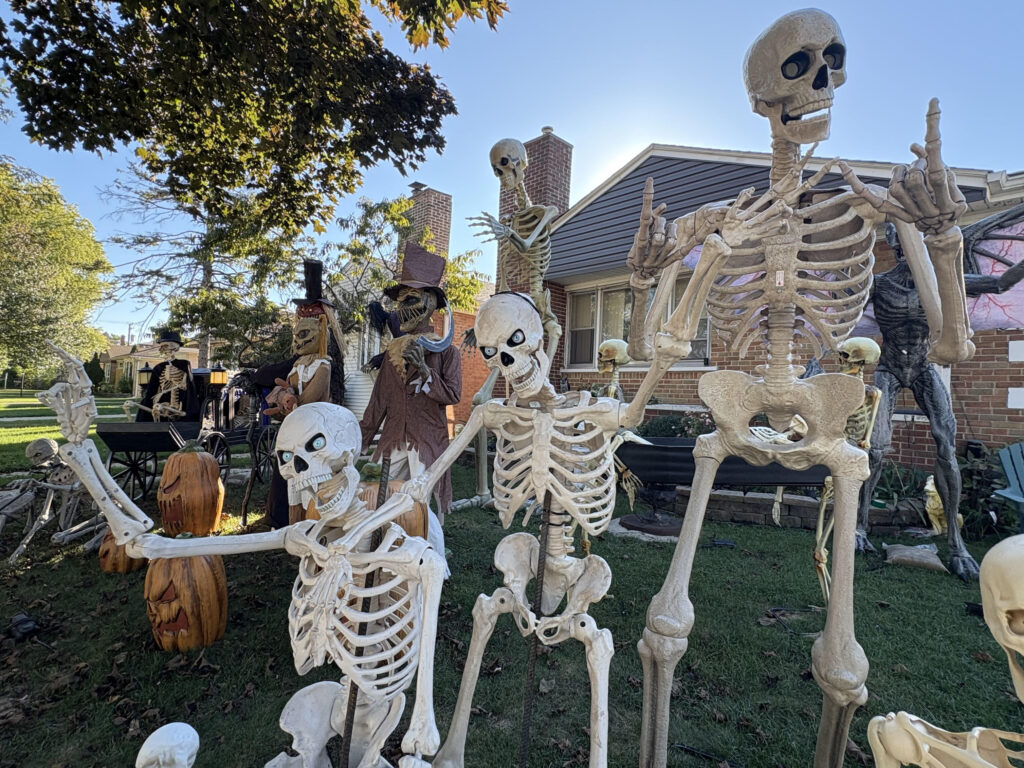
A drive through the village reveals a healthy display of local businesses, apartment buildings and homes getting in the seasonal spirit with spooky decorations. Skeletons are hovering in terraces, scary-faced pumpkins are falling over staircases and enormous inflatable spiders are clambering across rooftops.

“I always loved Halloween,” said Jeannette Camacho, a Skokie resident whose front lawn is crowded with skeletons and scarecrows in various menacing poses.


Make sure to read our other Getting the Creeps pieces — Wilmette | Highland Park | Glencoe | Northfield — all publishing before Halloween night.


In one corner, two plastic skeletons crawl on hands and knees to draw another wearing a top hat in a carriage.

A display of skeletons, scarecrows, pumpkins and other types of monsters crowd the front lawn of Jeannette Camacho’s Skokie home.

Elsewhere, another sits on a bench made of bones.

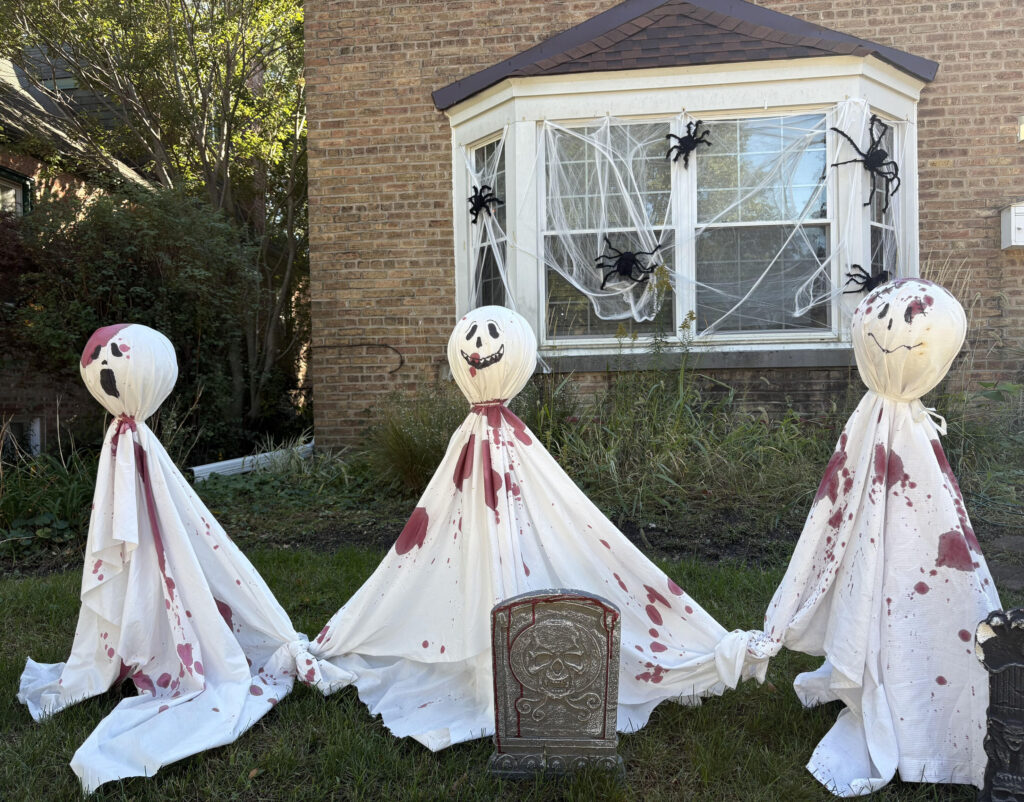
In front of other nearby homes, ghouls walk inflatable black cats and tattered ghosts hang from tree branches. 

Camacho said she likes to start putting up her Halloween decorations in September every year; though each season she changes it up a bit. Last year, she had her skeletons walking a dog that was chasing a mailman up a tree. 

Her property is also highlighted on FrightMaps, which records where homes go all out with Halloween decorations.

“We always added in a few things here and there, but it’s always something that just excites me, and seeing everyone’s decorations made me want to pull the plug and get a little more serious about it,” Camacho said. “It’s just for fun and I love it. I love other people’s reactions to it as well.”

Sara Sayze, another Skokie resident, was filling her front yard with spiders, witches and strings of skulls one October afternoon. They’re decorations, some vintage, that she’s accumulated over the years and continues to put up even though her kids no longer trick or treat.

Red-stained ghosts and fake spiders are just some of the Halloween decorations you can see around town as the Village of Skokie gets in the season’s spirit.

“They loved it but they’re adults now,” said Sayze, a pair of gardening gloves on her hand to help stake some of the displays into the ground. “The old people tend to like it, the kids, they love it, so I still do it.”

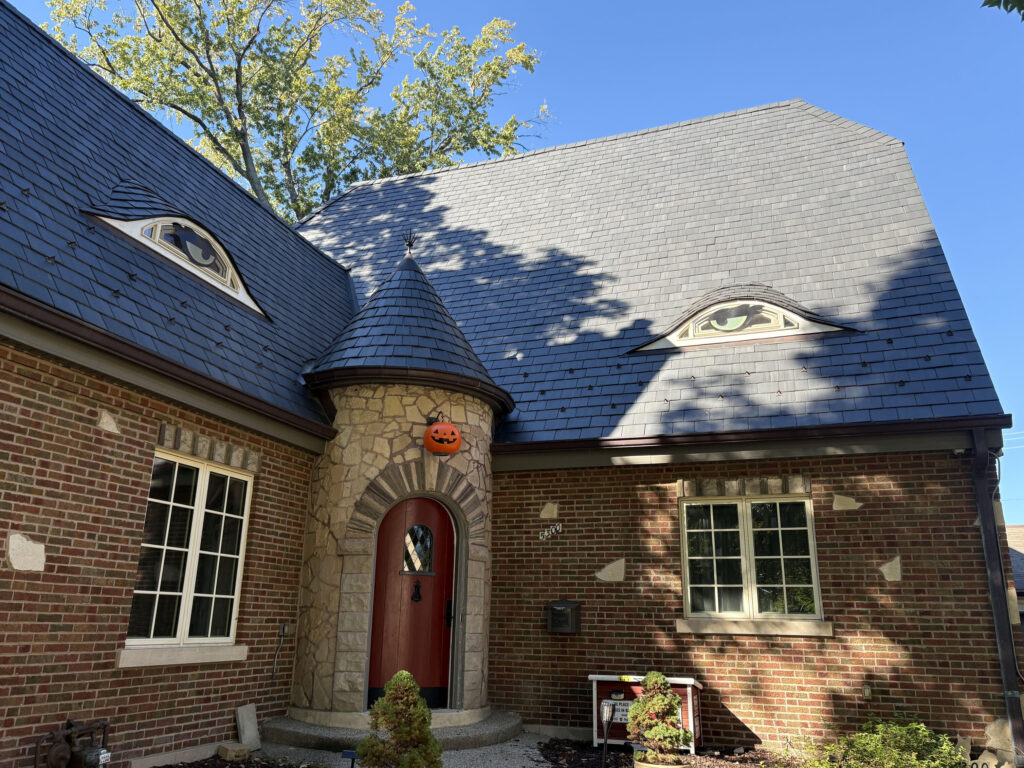
Patricia Butler and her husband, Ron Kirschner, put up the same decorations every Halloween: a simple but captivating pair of eyes over curved windows that peek out of their slanted roof, giving their unique-shaped home a face.

A pumpkin hangs over their door. 

Patricia Butler, a Skokie resident, says she and her husband put the same simple, yet effective, Halloween decorations up every year.

“The eyes are what we do every year and the pumpkin is what we do every year,” Butler said. “People seem to like it and think it’s creepy, and that makes me happy.”


The Record is a nonprofit, nonpartisan community newsroom that relies on reader support to fuel its independent local journalism.

Become a member of The Record to fund responsible news coverage for your community.

Already a member? You can make a tax-deductible donation at any time.
Athlete of the Week: 10 questions with Grace Leber, New Trier golf

Grace Leber just finished her senior season with the Trevians with an All-State finish (fourth) in the IHSA Class 2A championships. Leber will compete with Boston College starting next year.

1. Do you have any preround or preshot rituals?

I’m not too particular; though, when I putt I touch the face of my putter twice. When I line up for my practice putts, I wipe it and when I line up to the ball, I wipe it again. Usually players will wipe it to clean the face … but I just kind of made it a habit. And throughout the round I always use a quarter as my ball mark, instead of a particular ball mark.

2. Why Boston College?

I love the school and my mom went to Boston College and my dad went to College of the Holy Cross, which is near it. So our family loves that area, so I’ve grown up knowing the school. The campus is beautiful, the academics are incredible. They definitely set you up for a very bright future. Golf-wise, I was trying to play as good and competitive golf as I could in college and with this team and coach, I definitely think I’m going to be pushed my full potential there. I’m excited to see how far I can get in the game.

3. What’s your favorite club in your bag?

Probably my driver. I can hit it pretty far and most of the time I’m able to control it. It’s always been a fun club for me to hit and always been a good asset to me.

4. When did you know golf was the sport for you?

Probably my sophomore year of high school. I played ice hockey and continued that through last year, so I played for around a decade. And I always played it at a medium level skill-wise, but for golf, I was always so competitive and noticed my game was getting better each year and I was never plateauing like I did in ice hockey. I could see myself going really far and loving it for a long time.

5. What is your favorite golf memory or moment?

I’d probably say the 50-foot putt (to birdie the 18th hole in the state finals), just because the whole team was watching and my parents were there and for the last hole, there’s a huge hill behind the green and we were the last group out so all my friends from other teams were there to watch. And the first, second and third teams — obviously ours was third — stormed the green. So we got to celebrate together.

6. What’s your favorite thing to do off the course?

I like just hanging out. Some hobbies I enjoy doing are baking and cooking, but most of the time I like to just hang out around the house. I also just love athletics in general. I like just picking up a sport and playing with some friends.

7. What would be your dream job?

Right now, I want to try to go into accounting and see how far I can get on that career path. I really enjoy math and enjoy repetitive math, which is good for that career path. It’s also stable. I feel like I can go a long ways there while still being interested in the topic.

8. If you’re in Walgreens with a couple bucks, what are you buying?

I’d probably buy like a Hershey’s chocolate bar.

9. If you could travel anywhere, where would you go?

I’d love to go to Italy one day. I’ve taken Latin since fifth grade, so you learn a lot about the history of Rome, so I’d like to use that knowledge and just travel around that area.

10. What does New Trier golf mean to you?

It was great. It’s definitely a fun change of pace from summer tournaments. Summer tournaments you’re almost always alone even if you’re kind of seeing friends. You’re always your own team. Right after stress of that season ends, you go into high school season and you’re around the same people every day and all these different support systems. You get to joke around and have this outlet and have fun at the end of your day and just laugh. This team this year has probably been my favorite of all the years. I feel like we really got along and had a lot of laughs, especially toward the end.


The Record is a nonprofit, nonpartisan community newsroom that relies on reader support to fuel its independent local journalism.

Become a member of The Record to fund responsible news coverage for your community.

Already a member? You can make a tax-deductible donation at any time.
CTA, Metra propose fare increases of 25, 50 cents a ride

(Editor’s Note: This story was reported by Igor Studenkov for the Evanston RoundTable, a neighboring independent newsroom. It was shared with The Record as part of an ongoing collaborative effort.)

The Chicago Transit Authority and Metra still kept any potential service cuts close to their vest as they released their proposed 2026 budgets this month.

The two agencies both face a fiscal cliff as their COVID-19 stimulus funding runs out, but CTA is projected to hit a shortfall first, in mid-2026, while Metra says it will run out of that money in the final quarter of next year.

The Illinois General Assembly’s veto session began on Tuesday, Oct. 14. With funding uncertain, the Regional Transportation Authority, which has the final say over the CTA, Metra and Pace budgets, instructed those three agencies to prepare two budgets: one that assumes a financial bailout from the state to cover funding gaps and one that does not.

For both CTA and Metra, the key difference is that, with help from the state, they would be more proactive about filling vacancies and improving schedules

In any case, though, RTA asked all three transit agencies to raise their fares by at least 10%. While Pace released its new fare proposal back in September, CTA and Metra released them with their respective budgets this month. While riders would pay more no matter what, CTA is proposing an expanded discount program for students who take the bus or the train to their high school.

Pace was scheduled to release its budget on Wednesday, Oct. 15. The state legislature’s veto session takes place through Oct. 16 and Oct. 28-31, and transit is expected to be a top item on the agenda.

All three agencies will finalize their budgets and send them to RTA for approval in November.

CTA

In addition to the budget that assumes that the fiscal cliff will be averted (what it calls the “baseline budget”), CTA developed a “growth budget” outlining what it would do if RTA receives twice as much new state funding as under the baseline budget. That budget goes beyond modest service improvements to call for bus service improvements and extensions (along the lines of the extension of CTA Route 93 California/Dodge to Logan Square).

Both the baseline and growth budgets call for more social services outreach on L trains and more funding for police and other security services.

Under the proposed new fare schedule, CTA bus fares would go up from $2.25 to $2.50, and L fares would go from $2.50 to $2.75. In a notable change, the cost of paying with a debit or credit card (whether physical or virtual) instead of a Ventra card would go up to $3 “to offset additional merchant expenses.”

Both CTA and Pace currently offer discounted fares to high school students on school days between 5:30 a.m. and 8:30 p.m. Pace also lets students buy 30-day reduced fare passes, which currently cost $30 and would cost $33 under the proposed fare increase.

CTA is hoping to remove the time and day restrictions for student discounts “so students can pay the discounted fare to get to extracurricular activities, jobs, internships, and other activities on weekends and non-school days throughout the year, including summer months.”

On top of that, weekly passes for high schoolers would cost $7.50, and 30-day passes would cost $30. In recent years, Pace has agreed to accept most CTA passes, but these passes would be for the CTA only.

Metra

While Metra officials announced in September that fare increases were coming, they didn’t share any figures. The draft budget released last week shows that riders traveling between Chicago and any local station would see one-way tickets rise from $3.75 to $4.25. The fare for riding to any station other than Ogilvie Transportation Center in Chicago, which has been a flat $3.75, would also go up to $4.25.

One-day passes, which are equivalent to the cost of two one-way tickets, will go up accordingly. Monthly passes would increase from $75 to $85, which, as Metra officials noted, puts it in line with the proposed CTA/Pace 30-day pass increase.

One-day weekend/holiday passes would also go up from $7 to $8, and passes that are good for both weekend days would go from $10 to $11.50. The weekend passes are currently unique because they work system-wide.

Add-ons that allow Metra riders to use daily and monthly passes on CTA and Pace would increase as well. The Regional Day Pass would go up from $2.50 to $3, while the monthly Regional Connect Pass would go up from $30 to $45.

Notably, Metra plans to allocate $141 million to 200 new bi-level passenger rail cars to replace the oldest cars currently in service. According to data compiled by the RTA, Metra still uses 339 Budd coach rail cars and 27 Pullman bi-level cars, the oldest of which were built in the 1950s and the newest of which were built in the late 1970s.

Most, but not all, of those cars are assigned to Union Pacific lines, including the Union Pacific North line that runs through the North Shore. The new cars, which are being built by Alstom, a French rolling stock manufacturer, would be more accessible than most rail cars in the existing fleet with doors and lower-level seats at ground level.

While the Metra board didn’t identify any issues with the budget itself, several members expressed concern with the uncertainty of the veto session and potential federal funding freezes.

More budget issues

Metra Director Rodney Craig, who represents the Northwest Cook County suburbs, also said he’s worried about how much the commuter rail agency will ultimately need to pay Union Pacific for the right to use its tracks.

“Where in our budget is that?” he asked.

The budget mentions that operating expenses would increase by 4.7% compared to 2025 in part due to extra “funding for additional access, trackage, rental and legal costs associated with Union Pacific and BNSF agreements.”

One small point of contention was Metra Capital, or MetCap, funds, or money from ticket revenue and sales tax revenue that Metra set aside to help provide matching funds for state and federal capital project grants. The agency paused that practice during the pandemic, but Metra’s executive director lobbied the board to bring it back next year due to a backlog of routine projects, like on aging bridges, for example. The budget proposes setting $60 million aside for MetCap whether the state comes through with a bailout or not.

While the majority of the board favored this proposal, Director Romayne Brown, who represents Cook County at large, said that, given all the uncertainty, it would be better to keep as much money as possible in operations.

“It’s not the time [for it] without certainties from Springfield,” Brown said. “We don’t have any certainty from the federal government about any grants or loans or anything like that. My vote is no.”

Director Mimi Rodman, who represents Evanston and parts of northern and western Cook County, said she hoped the veto session would bring some clarity moving forward.

“We’ve absolutely got to get this bill passed down in Springfield,” she said, “so that we can meet what our riders expect of us and continue that quality of service.”


The Record is a nonprofit, nonpartisan community newsroom that relies on reader support to fuel its independent local journalism.

Become a member of The Record to fund responsible news coverage for your community.

Already a member? You can make a tax-deductible donation at any time.
Winnetka post-office project is still alive. Trustees next want residents’ input

Winnetka officials are going to residents for ideas or hopes for the redevelopment of the local post office site.

The Village Council discussed how to move forward with planning for the site, which has been viewed as a project for decades, during its study session on Tuesday, Oct. 14.

According to village documents, Winnetka purchased the building where the post office is located in 1982, and has leased it to the U.S. Postal Service since. Starting with the village’s 1986 comprehensive plan, the site has been identified as a redevelopment opportunity, but to date, the site has remained as is.

More recently, in 2022, the Village Council held a study session where then-Village President Chris Rintz suggested converting the area into a public plaza that would have included informal gathering spaces and areas for small-scale concerts and markets. This concept was referred to as the Bennett Plan, referencing the village’s first comprehensive plan in 1921, designed by architect Edward Bennett.

And in 2024, Village staff commissioned conceptual designs for a public plaza, but according to Tuesday’s board packet, no further discussion or action has occurred.

At Tuesday’s meeting, trustees were presented with two options for public engagement: contracting with an architectural or landscape firm to provide conceptual designs for a public outdoor gathering space, and contracting with a land use planning consultant to oversee a public engagement process.

Trustees preferred the latter and kickstarting a public engagement process.

Much of the support for that process stems from the 2025 Winnetka Council Caucus Survey results, trustees said. That survey showed that 24.3% of residents preferred an outdoor park or year-round communal space for the post office site, while 16.8% wanted a gathering space for children and for indoor and outdoor gathering.

That same survey showed that 38% wanted to see a mixed-use for the site, potentially including retail, service and housing.

Trustee Scott Myers suggested that trustees come up with at least two “built-out” options that can be presented to residents so the consultants can gather feedback on them.

While he praised the caucus survey, he said that one disadvantage of it is that the results don’t include much detail. Pursuing the public engagement option, he said, would allow for more details to be shared with residents.

“I would suggest that either we, or a sub-group, come up with some additional parameters,” Myers added. “Are we saying to the village that we will spend any amount of money to build the best public space? Well, no. We’re not going to probably go to the community and say we’ll spend $10 million.”

Another suggestion was that any potential project costs, including operational and maintenance, be included in any public engagement.

Although trustees supported the public engagement approach, some had an issue with including project cost as a parameter.

Trustee Kim Handler said she wasn’t sure that restricting the budget, at least for the public engagement stage, was a good idea.

“Let’s really open our minds here to something different and unique,” she said. “You all know I’m far from reckless with money. But I’m concerned about what the parameters should be and how we come up with that and we’re shutting the door too early on different ideas.”

Trustee Rob Apatoff agreed.

“This is the middle of our village, the last open space we have,” he said. “I’m not looking for a $40 million plan, but there are certain elements that we’re constraining ourselves (to) that I think would make this truly a world-class type of development.”

Trustee Tina Dalman suggested having the public engagement firm come up with rough estimates to how much each idea could cost.

“Nobody’s going to give us a solid budget, because there’s no construction drawings,” she said. “I think there’s a lot here that somebody who’s a professional in that space could distill it down to three, four, maybe five different options with price points associated with it.”

Village President Bob Dearborn said that the cost of the project is a constraint with which the trustees will have to deal.

He noted that while Rintz’s idea was well received, but “I think we felt that we needed to go back to the public and confirm some of this.”

Officials have reported that the original concept would have cost around $8 million.

“Part of this is money,” Dearborn said. “We can’t ignore that fact. We have other capital investments that are very substantial.”

He suggested that there may be opportunities for public-private partnerships when it comes to developing the post office site but encouraged parameters, with one of them being a time frame in which to complete the public engagement.

“It seems to me we have to get some more public engagement on this,” Dearborn said. “I’m not looking to retread 50 years of work here, but I don’t think we’re in a position here to say that the Bennett Plan is absolutely the right plan right now with no incremental development on the property, because we may need that for financial reasons or other reasons.”

Trustee Kirk Albinson agreed.

“We want engagement,” he said. “We want to confirm direction before we dive in and start drawing stuff.”

In addition to discussing the public engagement process, trustees also discussed what to do with the site if the post office building is demolished. Trustees supported temporarily converting the site into a vacant lawn until a more permanent solution is agreed to.

Village Manager Kristin Kazenas said she and Community Development Director Scott Mangum would work together on finding a firm to handle the public engagement process, which would return to the Village Council for future discussion and approval. Dearborn added that trustees will work out the parameters of the public engagement process and present them at that same future meeting.


The Record is a nonprofit, nonpartisan community newsroom that relies on reader support to fuel its independent local journalism.

Become a member of The Record to fund responsible news coverage for your community.

Already a member? You can make a tax-deductible donation at any time.
‘Lasting Impact’: Six-figure Lowe’s grant supports major upgrade to Our Place facilities

A Wilmette-based nonprofit recently got a major accessibility upgrade, with the help of a $100,000 grant from Lowe’s and the hands-on support of 11 employees from the Northbrook Lowe’s store.

Our Place of New Trier is a nonprofit that serves adults with intellectual and developmental disabilities and provides day programs for them, including physical education and community programs and activities such as baking, art and sports. 

The primary motivation behind the organization’s pursuit of the grant rests in a large new development: It recently purchased the church, Community Church of Wilmette, 1020 Forest Ave., where its programming is housed. 

There, the team serves a total of 120 participants, hosting 40 to 50 daily, according to Heather Williamson, Our Place of New Trier’s development manager.

But the building had been in need of upgrades, largely to improve accessibility and usable space for participants. 

“This $100,000 [Lowe’s] grant … is going to make a lasting impact for our participants to be able to use the space more comfortably and safely, making sure that we have a safe space as well,” Williamson said.

On Oct. 2 and 3, Lowe’s volunteers and community members, together with Our Place of New Trier staff and board members, got to work to complete some of the renovations. 

Hands-on renovation days like these are known as Red Vest Days, a nod to the red vests that Lowe’s employees sport.

Work done included renovating a new art room; adding new flooring, cabinetry and baseboards; resurfacing the exterior walkways; and painting exterior trims where new, accessible sliding doors are scheduled for installation.

Now, thanks to these efforts, most of the work is done. The remaining renovations are set to be complete by mid-November. 

Williamson shared some of those pending improvements with The Record.

“The front door is really a big one because we are housed in a former church, so a lot of the doors — most of the doors — are not accessible, and we have many participants here who have varied accessibility needs, so the front door is really going to be a key accessibility improvement for us,” she said. “The other thing that [will also be] installed [is] automatic openers on some of the bathrooms to help participants who have trouble opening some of the current doors to the bathrooms.”

While Williamson said the grant had originally been a “long shot” for the organization, it’s clear the grant was not so out of reach after all, particularly with Lowe’s emphasis on community.

This year, Lowe’s centered its commitment to deliver 10 million square feet of impact on communities nationwide, with store managers spearheading the volunteer work on the ground.

Lowe’s Hometowns is the company’s five-year, $100-million initiative created to support and fulfill 100 large-scale grants per year, plus 1,700 smaller, store-selected projects.

The next grant cycle is set to open on Jan. 21, according to Laurel Waller, Lowe’s external communications manager.

With the help of their grant, Our Place of New Trier can look to the future and continue to tap into its building’s potential.

“There’s a lot of further plans with the building to come,” Williamson said. “Prior to purchasing the building, we only really used the bottom floor and the top floor for programs, [but] we’re now able to use the whole building, so that’s really exciting for us and opens up a lot of opportunities to improve and enhance the programs that we already have and to expand our programming to better serve the needs of our participants.”


The Record is a nonprofit, nonpartisan community newsroom that relies on reader support to fuel its independent local journalism.

Become a member of The Record to fund responsible news coverage for your community.

Already a member? You can make a tax-deductible donation at any time.
After hitting all-time high, reports of rats in Skokie are falling — the Village wants them gone entirely

Reports of rats reached an all time-high in Skokie in 2024. Now, administrative staff have set a goal for the village to become as close to rat-free as possible by the spring of 2026. 

Michael Charley, director of Skokie’s Department of Health and Human Services, outlined that ambitious target while presenting an update and overview of the department’s rat control program to trustees during an Oct. 9 Village Board meeting.

Skokie started measuring a steady increase in reports of rats in 2020, a phenomenon Charley said other municipalities in the region have experienced and may be caused by pandemic-era behavior changes leading to more residential trash and warmer temperatures leading to more year-round rat activity.

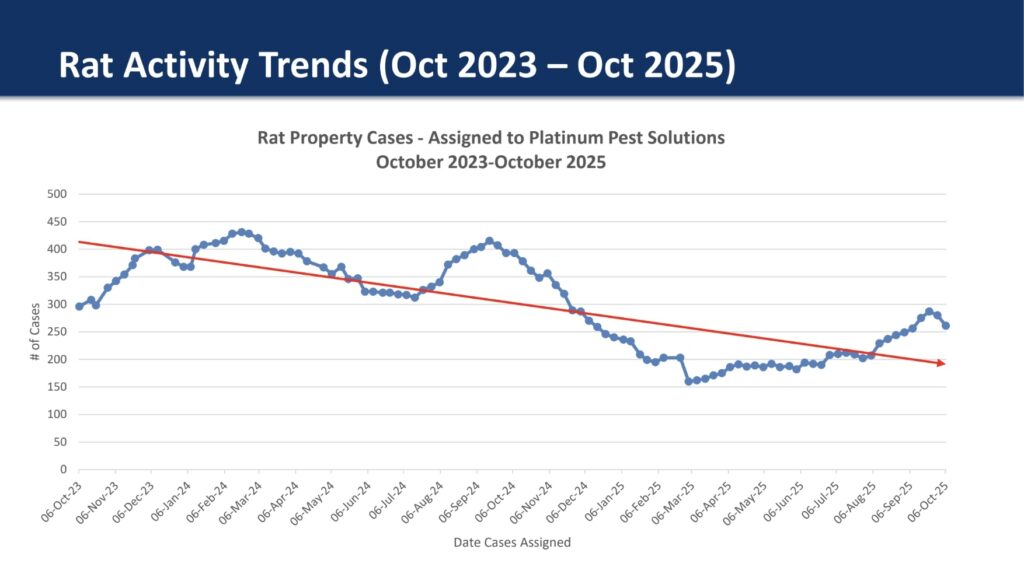
That increase in reports continued until Skokie hit a peak of 431 weekly reports of rats in February 2024, according to data Charley presented to the board. 

The village subsequently decided to invest $274,000 by May 2024 to switch to a new pest control contractor — from Rose Pest Solutions to Platinum Pest Solutions — and hire another full-time environmental control officer to join the local health department’s operations. 

Reports of rats in Skokie have since fallen by more than half to 203 weekly cases in February 2025 — a 53% drop indicating that the latest changes to the village’s rat control measures are effective, Charley said.

The number of weekly cases is now at  261, as reports of rats fluctuate by season.

Reports of rats hit a high in February last year, but have since followed a downtrend according to village data.

“I’m excited about it but we’re still working hard to reduce the numbers,” Charley said. “Our goal is as close to zero as possible by March 1, 2026, and we stand by that, but it’s a lot of work and I appreciate everything that my staff is doing, our communications team is doing and the community is doing.”

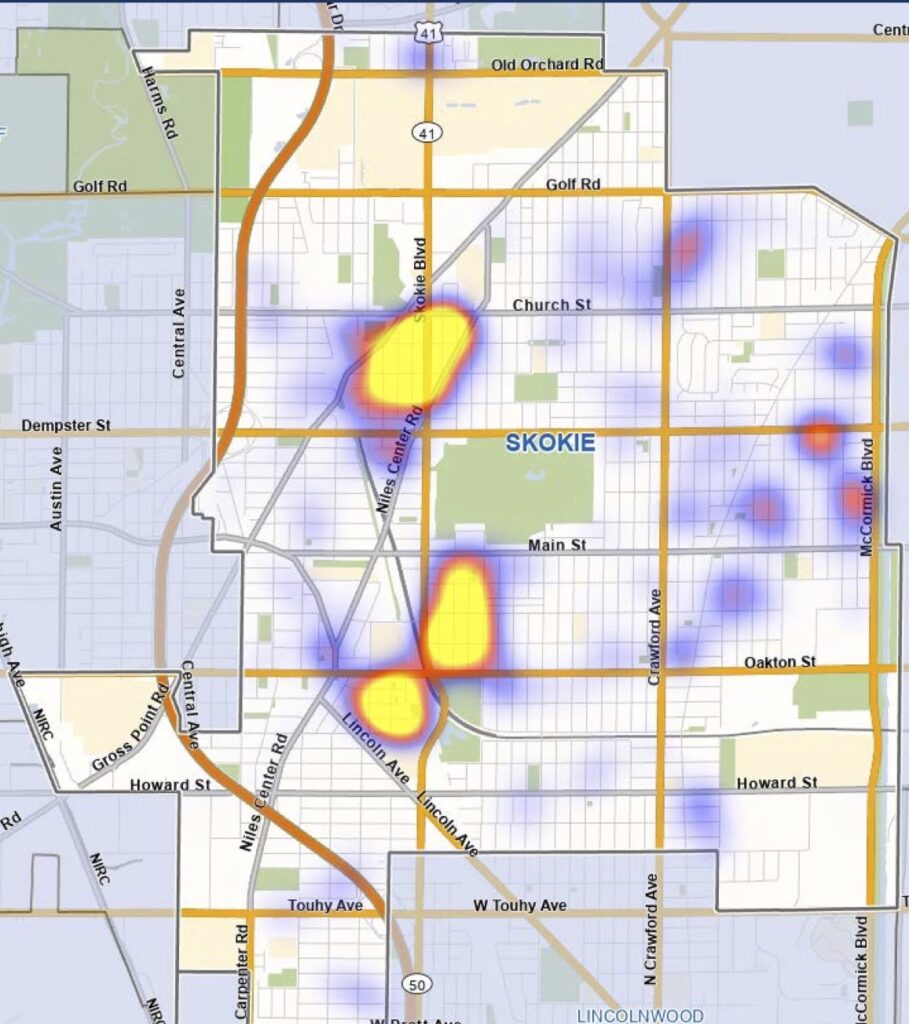
Charley’s report to the board included a map showing three main “hot spots” where reports of rats are most commonly sourced in Skokie — along Skokie Boulevard between Dempster Street and Church Street, just east of Skokie Boulevard between Main Street and Oakton Street, and between Oakton Street and Lincoln Avenue around Lincoln Junior High School — all areas primarily of residential properties.

As part of this month’s “Rat-tober” initiative, Charley said his department is collaborating with personnel from the Skokie Community Development Department to canvass properties in those three hot spots to search for the factors that most commonly contribute to the presence of rats. 

Those factors include overgrown vegetation, unsecured garbage, water sources, grills with accumulated grease, dog feces, bird feeders and compost bins. 

The village previously voted in 2024 to ban Skokie residents from raising chickens in their backyard, and likewise voted in 2023 to prohibit platform bird feeders and in 2012 to require rear porches to rest on concrete — all measures aimed at mitigating rat activity.

“In Skokie, with the amount of rats we have, we just can’t do things like that anymore,” Charley told the board in regard to residents feeding chickens with leftover food. “We can’t feed chickens, we can’t feed the birds, we shouldn’t be feeding wildlife that way.”

A heat map informed with Village data shows where rat activity is most prevalent in Skokie.

Notably, the average lifespan of a rat is two to three years in the wild, but they become sexually mature after just five to six weeks of being born and can reproduce up to 100 pups a year. 

That’s why when rats are reported to the city, an environmental control officer will survey the property within 48 hours to paint the rat burrows and immediately bait them with poison. The city’s pest control contractor will then return on a weekly basis to continue baiting and monitoring the burrows. 

The village’s efforts to curb rats has also included re-evaluating how it educates and communicates with residents.

Charley said that his office previously received 10 to 20 calls a week from people concerned about the status of rat mitigation efforts on their property. But that volume has dropped ever since village staff now leave door hangar pamphlets and email residents once work is deemed complete. 

The head of health services asked residents to report all rats they see by either calling the village at (847-933.8254)  or filling out this form online.


The Record is a nonprofit, nonpartisan community newsroom that relies on reader support to fuel its independent local journalism.

Become a member of The Record to fund responsible news coverage for your community.

Already a member? You can make a tax-deductible donation at any time.

Police Reports: Gas-station break-in and burglary and more

The following reports were pulled from the latest incident summaries provided by law enforcement departments in our coverage area (Wilmette, Winnetka, Highland Park, Northfield, Kenilworth and Glencoe).

WILMETTE

(Updated with Wilmette reports on Wednesday, Oct. 15)

Oct. 11

• A car reportedly was damaged overnight in the 300 block of Skokie Court, with its windows broken and tires flattened.

Oct. 10-11

• Two reports in two days of the attempted use of counterfeit bills in the 1500 block of Sheridan Road.

Oct. 9

• A Highland Park man was arrested twice on Oct. 9, once for allegedly urinating in public and again three hours later for allegedly stealing from a store in the 800 block of Green Bay Road.

Oct. 7

• An item reportedly was stolen from a car parked in a garage in the 800 block of Sheridan Road. Bicycles reportedly were also taken from the garage but found nearby.

• A Chicago man was arrested for allegedly using a resident’s credit card.

WINNETKA

No incidents reported between Oct. 7-12 that meet The Record’s standards for publication.

GLENCOE

No incidents reported between Oct. 1-8 that meet The Record’s standards for publication.

HIGHLAND PARK

Oct. 11

More than $500 in merchandise reportedly was stolen on Sept. 30 from Jewel, 1600 Deerfield Road.

Oct. 10

• Merchandise reportedly was stolen from Walgreen’s, 655 Elm Place.

Oct. 9

• Several boxes of e-cigarettes and other products reportedly were stolen from Shell gas station, 2135 Green Bay Road, after the business’s front-door glass was shattered.

Oct. 8

• A resident reportedly saw an individual rummaging through their vehicle in the 700 block of Pleasant Avenue.

NORTHFIELD

Oct. 11

• Police officers reportedly assisted with a call for medical attention at Sunset Ridge Road and Old Farm Road for at least four minors who appeared to be intoxicated on a party bus that originated in Highland Park. Four juveniles reportedly were in stable condition when admitted to Glenbrook Hospital.

KENILWORTH

Oct. 9

• A Kenilworth woman was arrested for allegedly trespassing on Joseph Sears School property, 542 Abbotsford Road.

The Record’s police reports are taken from police-activity summaries prepared by local police departments. Police Reports contain public information from preliminary reports and are not a complete listing of all police activity. The Record does not publish the names of individuals arrested and named in preliminary reports unless the incident is a matter of public safety or has significant community implications. All arrestees are innocent until proven guilty.

After 8 years without, New Trier earns state trophy — the 17th in program history

The girls golf is good here in the northern suburbs.

How good?

The top three finishers in the IHSA Class 2 championships held on Friday-Saturday, Oct. 10-11, at Hickory Point in Decatur were the same as the top three finishers in the Class 2A New Trier Sectional, which were the same as the Class 2A Prospect Regional.

New Trier picked up third place in all three postseason tournaments, capping its return to the state finals — after just missing in 2024 — with its first IHSA trophy (top-three finish) since winning state in 2017.

It is the Trevians’ 17th state trophy (7 firsts, 6 seconds, 4 thirds) in program history.

“It was great to see, just knowing how competitive it is and how many good teams are out there,” New Trier head coach Scott Fricke said. “Some of these kids haven’t played down state. … It was a new environment and they went down there and took care of business.”

New Trier senior Grace Leber tees off on the 18th hole at Hickory Point on Oct. 11.

While several newcomers contributed, the Trevians were led by senior standout Grace Leber, who earned a second straight All-State designation with a fourth-place finish at 1-under par over the two-day event.

With the Trevians in a “dogfight” for third place, Fricke said, Leber saved her best for last, carding birdies on the final two holes of her decorated run as a high-school golfer.

“It was a great way to end her New Trier career,” said Fricke, who added that Leber’s 9-hole average her senior season was under par (35.6). “I told one of my coaches when we ended up being up a stroke with two (holes) to play that it’s really nice knowing we have Grace Leber on the course to bring us home.”

Leber’s finish helped the Trevians (626 strokes) finish five strokes ahead of Lincoln-Way East for the third-place slot. Glenbrook North (604) won its third straight state championship five strokes better than runnerup Stevenson.

Alli Wartel, a sophomore from Oswego East, dominated the individual field, going 7-under-par on Day 2 to finish at -8 and win the state title by five strokes. Glenbrook North senior Martha Kuwahara and Downers Grove South senior Miah Wanserski tied for second at 3-under — two strokes in front of Leber.

Supporting Leber’s All-State effort for the Trevians were junior Molly Tir (+15, 36th place), senior Sophie Patel (+16, 42nd) and junior Charlotte Giczewski (+20, 59th). Tir, Patel and Giczewski all shot 7-over 79s on the final day to keep the Trevians in trophy position.

Freshman Nadiya Kundu (79th) and junior Maddie Shabaz also competed with the Trevians.

Coach Scott Fricke (right) and the New Trier girls golf team with their IHSA Class 2A third-place trophy.

Fricke made sure to point out Patel, who he said played her best golf of the season (shooting a 79-80) on the final weekend.

“It was great to have her playing her best at the end of the year,” he said.


The Record is a nonprofit, nonpartisan community newsroom that relies on reader support to fuel its independent local journalism.

Become a member of The Record to fund responsible news coverage for your community.

Already a member? You can make a tax-deductible donation at any time.

Viral video’s ICE arrest did not happen in Kenilworth, but federal agents have been active in nearby suburbs

Social media rumors continue to swirl about federal immigration enforcement in the North Shore.

By and large, however, the rumors are unfounded.

A dramatic video posted Oct. 9 showing federal border agents apprehending a woman in a residential neighborhood gained traction on several social media platforms, including NextDoor, X and Reddit. The caption to the video — which was viewed millions of times — said the incident occurred in Kenilworth; however, that is not true.

A City of Waukegan spokesperson confirmed the video was taken of an immigration-related arrest this October in the 300 block of Glendunning Place in Waukegan, a community outside of The Record’s coverage area. There is a Glendenning Road in Kenilworth.

Also, multiple Instagram accounts with substantial followings suggested Immigration and Customs Enforcement agents were active in Wilmette on Thursday, Oct. 9, and possibly targeting landscape professionals. The posts garnered thousands of reactions and tens of thousands of views.

Wilmette Village Manager Mike Braiman told The Record that village and police officials could not confirm any such reports, despite receiving calls about ICE activity in the community.

Braiman added that in cooperation with the state’s Trust Act, local law enforcement would not interfere or participate in federal immigration enforcement; however, he said, local police may respond to resident calls involving ICE activity to address any local concerns.

The unfounded reports involving Wilmette and Kenilworth occurred about a week after similar unfounded reports about ICE activity in Winnetka circulated social media.

Federal-agent operations, however, have been confirmed in nearby communities. On Sunday, Oct. 12, ICE agents took two people into custody at a Home Depot in Evanston, according to reporting from Evanston RoundTable.

The arrests disrupted youth soccer games at nearby James Park, the RoundTable reported.

Also over the weekend, ICE agents reportedly swarmed and aggressively detained a teenager in the northwest suburb Hoffman Estates, as depicted in a now-viral video and admonished by U.S. Rep. Raja Kirshnamoorthi.

In July, ICE agents reportedly took a Skokie resident into custody, according to Village of Skokie officials.

And immigration enforcement continues across the citywide on a nearly daily basis, with independent newsroom Block Club Chicago publishing daily reporting.

The North Shore Legal Aid Clinic has been regularly highlighting its “Know Your Rights” resources, which include information on remaining silent, contacting an attorney, and protecting against illegal search and seizure.

The local tension stems from President Donald Trump’s Operation Midway Blitz, an immigration crackdown in Chicago announced on Sept. 8.


The Record is a nonprofit, nonpartisan community newsroom that relies on reader support to fuel its independent local journalism.

Become a member of The Record to fund responsible news coverage for your community.

Already a member? You can make a tax-deductible donation at any time.