
Winnetka post-office project is still alive. Trustees next want residents’ input
Winnetka officials are going to residents for ideas or hopes for the redevelopment of the local post office site.
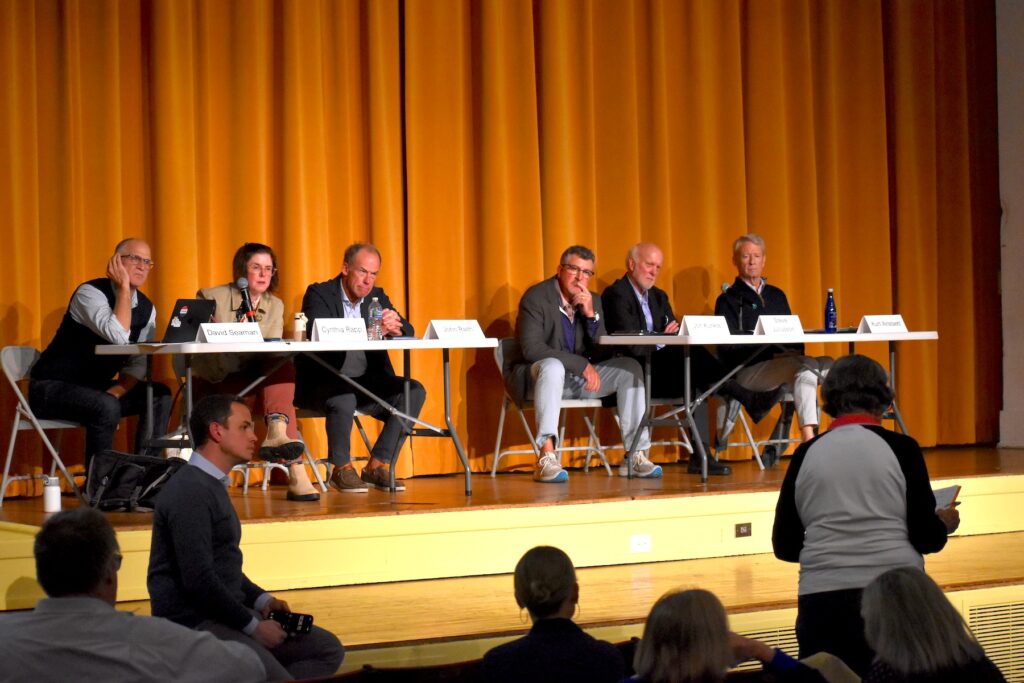
The Village Council discussed how to move forward with planning for the site, which has been viewed as a project for decades, during its study session on Tuesday, Oct. 14.
According to village documents, Winnetka purchased the building where the post office is located in 1982, and has leased it to the U.S. Postal Service since. Starting with the village’s 1986 comprehensive plan, the site has been identified as a redevelopment opportunity, but to date, the site has remained as is.
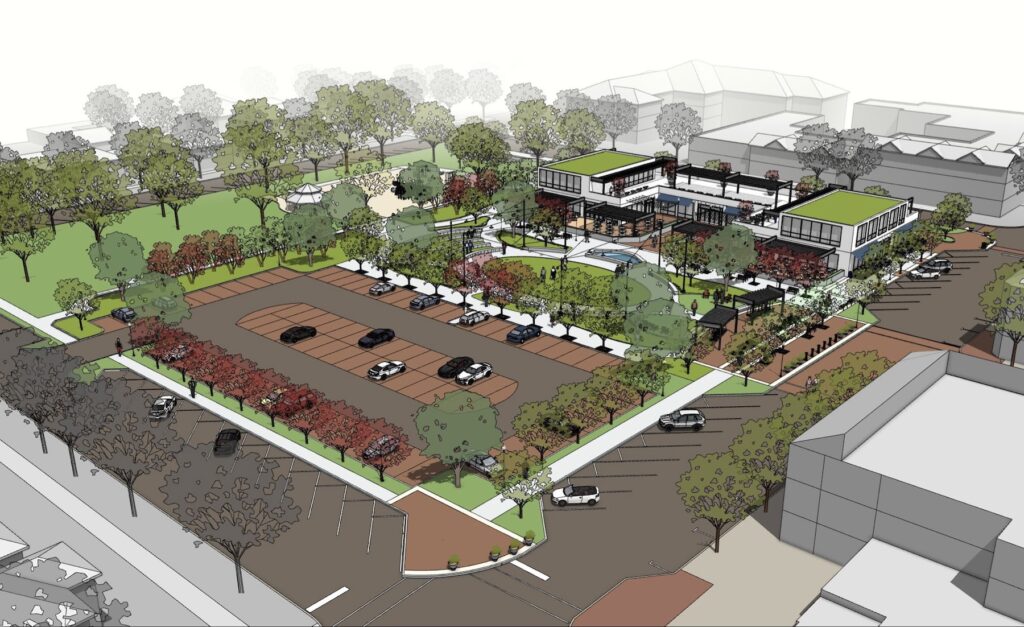
More recently, in 2022, the Village Council held a study session where then-Village President Chris Rintz suggested converting the area into a public plaza that would have included informal gathering spaces and areas for small-scale concerts and markets. This concept was referred to as the Bennett Plan, referencing the village’s first comprehensive plan in 1921, designed by architect Edward Bennett.
And in 2024, Village staff commissioned conceptual designs for a public plaza, but according to Tuesday’s board packet, no further discussion or action has occurred.
At Tuesday’s meeting, trustees were presented with two options for public engagement: contracting with an architectural or landscape firm to provide conceptual designs for a public outdoor gathering space, and contracting with a land use planning consultant to oversee a public engagement process.
Trustees preferred the latter and kickstarting a public engagement process.
Much of the support for that process stems from the 2025 Winnetka Council Caucus Survey results, trustees said. That survey showed that 24.3% of residents preferred an outdoor park or year-round communal space for the post office site, while 16.8% wanted a gathering space for children and for indoor and outdoor gathering.
That same survey showed that 38% wanted to see a mixed-use for the site, potentially including retail, service and housing.
Trustee Scott Myers suggested that trustees come up with at least two “built-out” options that can be presented to residents so the consultants can gather feedback on them.
While he praised the caucus survey, he said that one disadvantage of it is that the results don’t include much detail. Pursuing the public engagement option, he said, would allow for more details to be shared with residents.
“I would suggest that either we, or a sub-group, come up with some additional parameters,” Myers added. “Are we saying to the village that we will spend any amount of money to build the best public space? Well, no. We’re not going to probably go to the community and say we’ll spend $10 million.”
Another suggestion was that any potential project costs, including operational and maintenance, be included in any public engagement.
Although trustees supported the public engagement approach, some had an issue with including project cost as a parameter.
Trustee Kim Handler said she wasn’t sure that restricting the budget, at least for the public engagement stage, was a good idea.
“Let’s really open our minds here to something different and unique,” she said. “You all know I’m far from reckless with money. But I’m concerned about what the parameters should be and how we come up with that and we’re shutting the door too early on different ideas.”
Trustee Rob Apatoff agreed.
“This is the middle of our village, the last open space we have,” he said. “I’m not looking for a $40 million plan, but there are certain elements that we’re constraining ourselves (to) that I think would make this truly a world-class type of development.”
Trustee Tina Dalman suggested having the public engagement firm come up with rough estimates to how much each idea could cost.
“Nobody’s going to give us a solid budget, because there’s no construction drawings,” she said. “I think there’s a lot here that somebody who’s a professional in that space could distill it down to three, four, maybe five different options with price points associated with it.”
Village President Bob Dearborn said that the cost of the project is a constraint with which the trustees will have to deal.
He noted that while Rintz’s idea was well received, but “I think we felt that we needed to go back to the public and confirm some of this.”
Officials have reported that the original concept would have cost around $8 million.
“Part of this is money,” Dearborn said. “We can’t ignore that fact. We have other capital investments that are very substantial.”
He suggested that there may be opportunities for public-private partnerships when it comes to developing the post office site but encouraged parameters, with one of them being a time frame in which to complete the public engagement.
“It seems to me we have to get some more public engagement on this,” Dearborn said. “I’m not looking to retread 50 years of work here, but I don’t think we’re in a position here to say that the Bennett Plan is absolutely the right plan right now with no incremental development on the property, because we may need that for financial reasons or other reasons.”
Trustee Kirk Albinson agreed.
“We want engagement,” he said. “We want to confirm direction before we dive in and start drawing stuff.”
In addition to discussing the public engagement process, trustees also discussed what to do with the site if the post office building is demolished. Trustees supported temporarily converting the site into a vacant lawn until a more permanent solution is agreed to.
Village Manager Kristin Kazenas said she and Community Development Director Scott Mangum would work together on finding a firm to handle the public engagement process, which would return to the Village Council for future discussion and approval. Dearborn added that trustees will work out the parameters of the public engagement process and present them at that same future meeting.
The Record is a nonprofit, nonpartisan community newsroom that relies on reader support to fuel its independent local journalism.
Become a member of The Record to fund responsible news coverage for your community.
Already a member? You can make a tax-deductible donation at any time.

Peter Kaspari
Peter Kaspari is a blogger and a freelance reporter. A 10-year veteran of journalism, he has written for newspapers in both Iowa and Illinois, including spending multiple years covering crime and courts. Most recently, he served as the editor for The Lake Forest Leader. Peter is also a longtime resident of Wilmette and New Trier High School alumnus.
The Record is a nonprofit, community news site from former editors of 22nd Century Media
Our daily coverage of your government, schools, businesses and neighbors is not possible without your support.
Latest

The Record: Shortcut
Related Stories