
Highland Park, Deerfield high schools may move to flat fee per student
The administration at Township School District 113 is proposing a change to how it charges student fees for classroom materials, including textbooks, technology and activities.
During the School Board’s regular meeting on Tuesday, April 28, district leaders discussed why they began studying student fees, and why they are proposing the district adopt a flat student fee of $450 for all students beginning with the 2026-2027 school year.
Dr. Karen Ritter, assistant superintendent for curriculum, instruction and assessment, said that since 2023 the district had been using a third party vendor for its bookstore and Chromebook management. But this year, the company announced it was closing, and the district decided to bring the management of those programs back in-house, which it had done prior to 2023.
This prompted the district to examine its student fee structure and see how it aligned with the district’s strategic plan, specifically regarding efficiency and fiscal responsibility.
Ritter said that during the analysis it was determined that the third-party management led to “challenges,” such as a range of fees for educational materials; cost barriers, like students avoiding classes with materials they couldn’t afford; and inconsistent fee structures at both Highland Park and Deerfield high schools and across departments.
Ali Mehanti, assistant superintendent for finance/district treasurer, said the analysis also found that required fees for students were “spread across multiple line items, creating a fragmented system. This adds complexity and made it difficult for families to clearly understand and predict total costs. This highlights the opportunity to simplify and consolidate required fees into a more transparent predictable structure.”
Further, Mehanti said that it was determined that the total required fees varied from $115-$730 per student, with most students paying between $300-$500.
An internal team of staff members came up with three options for fee structures, with the administration recommending Option 1, known as the “all-inclusive model.”
“It threads together many of the costs families are already paying today, but in a more simplified and predictable way,” Mehanti said, adding, “What this model does is consolidate the separate costs into one all-inclusive fee, eliminating all the charges and creating a more transparent and consistent experience for families.”
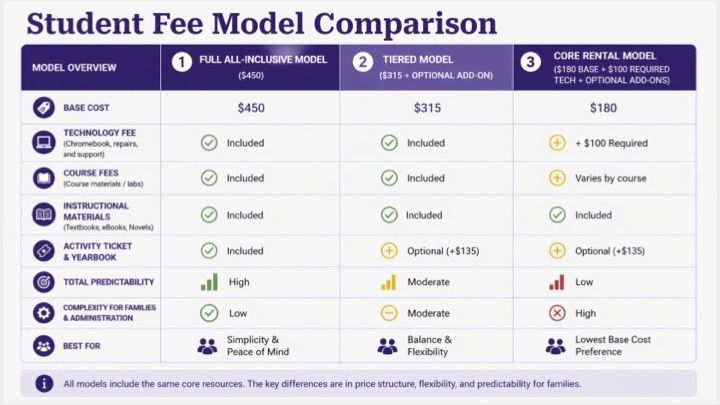
The recommended option would charge $450 upfront per student, a fee that includes $135 for a yearbook and an activity ticket, which Mehanti said gives students access to school-sponsored events.
The flat fee would not include a variety of other potential fees, such as transportation ($230), parking ($360), graduation ($41), AP exams ($99), and various club and trip fees.
A second option, which administrators are not recommending, would be the same as Option 1 but without the yearbook and the activity ticket.
Ritter said it was decided to include the yearbook and activity fees “because we believe that all students should get a yearbook as part of their high school experience and building those memories
“Including the yearbook and activity pass allows students to get more involved in their high school experience by attending events and contributing to their sense of belonging in high school.”
Another option, also not recommended, would charge $180 for “instructional and digital resources that are currently purchased individually,” according to Mehanti, but with a separate $100 fee, plus separate course and lab fees. He said this is similar to what families are experiencing now with separate line items.
Ritter said Option 1 has many advantages.
“It’s equitable and consistent so students do not have to worry about additional fees for certain class materials and they have access to the same resources and opportunities,” she said. “This model also streamlines processes internally so we are not managing individual fees and line items. And this model also supports curriculum and instruction by covering all classroom materials.”
She added that the flat fee “will remain all-inclusive, but may be adjusted over time in future years to account for the annual CPI increases.”
Mehanti added that the district will continue to offer payment plans and other options for families who may not be able to afford the student fees.
Board member Anne Neumann asked if it was too late for students who may have passed on a course because of the high materials fees to enroll in it for the fall. Ritter said course selection has already been completed for the next school year, but there may be some opportunities for students depending on space availability in classes.
Board member Rick Heineman said he supported including the activity fees.
“We’ve talked often in this board about the significance and the value of being involved in the school and how that helps with student achievement and student wellbeing,” he said. “I appreciate that that’s been an important part of the conversation.”
The School Board will vote on the proposed student fee update at its next meeting on May 19. If approved, Ritter said the district will immediately begin communications and outreach with families so they’re aware of the changes.
The Record is a nonprofit, nonpartisan community newsroom that relies on reader support to fuel its independent local journalism.
Become a member of The Record to fund responsible news coverage for your community.
Already a member? You can make a tax-deductible donation at any time.

Peter Kaspari
Peter Kaspari is a blogger and a freelance reporter. A 10-year veteran of journalism, he has written for newspapers in both Iowa and Illinois, including spending multiple years covering crime and courts. Most recently, he served as the editor for The Lake Forest Leader. Peter is also a longtime resident of Wilmette and New Trier High School alumnus.
The Record is a nonprofit, community news site from former editors of 22nd Century Media
Our daily coverage of your government, schools, businesses and neighbors is not possible without your support.
Latest

The Record: Shortcut
Related Stories