Audit of special education in District 73.5 shows systemic flaws, while parents call for more accountability
A recent audit of Skokie School District 73.5 revealed its system for tracking students with disabilities produces inaccurate records and its lack of written special education plans may break the law.
Yet parents of D73.5 students with disabilities — many of whom advocated for the audit after alleging the district was responsible for a pattern of discriminatory practices against their children — have argued the formal assessment doesn’t go far enough in addressing their concerns.
“We’re glad there’s an audit and we do see in there a lot of the very technical but tangible operational context for how the things we described in our report occurred,” said Sarah North, a local parent who in 2025 worked with other D73.5 parents to create a report documenting their concerns.
“(The audit) leaves out, sort of, the human impact,” she continued. “It leaves out the clear messaging about what it means for our children and how it fits into the allegations we made in our report and it doesn’t at all recognize that backstory. It doesn’t say there was a parent outcry about that.”
The audit — which Dr. Lea Anne Frost, an outside consultant, submitted to the D73.5 Board of Education in June — identified a “host of strengths” the district demonstrates in supporting its 188 students with individualized education programs (commonly called IEPs) this past school year.
The audit also outlined five intersecting “challenges” — such as keeping accurate records, maintaining financial responsibility and effectively communicating with parents — the district needs to manage and, in some cases, bring into “compliance” with state standards and federal law.
Superintendent Dr. Charles Kyle said in an email that he is “in support” of Frost’s audit and, during a June 9 School Board meeting, said he and the district’s incoming director of student services will develop a three-year plan to address Frost’s recommendations.
“I’m just saying it’s not all going to be accomplished in one year. But what we’re going to look at is what are the big levers that we can change immediately, update, and we can bring that to the board in the August board meeting,” Kyle said.
‘Severe dysregulation, social and academic isolation’
North, who works for the Office of the Illinois Attorney General but spoke as a district parent, said she met with D73.5 staff in the fall of 2024 to discuss her child’s IEP.
After she left the meeting feeling the district was “not operating in an appropriate way at all,” she posted on a D73.5 parent Facebook page about her experience and was “inundated” by other parents who had similar experiences.
North said she worked with a group of about 20 other D73.5 parents to form SD73.5 Caregivers of Special Education, 504, and Diverse Learners, a volunteer group that in April 2025 assembled an anonymously sourced, 31-page report recording their experiences and concerns.
The report alleges 27 examples of different discriminatory practices pertaining to special education in D73.5 over the past several years, including the district predetermining classroom placements before reviewing IEPs, utilizing “inappropriate discipline” procedures and refusing to provide requested services.
In one instance, the report claims, parents of an autistic Elizabeth Meyer School preschool student requested the district implement a plan to ease their child’s transition to kindergarten in the spring of 2024, but the district did not, causing the student to suffer “severe dysregulation, social and academic isolation, and a total inability to access academics according to his teacher.”
Among other requests, the report called on the district to dismiss its then-Director of Student Services Angela DeMay, who oversaw D73.5’s special education services. The report alleges that DeMay’s actions in the role violated “the civil rights of students with disabilities.” DeMay resigned for personal reasons in March, Kyle said.
A letter then-D73.5 School Board President Emily Miller sent to the volunteer group on April 18, 2025, thanked them for the report and outlined next steps: The board would ask the district to contract an audit of its special education services and create a committee of parents of students with disabilities.
Board President Kelli Nelson said on June 9 that the board first heard about the need to address the district’s special education challenges from staff before receiving the April 2025 report from parents, and it was a concern the board held in mind while searching for a new superintendent.
After Kyle became superintendent in July 2025 (he was preceded by two interim superintendents following Dr. Zipporah Hightower’s resignation in February 2025), the board hired Frost in November 2025.
In an email to The Record, Kyle said he has been meeting monthly with the Diverse Learners Committee (what is now called the Skokie 73.5 Caregivers of Diverse Learners) since September 2025.
The group reportedly hosted a meeting with Frost on April 15 about caregiver rights and meaningful participation in the IEP process, and the district is “hoping” to have three more events like that in the 2026-2027 school year, Kyle said.
‘Warts and all’
Addressing the D73.5 board on June 9, North and two other members of the D73.5 parent volunteer group said they were grateful the district responded to their request for an audit and they hoped the board would take Frost’s recommendations seriously.
The real-life impact of years in a district of dysfunction is incredible harm to the most vulnerable.”
Courtney Buckalew, a District 73.5 parent
Now 14 months after the group first submitted the report that helped incite the audit, however, D73.5 parent Courtney Buckalew said she did not expect their experiences would be “erased from the district’s audit or watered down and described simply as complaints about communication.”
“The real-life impact of years in a district of dysfunction is incredible harm to the most vulnerable,” she said. “Students, whose special needs have only increased because of the failure to provide proper skilled services and neuro-affirming individualized teaching, now struggle enormously.”
“Among the parents of these kids, some have quit their jobs or taken lower paying more flexible jobs to deal with the consequences of these failures. The mental and physical health of parents, disabled students and their siblings have suffered in the extreme.”
Nelson thanked Frost on June 9 for her work and said the board asked for her audit to “be presented in its true form, warts and all” so the district can know what to fix. The board president also suggested the district establish a way to measure parents’ satisfaction moving forward.
Notably, the board hired a new director of student services in April.
Kristen Moore will take over the job following DeMay’s resignation. DeMay was in the role for more than four years, public records show.
Audit: Data and communication
Frost’s report highlights five general “challenges” but then breaks down problems within each of those challenges. Among them: keeping accurate data.
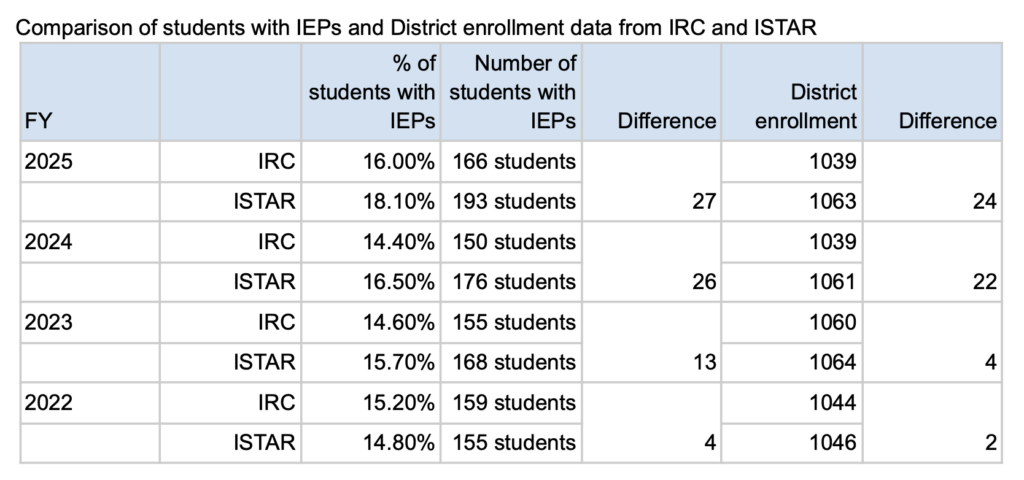
The audit states the three different systems D73.5 uses to track students do not consistently record how many district students have IEPs.
The state’s Illinois Report Card, which draws on data from one data system (PowerSchool), reportedly recorded 166 D73.5 students with IEPs in fiscal year 2025. But another data system (ISTAR) reportedly showed 27 more students, or 193 total, with IEPs last school year.
Frost’s audit also states that the number of students D73.5 records as eligible for a Section 504 plan, which can provide legally protected accommodations, “may be artificially inflated” with “inactive files.”
Some D73.5 staff reportedly have also even been using manual spreadsheets or Google folders for students with disabilities, so their info is not necessarily following them from teacher to teacher.
Frost recommended the district define just one platform as its primary special education data hub.
Accurate data, the report says, is crucial for D73.5 staff to understand the status of their students’ IEPs as it can help prevent the district losing out on state funding (D73.5 lost funding for those 27 students with IEPs last school year) and is a key metric for state monitoring.
When it comes to effectively communicating with staff, Frost’s audit says that many of D73.5’s internal documents are outdated and some guidelines that were previously removed were never replaced, leading to “inconsistent processes” and “procedural uncertainty between schools.”
For parents, the district has “systemic gaps” in its public information, leading to a lack of clarity in staff responsibilities, limited info on special education programs and communication systems described as “rudimentary, untimely, or inconsistent,” the report says.
Audit: ‘Significant discrepancies’
Dr. Frost’s audit emphasizes D73.5 was not providing its students a “written continuum of services,” a document federal law mandates the district create for parents.
By not providing the document, the report says, D73.5 exacerbates “confusion” over the range of special education programs and classroom sizes the district offers, and what classroom placement options are available to students with disabilities.
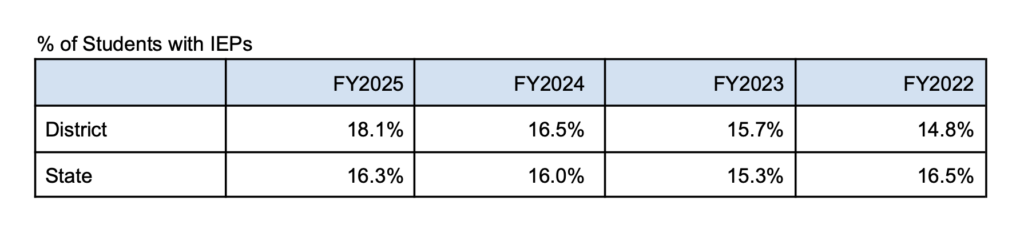
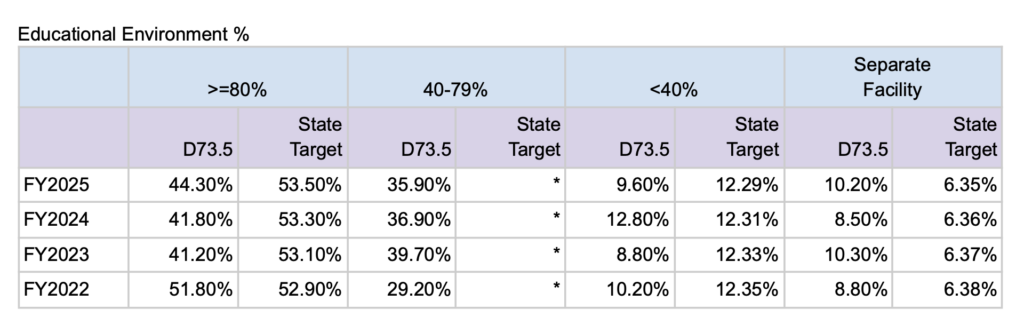
For the last four years, the district reportedly has not met the state target (53.5% in 2025) for students with IEPs in general education classrooms at least 80% of the time.
Frost’s audit goes on to highlight “significant discrepancies” in the amount of D73.5 students who have certain disabilities compared to state averages, and the “need to address” how the district determines whether its multilingual students are eligible for special education services.
The district has recorded big swings of students with certain disabilities within D73.5 itself from year to year, like 43% more D73.5 students with autism in FY2025 compared to FY2024, and 29% fewer students with developmental delays over the same time frame, according to Frost.
And for multilingual students, D73.5 staff reportedly “consistently indicated” to Frost that they “are unable to qualify” for certain special education designations. But Frost wrote that “to ensure legal compliance and equitable access,” multilingual students must be considered eligible for special education.
Frost also observed that D73.5’s special education staffing levels have historically been set by prior budgets and “anecdotal assessments rather than data.”
After applying models other districts use, Frost said D73.5 has slightly more full-time speech therapists and social workers than it needs. Additionally, the district needs to build schedules around special education services so IEPs are “implemented exactly as written,” Frost wrote.
The Record is a nonprofit, nonpartisan community newsroom that relies on reader support to fuel its independent local journalism.
Become a member of The Record to fund responsible news coverage for your community.
Already a member? You can make a tax-deductible donation at any time.

Samuel Lisec
Samuel Lisec is a Chicago native and Knox College alumnus with years of experience reporting on community and criminal justice issues in Illinois. Passionate about in-depth local journalism that serves its readers, he has been recognized for his investigative work by the state press association.
The Record is a nonprofit, community news site from former editors of 22nd Century Media
Our daily coverage of your government, schools, businesses and neighbors is not possible without your support.
Latest

The Record: Shortcut
Related Stories