
With officers cleared, documents and footage shed light on a fatal police shooting in Highland Park
Earlier this year, while performing a wellness check, Highland Park police knocked on the front door to a familiar home on Half Day Road.
In a span of 15 seconds, Brent Bucholtz answered the door, displayed a large kitchen knife, advanced on police officers, ignored multiple commands, yelled “shoot me” and was shot at least 15 times.
Bucholtz, 59, of Highland Park, was pronounced dead later that morning, June 20.
Prior to June, the most recent Highland Park police shooting was in 2014 at Highland Park Hospital. Amanda Bennett, the city’s communications manager, said she could not find any other record of a police shooting in Highland Park.
Based on a Lake County Major Crimes Task Force investigation, finished in October, Lake County State’s Attorney Eric Rinehart declined to file criminal charges against the three Highland Park police officers involved, Rinehart wrote in a September letter.
“We have determined that the officers from the Highland Park Police Department acted reasonably and professionally. This was a justified use of force, and this matter is closed from our perspective,” Rinehart said in a statement to The Record.
Following a public-records request, The Record obtained investigation documents that reveal details about the fatal shooting of Bucholtz, who had a history of encounters with police and struggles with mental illness. The information reported in this article is based on those documents, footage from police body cameras, and interviews with local officials.
In interviews with investigators, the police officers — who fired 21 combined shots at Bucholtz — all said they did not believe de-escalating the confrontation was possible.
They said, among other reasons, that Bucholtz was moving quickly and ignoring commands, and they did not believe their tasers or pepper spray would be effective.
During a September inquest proceeding at the Lake County Courthouse, one of Bucholtz’s relatives (who is not identified in the documents) said she tried to connect Bucholtz with “the psychiatric care he needed” and get in contact with area police departments to prevent “exactly this type of tragedy.”
“Despite years of persistent effort I got nowhere,” the relative said, adding that she wondered if officers could have responded differently, given that police had frequent contact with Bucholtz. A law enforcement database documented at least 73 previous incidents involving Bucholtz.
“While the officers faced a dire situation that day, the real failure happened in the months and years before when our systems couldn’t respond to a family’s pleas for help,” Bucholtz’s relative said.
Bennett said in an email that city police were “familiar with Mr. Bucholtz due to a history of prior calls of service to that address, including two well-being checks among other incidents” noted in the county task force’s investigation.
But Bennett affirmed that Highland Park police receive a “significant amount of training relating to crisis intervention, de-escalation, use of force,” and “independent and internal investigations concluded that the officers followed local policy and legal requirements.”
Adrianne Mautner, Bucholtz’s mother, told The Record via telephone that her son had an “illness,” but she believed that he was on medication, saw his doctor regularly and was “not a danger to anybody.”
She remembered him as a “sweet” and “caring” man who loved to play drums and guitar with his friends, listen to music nearly every night at Ravinia Festival, and volunteer at places like Thresholds, a Chicago-based mental health organization with which he had previous relationship.
“He was my only child,” Mautner said. “He would volunteer to do anything and he was wonderful. It was an unfortunate thing.”
Officers were ‘aware of this residence’
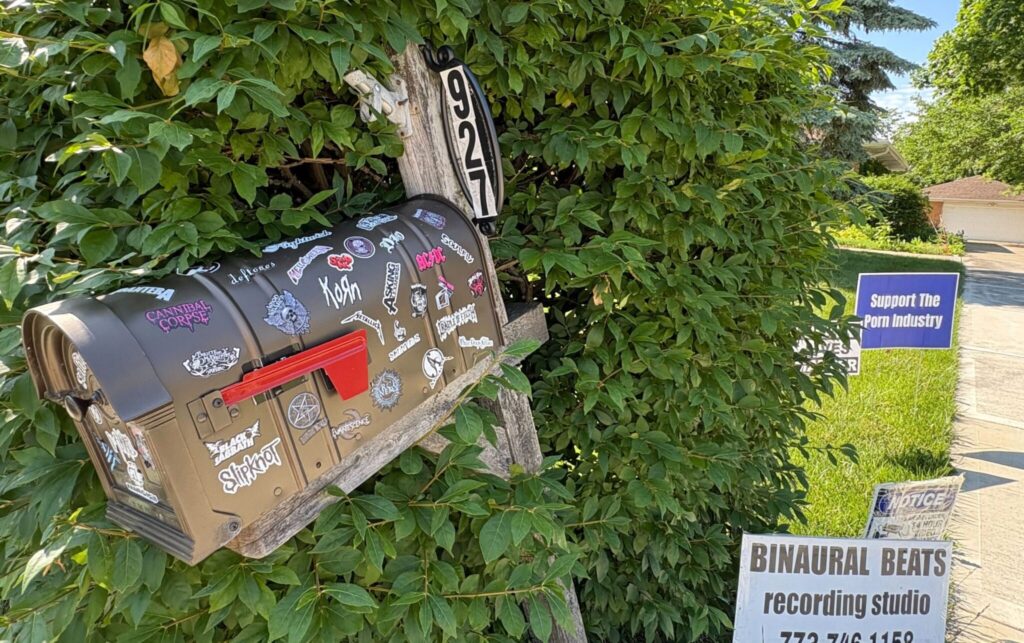
The Lake County Major Crimes Task Force’s investigation notes Bucholtz was diagnosed with schizophrenic disorder and had numerous contacts with police for incidents caused by his “erratic driving, erratic behavior, suicidal and homicidal statements, and posts on social media.”
Bucholtz reportedly attempted suicide in 2018, was hospitalized multiple times for mental health evaluations in 2019, received a firearm restraining order in 2024 for threatening to bring guns to the North Shore, and blacked out twice while driving in the past two years.
After the shooting, Bucholtz’s mother told police that her son was “becoming increasingly more agitated than usual” in the days leading up to June 20; he abruptly left a dinner on June 18 and did not answer his phone or his door when she tried to bring him food on June 19.
Highland Park police were dispatched to Bucholtz’s home around 4:52 a.m. on June 20 after a driver saw a man lying motionless in the road. The driver told police they saw two cars almost run him over before he stood up and walked into the home at 927 Half Day Road.
Three Highland Park police officers reported to the home around 4:57 a.m. for a “check on well-being,” they later recounted to investigators during separate, unrecorded interviews inside the city police department’s headquarters.
One officer said he was “aware of this residence but never interacted with the resident.” The officer said that Bucholtz was “weird and had controversial signs in the house,” and the officer was aware of a case involving Bucholtz allegedly disrupting a Highland Park restaurant.
Another officer told the investigator he was “familiar with Bucholtz” because he had responded to 927 Half Day Road when one of Bucholtz’s lawn signs allegedly was stolen and the interaction went “smoothly.”
The third officer on-scene June 20 told investigators he took a report from a person concerned about Bucholtz’s allegedly inappropriate social media posts and behavior but never had direct contact with him.
All three officers, who were equipped with tasers and pepper spray on June 20, said they expected the call would be “routine” and they did not anticipate an arrest or an attack.
Shouting ‘gibberish’
Outside Bucholtz’s home June 20, one officer knocked on the front door, backed up off the front steps and waited.
About 20 seconds later, at 4:59 a.m., Bucholtz opened the door holding a knife and said, along with expletives, “come here you,” as he moved toward the officers, as seen in body-cam footage reviewed by The Record.
The officer who knocked on Bucholtz’s door initially shouted “gun” three times before retreating down the driveway with his partner. He then said into his radio that Bucholtz had a knife, which can be seen in the footage.
As Bucholtz walked toward the officers, he shouted “shoot me” at least twice. One of the officers later described his words as “gibberish.” That officer recalled it did not seem Bucholtz was seeking assistance and said Bucholtz’s movements were “fast” before he “slowed down at some point.”
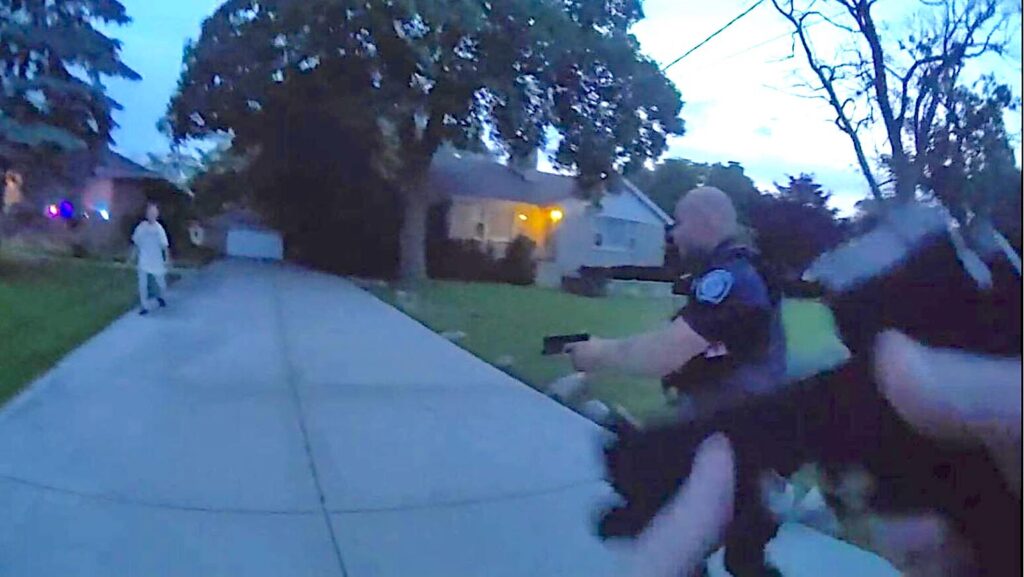
The officer who had knocked on Bucholtz’s door recalled he drew his firearm after retreating down the sidewalk and did not recall seeing the other officers draw their firearms prior to that.
The officer further down the yard unholstered his firearm after seeing his partner draw his firearm, that officer said.
The two officers, with their handguns now drawn and pointed at Bucholtz, repeatedly told him to “get back” and “get on the ground.” Bucholtz kept moving toward them with the knife in his hand.
A third officer approaching the scene on foot thought he heard one of the other officers yell “He got me,” and unholstered his firearm when he saw Bucholtz holding the knife.
The officer who shot at Bucholtz first recalled that he was about 6 feet away from Bucholtz at 4:59 a.m. The two other officers then opened fire as well.
In interviews, none of the officers could recall exactly how many times they fired at Bucholtz. A forensic pathologist later concluded Bucholtz was shot in the head, torso, arms and both legs a total of 15-16 times.
One of the officers saw Bucholtz fall to his knees with the knife still in his hand and, “not sure if the man was faking being hit” because Bucholtz’s eyes were open and he was breathing, and believing Bucholtz “may get back up and charge” at the officers, fired at Bucholtz one more time.
After pulling the large kitchen knife away from Bucholtz’s hand and placing him in handcuffs, the officers began rendering first aid at 5:01 a.m. Ambulances arrived on scene at 5:03 a.m. and took over.
Knife, taser and ‘center mass’ training
The first officer who fired at Bucholtz told an investigator he believed deadly force was necessary because of the size of his kitchen knife and the fact Bucholtz was ignoring commands.
The officer, an Army veteran, said he had received general de-escalation and simulator training at the police academy that would have included scenarios for knife-wielding subjects.
Based on the distance between him and Bucholtz on June 20, the officer believed he would not have stopped Bucholtz in time had Bucholtz charged and struck unprotected parts of the officer’s body.
Likewise, the officer who was nearest to Bucholtz on June 20 said he attended an eight-hour knife defense training course in 2024 that instructed it takes about the same amount of time (1.5-2 seconds) for a person with a knife to close a distance of 30 feet and attack as it would take for the other person to recognize the threat, draw a firearm and shoot.
The officer said he was taught ballistic vests are not designed to stop knives and, in past training where he was personally shot with a taser, one of the device’s probes bounced off of him. Therefore, he did not believe they’re always effective — especially in this scenario that “happened so fast.”
The officer also said he’s trained to shoot threats in “center mass,” not the hand, arm or leg, since it’s the largest target.
As Half Day Road is a main causeway to U.S. Route 41, the officer said he was concerned about backing up into the street and the presence of other people.
The third officer on-scene echoed the above reasons for using his firearm and said “he was sure Bucholtz would’ve killed one of them” had he not fired his gun.
He noted he was concerned about the officers walking backward into Half Day Road as morning traffic was picking up; less-lethal options like tasers, which are “not 100% effective,” were not viable due to the Bucholtz’s close distance and his speed of movement on June 20, the officer told an investigator.
‘Mental health treatment infrastructure is lacking’
Addressing a courtroom earlier this fall, one of Bucholtz’s relatives said she “truly, sincerely was concerned” about the community’s safety in light of Bucholtz’s psychiatric needs.
She, however, struggled to find a “clear pathway” to “effectively collaborate with law enforcement and the State’s Attorney’s office to intervene before a crisis became deadly.”
“We remain uncertain about what protocols are in place in the Highland Park Police Department for wellness checks for individuals who are known to have serious mental illness and if the officers dispatched to Brent’s house followed those protocols,” Bucholtz’s relative said in September.
Bennett said Highland Park did not communicate its policies to Bucholtz’s family directly, but the city provided its crisis intervention policies and other related protocols to the Lake County State’s Attorney’s Office in October to fulfill a request the county made on behalf of Bucholtz’s family.
Highland Park’s policy manual states that a “known history of mental illness” is one of the possible signs of an individual in crisis.
Among other things, an officer responding to a person in crisis should “attempt to determine if weapons are present,” “take into account the person’s mental and emotional state and potential inability to understand commands” and “secure the scene.”
“Once it is determined that a situation is a mental health crisis and immediate safety concerns have been addressed,” responding officers should then consider de-escalation measures like introducing themselves, moderating eye contact and looking for “avenues of retreat or escape should the situation become volatile.”
The manual notes that individuals in crisis “may still present a serious threat to officers; such a threat should be addressed with reasonable tactics. Nothing in this policy shall be construed to limit an officer’s authority to use reasonable force when interacting with a person in crisis.”
Bennett said Highland Park police officers have received more than 1,350 hours of training and the city’s police department is one of 14 in the state that completed the International Association of Chiefs of Police’s One Mind Campaign certification process that pertains to mental health.
“When responding to emergencies, police officers must make real-time decisions based on the information they have available to them at the time,” Bennett said. “Highland Park officers are trained to assess a threatening situation and apply force if necessary to protect public safety or themselves.”
The other recorded time that Highland Park police officers have used deadly force was in 2014 when two city officers fatally shot a 27-year-old man in Highland Park Hospital, Bennett said.
The man had displayed a handgun while being treated for a car accident and “refused to drop it,” ABC7 Chicago reported. The Lake County State’s Attorney’s office ruled the shooting was justified.
Even though the Highland Park officers actions were “completely justified” in shooting Bucholtz on June 20, Rinehart said that the Lake County State’s Attorney’s office still wants to support Bucholtz’s family.
“We remain committed to assisting anyone in need of mental health services,” Rinehart said.
“Sadly, the mental health treatment infrastructure is lacking throughout the United States, and we will always advocate for more resources to help those in need.”
The Record is a nonprofit, nonpartisan community newsroom that relies on reader support to fuel its independent local journalism.
Become a member of The Record to fund responsible news coverage for your community.
Already a member? You can make a tax-deductible donation at any time.

Samuel Lisec
Samuel Lisec is a Chicago native and Knox College alumnus with years of experience reporting on community and criminal justice issues in Illinois. Passionate about in-depth local journalism that serves its readers, he has been recognized for his investigative work by the state press association.
The Record is a nonprofit, community news site from former editors of 22nd Century Media
Our daily coverage of your government, schools, businesses and neighbors is not possible without your support.
Latest

The Record: Shortcut
Related Stories