
With recommendation, developer’s plan for Solo Cup land ready for Highland Park City Council
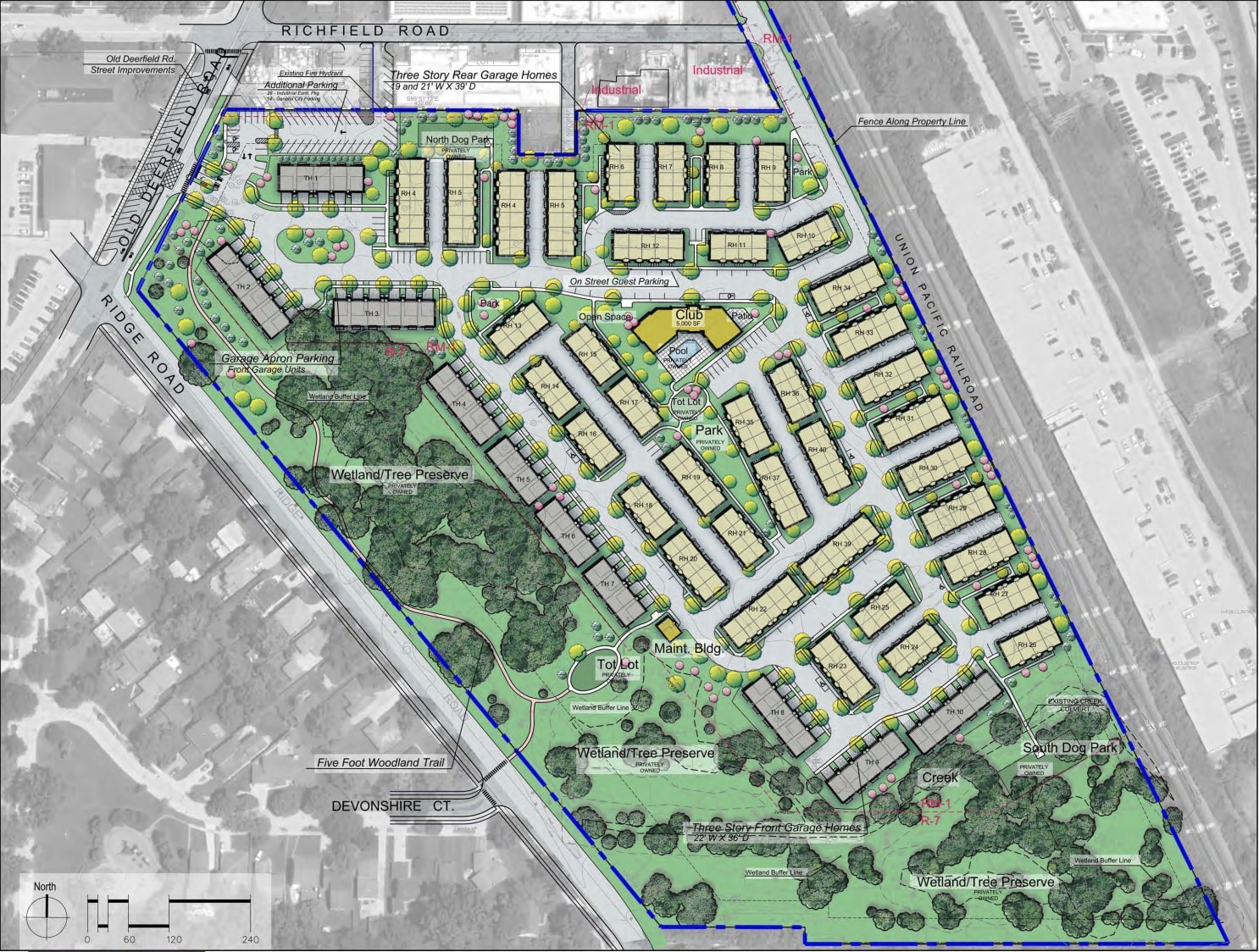
After numerous revisions, a developer seeking to build a 227-townhome residential community in the lot of the former Solo Cup facility obtained a nod of support from a Highland Park commission last week and will soon have the plan before the Highland Park City Council.
The Highland Park Plan and Design Commission voted 5-2 on Sept. 9 to recommend the city rezone 28 acres of vacant land at 1700 Deerfield Road from industrial to residential.
The Habitat Company, a Chicago-based developer working on behalf of Red Cup Land Company, petitioned for the rezoning.
If Highland Park City Council votes in favor of the project, The Habitat Company will move forward with building the 49-block community that has attracted both support for those who want to see the long vacant site developed and ire from those concerned about its density and impact on local traffic.
Highland Park City Council will vote on the rezoning request at their upcoming special meeting scheduled for 7 p.m. on Monday, Sept. 29, at The Moraine, located at 1201 Park Ave.
Presenting the latest round changes meant to address remaining concerns, Kathie Jahnke Dale, a partner with The Habitat Company, outlined on Sept. 9 that the residential community would now include 227 townhome units, five fewer than the previous count.
The site will also include fewer parking spaces (661 as opposed to 678), an increase to the setback on the northern edge of the property (now 50 feet), more green space to the nine acres of it west and south, and The Habitat Company offered to conduct an additional traffic study once the “project is stabilized.”
The Habitat Company updated its current traffic study to include data regarding the slated opening of the West Ridge Community Center and changes to Sherwood Elementary School’s enrollment in light of North Shore Education District 112’s decision to close Red Oak Elementary School in 2027.
Given proposed intersection improvements and projected traffic volumes for year 2031, the area intersections “are projected to operate at a good level of service and sufficient reserve capacity is available to accommodate any additional growth in the area,” analysis from The Habitat Company shows.
Highland Park’s independent traffic study contractor, CivilTech, reviewed the group’s traffic study and agreed that left turn lane additions to Old Deerfield and Richfield Road would improve traffic operations, Karl Burhop, Highland Park city staff’s liaison to the commission, said on Sept. 9.
Highland Park Plan and Design commissioners Kristin Inchak, David Fettner, Josh Nanus, Daniel Mantis and Karen Moore voted in support of rezoning for the proposed development. Commissioners Kenneth Henry and Steven Kerch voted not to recommend rezoning.
“To Commissioner Nanus’ point last week, I don’t want perfect to be the enemy of good and I think that this is a good proposal that solves a lot of problems with the site,” Commissioner Daniel Mantis said before voting.
“To me, housing here makes a lot of sense and I think, again, this country in general and this area is facing a housing shortage,” Mantis added. “This is our way out of that and for that reason I’m certainly supportive of this and I’m excited to see this get built.”
Sept. 9’s sessions was the sixth public meeting the Highland Park Plan and Design commission has held on The Habitat Company’s proposal since it was first submitted in October 2024.
The commission previously discussed the residential project on April 1, May 20, June 24, July 29 and Aug. 26 this year.
The Habitat Company has accommodated multiple other revisions through the course of those meetings, Jahnke Dale’s presentation showed.
Among others, those concessions included shrinking the number of townhomes four times (originally 262), decreasing the number of parking spaces three times (originally 714), increasing the northern setback twice (originally 20 feet), planting 53% more trees than required by code, adding a 1,430-foot walking trail, 26 parking spaces for public use and 19 different visual styles of buildings.
Still, residents participating on Sept. 9 remained concerned about the development’s density compared to its neighborhood, the integrity of the traffic study, and the lack of native plantings.
“I’m still a little sad that we’re not going to get a nice mixed-use development or something,” Vice Chair Kerch said before voting.
“I can dream up a lot of better stuff for this site,” Kerch said. “It’s too dense, it’s an enclave and the public benefit, public parking spots and paint on the street, are not a public benefit commensurate with the relief being sought here.”
The Record is a nonprofit, nonpartisan community newsroom that relies on reader support to fuel its independent local journalism.
Become a member of The Record to fund responsible news coverage for your community.
Already a member? You can make a tax-deductible donation at any time.

Samuel Lisec
Samuel Lisec is a Chicago native and Knox College alumnus with years of experience reporting on community and criminal justice issues in Illinois. Passionate about in-depth local journalism that serves its readers, he has been recognized for his investigative work by the state press association.
The Record is a nonprofit, community news site from former editors of 22nd Century Media
Our daily coverage of your government, schools, businesses and neighbors is not possible without your support.
Latest

The Record: Shortcut
Related Stories