Lake County weighs handing off mosquito control to Highland Park, Highwood, 3 others
The Lake County Board has initiated the process to potentially dissolve the public agency that oversees mosquito control in Highland Park and four other North Shore communities.
The board voted on Aug. 12 in favor of a proposing ordinance that directs the county’s finance department to audit the South Lake Mosquito Abatement District, as board members suggested that the district’s services are redundant and should be undertaken by individual municipalities.
Once the audit into SLMAD’s debts, receipts and inventory is complete in September, the board may then vote on an “authorizing ordinance” that would proceed with dissolving the government agency within the span of 6-18 months, Assistant Lake County Administrator RuthAnne Hall said.
Yet if the authorizing ordinance is approved, said, individuals in the SLMAD’s boundaries could still gather 200 signatures for a “backdoor referendum” that would instead put the decision to Lake County voters on the next election ballot.
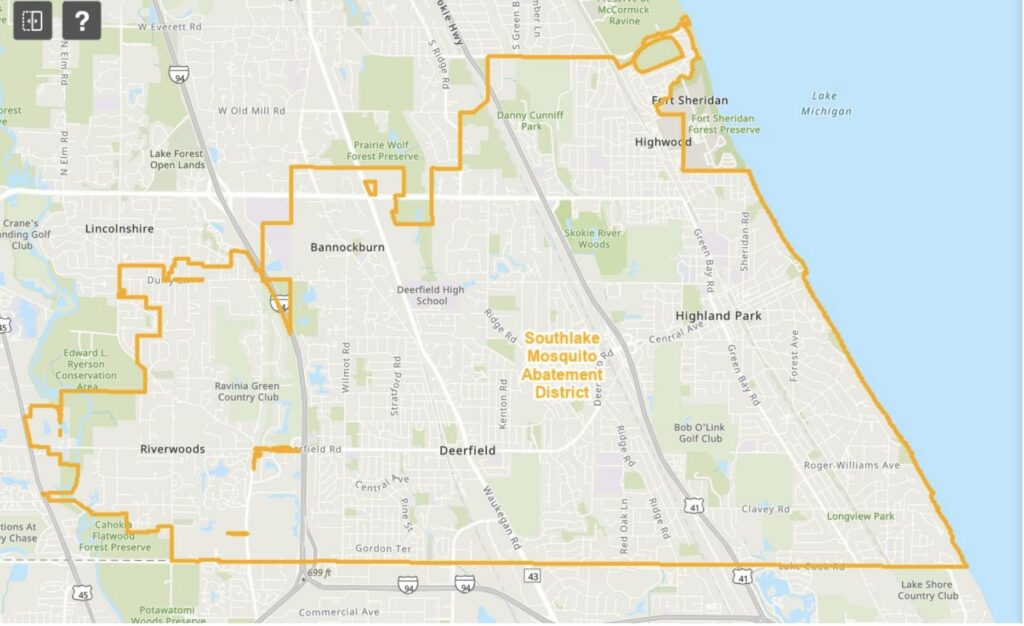
The SLMAD was created by state statute in 1920. Among other things, it oversees spraying of larvicide in seasonal breeding sites, testing for the presence of diseases in mosquito traps and public health education on mosquitos across Highland Park, Deerfield, Riverwoods, Highwood and Bannockburn.
Though SLMAD is directed by five volunteer trustees, the government body derives its revenue from a tax on properties within its boundaries to pay for its administrative, legal and hired contractor fees. According to the county’s proposed ordinance, the levy generated $481,722 in 2024.
During July 31 and Aug. 7 Financial and Administrative Committee meetings, Chair Sandy Hart noted that the SLMAD is the only government mosquito control entity left in Lake County after the county board dissolved the Lake Bluff Mosquito Abatement District in 2021.
There are now 47 municipalities in Lake County operating without a mosquito control district, but they have managed to avoid public health crises, Hart said. Auditing the SLMAD could help determine whether the government body is “cost effective,” she said.
“The state of Illinois has more units of government than any other state in the country,” Hart said during an Aug. 12 board meeting. “I’m really proud of the work that our board has done, little by little, chipping away and saying, ‘Hey, is there another place that would be more effective to do this work?’”
“To have a taxing body that only is looking at mosquitos is outdated,” Hart said. “Are we going to have a taxing body that maybe only looks at ticks or just something else? That doesn’t make sense to me.”
Board member Jennifer Clark also voiced support for municipalities handling their own mosquito abatement so that residents may enjoy more transparency and accountability over the local services rather than needing to contact an unelected leadership team that is appointed by the county board.
Board member Paul Frank said the SLMAD’s tax levy is uniform while some municipalities require more abatement services from the entity than others. Another board member, Paras Parekh, voiced support of dissolving the agency to potentially deliver cost savings to residents.
But board member Ann Maine — who alongside Linda Pedersen cast the only dissenting vote to the proposing ordinance — emphasized that unincorporated areas within the SLMAD’s boundary will lose mosquito abatement services when the county and local municipalities decline to offer them.
Maine argued municipalities can access a better “economy of scale” to abatement services when they band together and that an audit of SLMAD will only offer a snapshot of how the government body spends its money, not an informative evaluation on how effective it is.
Board Member Diane Hewitt indicated she voted in favor of the proposed ordinance with reservations, expressing concern that municipalities will not treat mosquito abatement as a high priority and residents may become unhappy with the quality of such services.
During the public comment section of previous Lake County committee sessions, Riverwoods Mayor Kristine Ford asked the board to consider the impact dissolving SLMAD would have on municipalities’ budgets and argued its consistent services should actually be expanded to more communities.
“The best way to cure an infection is to prevent it from happening in the first place. We might tolerate mosquitos if they were just a nuisance, but we know they’re vectors of disease,” said Lester Raff, a Riverwoods trustee and retired pathologist with 45 years in laboratories, to the finance committee.
He added, “Our municipalities working together provide an effective and inexpensive way to keep those vectors at bay. It is in everyone’s best interest to preserve that protection. I ask you as a citizen, as a physician and as a trustee, please do not dissolve the South Lake Mosquito Abatement District.”
Highland Park is the largest municipality SLMAD serves. Encompassing 50% of land in the district’s boundary, the city has four representatives on SLMAD’s six-person board.
During an Aug. 11 City Council meeting, Highland Park City Manager Ghida Neukirch said the city was asked to give a letter of support for dissolution, but city staff need to first evaluate the district’s finances and services and meet with the other four municipalities to understand their goals.
City staff will then generate a recommendation for a future council meeting regarding whether the Highland Park should partner with other municipalities for mosquito abatement services, join the nearby North Shore Mosquito Abatement District, support a backdoor referendum or undertake mosquito control independently, Neukirch said.
The Record is a nonprofit, nonpartisan community newsroom that relies on reader support to fuel its independent local journalism.
Become a member of The Record to fund responsible news coverage for your community.
Already a member? You can make a tax-deductible donation at any time.

Samuel Lisec
Samuel Lisec is a Chicago native and Knox College alumnus with years of experience reporting on community and criminal justice issues in Illinois. Passionate about in-depth local journalism that serves its readers, he has been recognized for his investigative work by the state press association.
The Record is a nonprofit, community news site from former editors of 22nd Century Media
Our daily coverage of your government, schools, businesses and neighbors is not possible without your support.
Latest

The Record: Shortcut
Related Stories