
History By Design: Prairie landscape meets the lake in Gillson Park, Wilmette Harbor
In 2024, Gillson Park and Wilmette Harbor were designated a historic district and placed on the National Register of Historic Places by the National Park Service, a designation honoring its exceptional significance.
Gillson Park (named Washington Park until 1955) was created out of landfill from dredging the waterway that is now Wilmette Harbor. It was laid out in two phases. In 1915, the Wilmette Park District hired a professional landscape architect and nurseryman, Benjamin E. Gage, to create a plan on this 22-acre lakefront site. The design included a kidney-shaped circuit drive system, gently winding paths, a lakefront promenade, a bathing beach, a naturalistic vision for the landscape and a boat harbor — all with glorious views of Lake Michigan.
The creation of the park was spurred by the development of the North Shore drainage channel, constructed by the Sanitary District of Chicago (now known as the Metropolitan Water Reclamation District of Greater Chicago) between 1907 and 1915 to increase the water flow away from Lake Michigan and improve water quality in the North Branch of the Chicago River.

In the 1930s, Gillson Park was expanded to 60 acres. Elements were retained of the original plan, while inspiration came from the Prairie Style of landscape design of the Midwest’s “dean” of landscape architecture, Jens Jensen.
Funded by the federal government’s Works Progress Administration, Charles D. Wagstaff and Robert E. Everly were hired. Everly had worked with Jensen on the design of parks in Glencoe.
Wagstaff and Everly’s 1935 plan provided a naturalistic landscape inspired by the prairie, with landscaped lawns resembling meadows and edged by shaped groups of shrubs that included native plants, stratified limestone walkways, steps and benches recalling native stone outcroppings, and a whole and a partial council ring. The circular form was favored by Jensen, inspired by his schooling in Denmark and by Native American council rings.
A distinctive amphitheater of 17 rusticated limestone tiers set into the sloping landscape was also created by the designers. Later it became known as the Wallace Bowl. Inspired by history, its design recalls ancient Greek amphitheaters.
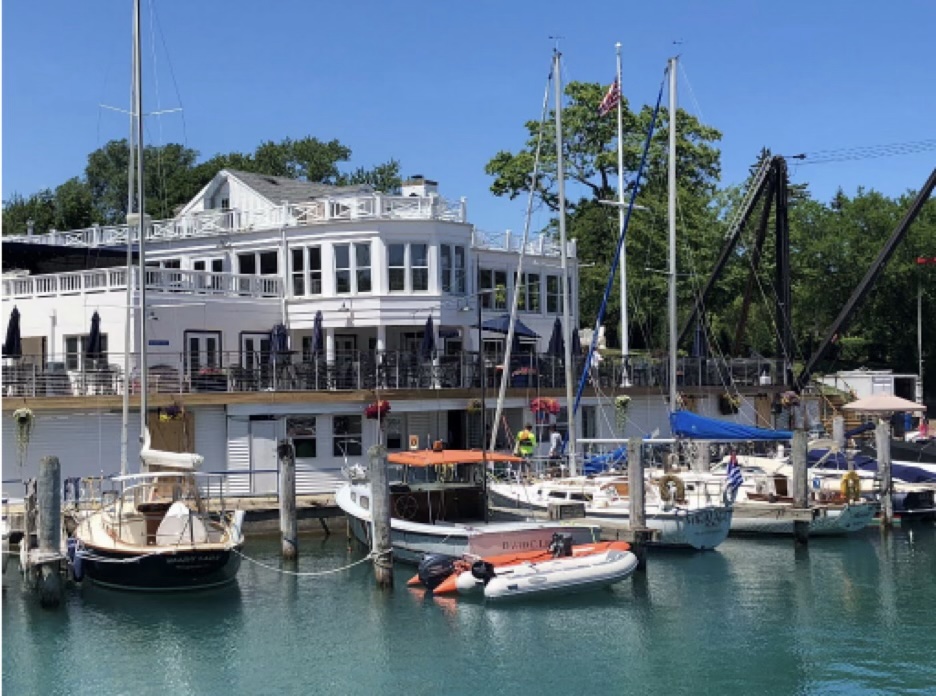
In the 1920s, what started as a silting basin became a popular location for pleasure boating. A Colonial Revival building designed in 1937 by Walter T. Stockton, with a 1972 addition by Booth & Nagle, today is jointly used by the Wilmette Harbor Club, the Sheridan Shore Yacht Club and the Sailing School.
History By Design is The Record’s monthly column focusing on the North Shore’s special and influential architectural history. Local historians and authors Susan S. Benjamin and Robert A. Sideman write and research the column.
____________________________
The Record is a nonprofit, nonpartisan community newsroom that relies on reader support to fuel its independent local journalism.
Become a member of The Record to fund responsible news coverage for your community.
Already a member? You can make a tax-deductible donation at any time.
The Transparency Box
Research for this piece utilized the work of Julia Bachrach, who wrote the historical-landmark application for Gillson Park.
The Record is a nonprofit, community news site from former editors of 22nd Century Media
Our daily coverage of your government, schools, businesses and neighbors is not possible without your support.
Latest

The Record: Shortcut
Related Stories