
Northfield’s MJ Moline rocks presentation to NASA
Mia Jane “MJ” Moline spent hours a week as a sophomore developing her research project, but something was missing.
Funding.
But the recent University of Vermont graduate said that was not her motivation.
“People think this is weird when I say it, but I was kind of just doing it as a hobby or for fun because it was interesting,” said Moline, a Northfield native.
Her “hobby”? Creating a machine learning protocol that uses satellite images and land samples to identify different minerals on Mars.
A year and a half later during her junior year, the New Trier High School alumna wrote a grant to NASA EPSCoR and received $45,000 for the project.
In accordance with the grant agreement, Moline traveled to NASA’s Lyndon B. Johnson Space Center in May to present her findings to a panel of scientists.
“I was so nervous because it just felt like the biggest deal ever,” Moline said. “I was so nervous, but it was also so satisfying because I had been working on this project for over two years at that point, so it just felt so satisfying to be like, ‘Oh, I did it, like I finally made it here.’”
From the ground up
Moline’s interest in rocks first began at Marie Murphy School when she joined the science olympiad team in sixth grade. She was assigned the geology event.
Marie Murphy science olympiad coach James Gravagna recalled Moline as a student who was always open to learning new things.
“(She was) just an outstanding student, always on top of everything,” Gravagna said. “But I think what kind of stood out most to me was … just her love of learning. It wasn’t just about the grades, which she could get very easily. It was just like she enjoyed learning something new and really understanding it to the maximum.”
Moline went on to become an environmental science major at the University of Vermont before adding a second major, geology.
She was a lab assistant to a graduate student studying sediment core samples from under Greenland.
Her own path
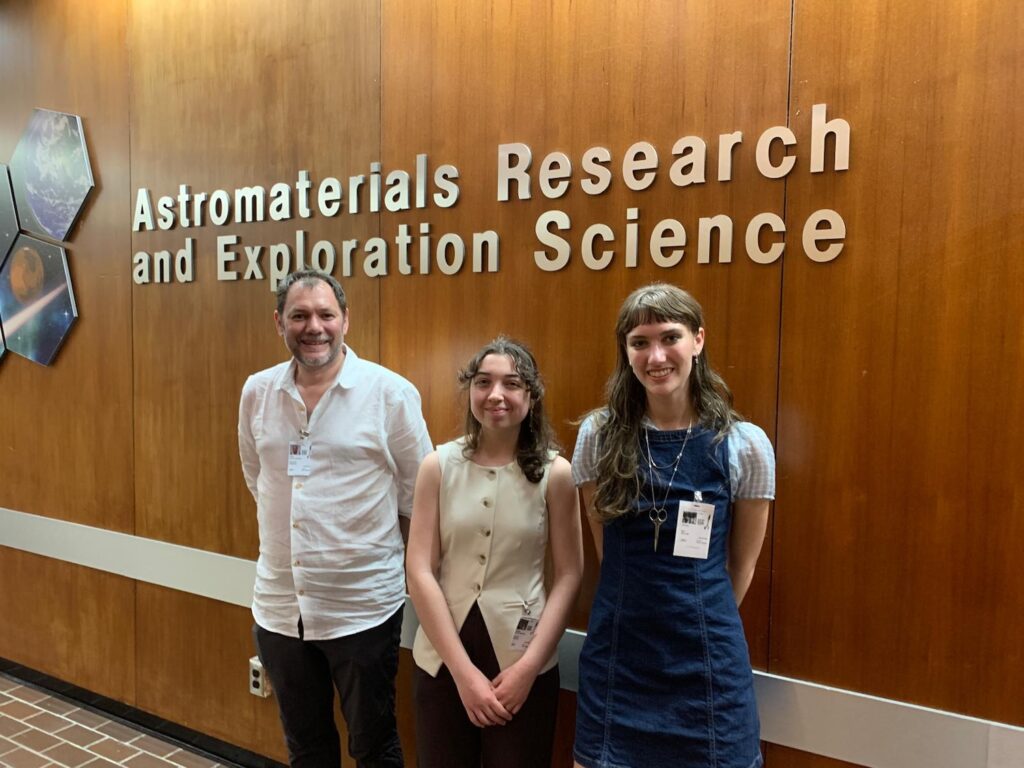
When it came time for Moline to develop her own research project in her sophomore fall of 2023, she originally thought she would do research on glaciers using data from Mars. But once she and her professor began looking through public data from NASA, they decided to pivot.
NASA’s Mars Curiosity Rover uses drill samples to analyze mineral composition on Mars. The Mars Reconnaissance Orbiter takes satellite images of Mars’ surface to record various wavelengths of the planet. Moline wondered what would happen if she combined the data from both.
“Most interpretations had either focused on the drill sites separately or just the satellite imagery,” Moline said. “None of them … really had done a full integration of the two. So then, all the ideas from before were put on the backburner, and it was like, ‘OK, we need to do this.’”
Her main mission for her research was to create a machine learning protocol that would combine those pieces of data.
Moline said she took those satellite images from the Reconnaissance Orbiter and turned them into pixels, with each pixel treated as its own data point.
Then, her machine learning protocol put those data points into a spreadsheet and sorted the points into groupings that corresponded with different mineral compositions. The Curiosity Rover’s data confirmed the accuracy of her algorithm.
When Moline and her project co-collaborator, Sky Boiros, applied for their NASA EPSCoR grant, she received a letter of recommendation from NASA’s Liz Rampe.
In front of NASA scientists, Moline and Boiros presented their findings and were met with a series of questions from the panel.
End game
Right now, the Curiosity Rover only explores Gale Crater. With this data, Moline hopes to one day figure out the mineral composition of the rest of Mars. To extend it even further, she hopes the methodology can figure out geologic elements of planets where rovers cannot travel.
Besides 140 million miles of space, if one thing stood between the geologist and Mars, it was technology. Working with the spreadsheet, Moline said, could be extremely frustrating.
She said she prefers doing field work, like going out and collecting data herself, but the struggle was well worth it.
“The whole time I was just like, ‘This is so cool,’” Moline said. “This is just so different from what I’ve been doing in college and classes and lectures and stuff. And I was just so excited to be doing something new. Even those frustrating points, I was like, ‘Well, I’m having fun. I’m being a researcher.’”
Gravagna is impressed with his former student’s research.
“Just the creativity of coming up with kind of a novel way of looking at a problem … I can just see her doing that,” Gravagna said. “ … Just going all in as an undergrad to do that kind of research is phenomenal. That’s normally masters, PhD level kind of research.”
Even though Moline is moving to Iceland this fall as a graduate student, she still plans to stay involved in her research and is working on a publication about it.
Moline plans to one day become a professor and explore comparative plantology but her end goal, she said, is to become a middle school science teacher.
“And this seems like a long, roundabout way to become a middle school teacher, but I just love science and I love doing things that are new,” Moline said.
The Record is a nonprofit, nonpartisan community newsroom that relies on reader support to fuel its independent local journalism.
Become a member of The Record to fund responsible news coverage for your community.
Already a member? You can make a tax-deductible donation at any time.
Penelope Roewe
Penelope Roewe is a reporting intern at The Record. In the past, she has reported on Skokie news as an editor for Niles North's student newspaper, North Star News. She is currently a sophomore studying journalism and political science at the University of Illinois Urbana-Champaign and writes for The Daily Illini.
The Record is a nonprofit, community news site from former editors of 22nd Century Media
Our daily coverage of your government, schools, businesses and neighbors is not possible without your support.
Latest

The Record: Shortcut
Related Stories