
History By Design: Two houses of worship along Sheridan Road, where architecture meets sculpture
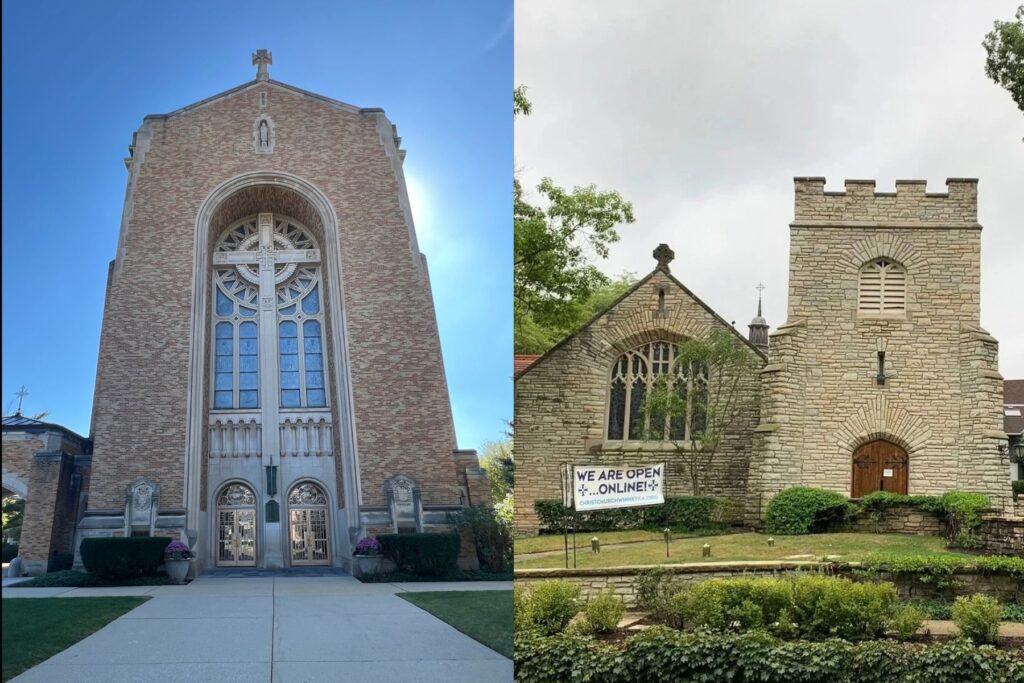
A ride up Sheridan Road takes you past two of the North Shore’s most iconic buildings: the Baha’i Temple at 112 Linden Ave., Sheridan Road and Linden Avenue, in Wilmette and North Shore Congregation Israel at 1185 Sheridan Road in Glencoe.
The Baha’i House of Worship is the North American “Mother Church” of the Baha’i faith. There are approximately nine Baha’i temples altogether, located throughout the world.
The structure of the Wilmette temple consists of nine columns of a polygonal drum supporting a 90-foot diameter circular dome.
The cornerstone was laid in 1912, but due to two world wars and the Depression, the building was not completed until 1952. It is a steel frame structure clothed in white Portland cement, sand and quartz, which in the sunlight makes the building glitter. The architect was Louis Bourgeois, a French Canadian architect who earlier worked for Burnham & Root and other leading architectural firms.
Followers of the Baha’i faith believe in three principles: the oneness of God, the oneness of religion, and the oneness of mankind. This oneness is expressed in the design of the building.
The number nine is significant, representing perfection and unity. The drum is nine sides. Nine gardens with various kinds of flowers and fountains create outdoor rooms for prayer and ceremonies. Symbols of the world’s religions are integrated into the design, including the Christian cross, the Jewish Star of David, and the Muslim star and crescent.
Inspiration for the design of the Temple came from a multitude of sources: Romanesque symmetry, Gothic arches, Byzantine filigree and Renaissance symmetry. Many architectural traditions are incorporated into the design — all but modern. Ornament was designed by sculptor John J. Earley. The property is listed on the National Register of Historic Places.
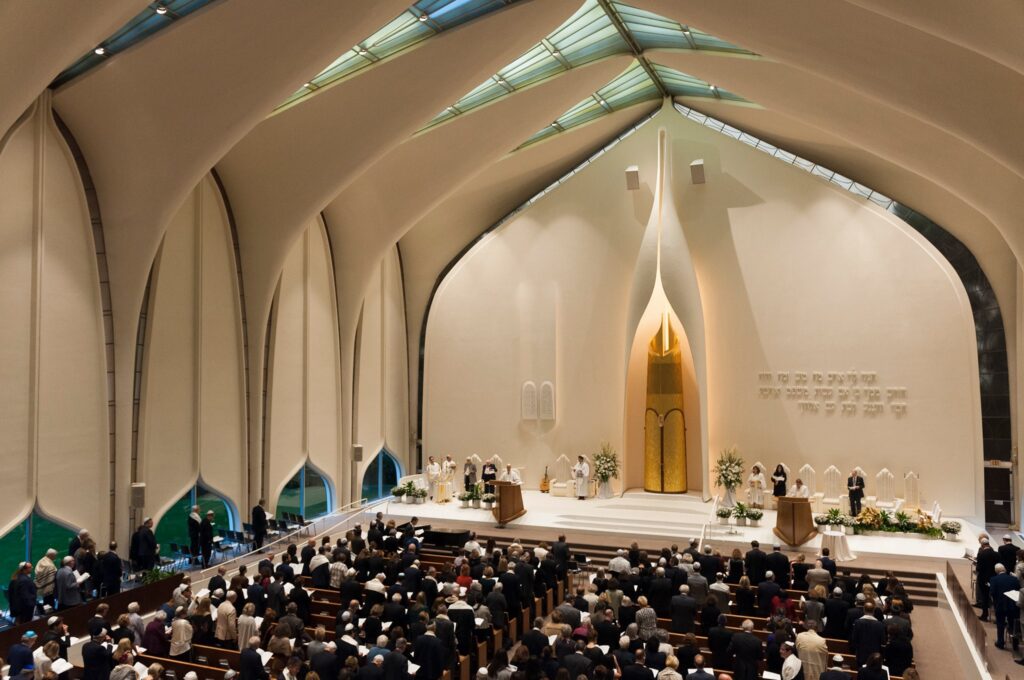
North Shore Congregation Israel was founded in 1920 and moved into the sculptural building designed in 1964 by Minoru Yamasaki.
Numerous architects were being considered, including Marcel Breuer, Eero Saarinen, Philip Johnson and Morris Lapidus. The building committee fell in love with Yamasaki’s vision.
The structure consists of eight pairs of reinforced, concrete, fan-shaped vaults filled with clear glass at eye level, incorporating views of Lake Michigan; and amber glass above, flooding the interior with warm light. The ceiling height is 55 feet and the span is 80 feet.
Yamasaki immersed himself in Jewish history as he had never before designed a synagogue. The architecture of synagogues isn’t associated with any particular style, but rather is based on the style popular at the time of construction.
In this case, a reaction in the 1960s against the severe, rectilinear forms of modernism resulted in structural experimentation with reinforced concrete shells by Yamasaki. The design of the synagogue calls to mind organic forms found in nature like the palm and the calla lily.
Yamasaki had an international practice from his base in Detroit, designing a wide variety of buildings. One of his best is found at Lambert Field, built in 1956 in St. Louis. Others are located on the campus of Wayne State University in Detroit.
In 1979, Thomas Beeby designed a smaller worship space. It is a cylindrical detached building with Post Modern references to history.
History By Design is The Record’s monthly column focusing on the North Shore’s special and influential architectural history. Local historians and authors Susan S. Benjamin and Robert A. Sideman write and research the column.
The Record is a nonprofit, community news site from former editors of 22nd Century Media
Our daily coverage of your government, schools, businesses and neighbors is not possible without your support.
Latest

The Record: Shortcut
Related Stories