Skokie trustee candidate removed from ballot but two others can stay on, commission rules
After reviewing objections claiming three candidates filed improper paperwork to run for the Skokie Village Board, a village commission ruled on Wednesday to remove one candidate from the ballot.
The Skokie Municipal Electoral Board voted 3-0 on Wednesday, Nov. 18, to sustain an objection Skokie resident Jinsky Jeanpois filed against the nomination papers Samuel Goldstein submitted last month to compete in District 3.
Jeanpois’ said that Goldstein submitted loose papers that were not “neatly fastened together at one edge in a secure and suitable manner” as is required by Illinois Election Code.
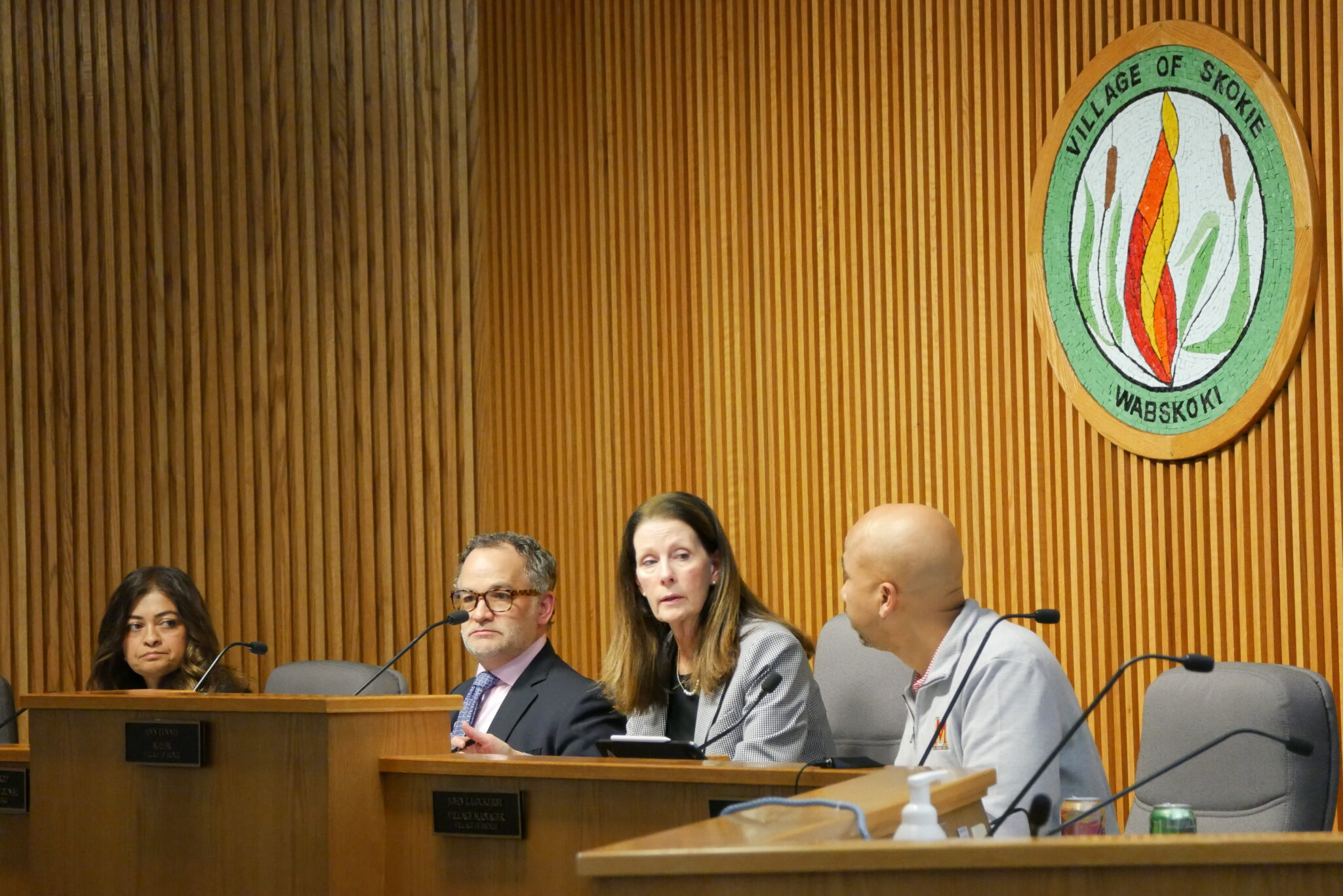
The electoral board — which comprises Mayor Ann Tennes, Trustee Keith Robinson and Village Clerk Minal Desai — also voted unanimously to reject objections filed against the nomination papers of District 3 candidate Madeleine England and District 2 candidate Brad Sugar.
The objections against England and Sugar each alleged the candidates did not obtain enough valid signatures to run for trustee.
After the electoral board ruled in favor of England and Sugar, District 3 Trustee Lissa Levy withdrew her objection alleging Goldstein did not obtain enough valid signatures.
The electoral board directed the village’s corporation counsel to prepare a written decision sustaining Jeanpois’ objection. The board will meet again at 8 a.m. on Tuesday, Nov. 22, to formally approve the written decision and remove Goldstein’s name from the ballot.
Reached by The Record, Goldstein declined to comment on the board’s ruling.
Deputy Clerk Sylvia Luke testified on Wednesday that when she received Goldstein’s nomination papers on Oct. 21, she did not see a fastener and Goldstein did not bring them in a folder. She did not recall if the papers had any holes or indentations indicating they were stapled.
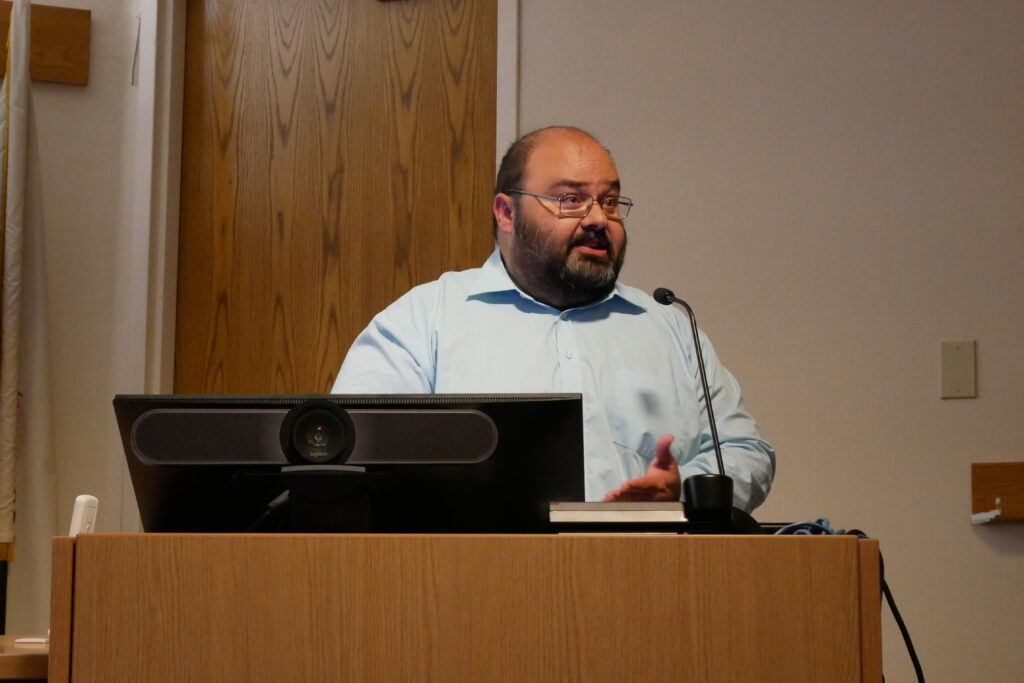
Goldstein testified he knew his petitions needed to be fastened and his nomination papers were not bound, but he argued that, since his papers were submitted together, numbered and in order the “integrity” of his petitions was maintained.
“The whole intent of the fastening statute is to make sure the integrity of the petition is together,” Goldstein said. “So, whether it’s actually stapled, with paper clip, in a folder, really, it’s more, the issue is can the integrity of the petition be acceptable.”
Answering a question from Tennes, Goldstein acknowledged that if his unfastened petition had slid off the counter and onto the floor, it is possible the papers could have been reassembled incorrectly.
Number of Signatures
Outside the dispute over paper fasteners, a common thread among the four objections was the question over how many signatures candidates must obtain to run for the Village Board.
After Skokie’s election code was reformed in 2025, the minimum number of signatures reportedly was left unclear.
Andrew Finko, an attorney representing candidates England and Sugar, argued the village should apply Illinois Municipal Code, which reportedly requires candidates obtain a number of signatures equal to at least 1% of the “total vote cast at the last preceding election” for mayor.
Finko argued that the state municipal code contains the “more specific provisions” that must be applied to the village’s nonpartisan elections, and it would be “discriminating” to force district trustee candidates to obtain more signatures from the residents in their district than the at-large or mayoral candidates who can obtain signatures from residents all over the village.
Ed Mullen — an attorney representing Rebecca Abraham, the Skokie resident who filed the objection against England — argued the village should apply Illinois Election Code, which reportedly requires candidates obtain a number of signatures equal to at least 5% of those who voted in the last election for that district.
Mullen said the Illinois Constitution authorized Skokie voters to create trustee districts via a referendum, but “that change was not anticipated by the municipal code,” which does not explicitly mention “districts.”
Since there is nothing in the state municipal code that explains how to calculate minimum signature requirements for districts, the village must apply state electoral code standards, Mullen argued.
Other Candidates Stay
The Cook County Clerk’s Office examined the signatures Abraham contested on England’s petition and found that 91 of her signatures were from outside the district, 18 signors were not registered at the address they listed, one signor was duplicated and six were invalid for other reasons, said Stewart Weiss, Skokie’s corporation counsel.
The audit left England with 172 valid signatures. After the electoral board accepted one appeal, she was left with 173.
The state municipal code standard required England to obtain 131 signatures and left her with 41 more than she needed. Applying the state elections code standard would have required her to obtain a minimum of 184 signatures and left her with 11 signatures too few to get on the ballot.
“I would argue the municipal code because it’s local.” Robinson said, explaining why he thought the 1% standard should apply. “I’m also trying to think of (ballot) access for candidates.”
Desai echoed that she sided with applying Illinois’ municipal code because “we need some ballot access.” Tennes agreed that the state municipal code “is the appropriate determinant.”
Sugar’s petition had 166 uncontested signatures, Weiss said. By applying the state election code standard, he would have reportedly needed 234 signatures to run in District 2. By applying the state municipal code standard, he needed 131 signatures and cleared the bar by 35 signatures.
Notably, if the Skokie electoral board had opted to apply the state electoral code standard instead, the board would have then needed to decide whether candidates need signatures equal to 5% of the number of District 3 residents who voted in the previous election or if candidates need signatures equal to 5% of the number of District 3 residents who cast a vote for a District 3 trustee in the previous election.
If the Skokie electoral board had applied the 5% standard to the number of District 3 residents who voted for a District 3 trustee in 2025, candidates would have needed 138 signatures and England still would have qualified to get on the ballot.
If the Skokie electoral board had applied the 5% standard to the total number of District 3 residents who voted in 2025, England would have needed the 184 signatures that objectors argued was the proper benchmark.
Four Skokie Village Board trustee seats will be up for new terms in April 2027, while the mayor and At-Large Trustees Robinson and Gail Schechter are not up for reelection until 2029.
Samantha Abraham is running uncontested for District 1; Sugar and Christopher Whitaker will compete for District 2; England will compete with Levy, the incumbent, for District 3; Edward Olivieri is running uncontested for District 4.
The Record is a nonprofit, nonpartisan community newsroom that relies on reader support to fuel its independent local journalism.
Become a member of The Record to fund responsible news coverage for your community.
Already a member? You can make a tax-deductible donation at any time.

Samuel Lisec
Samuel Lisec is a Chicago native and Knox College alumnus with years of experience reporting on community and criminal justice issues in Illinois. Passionate about in-depth local journalism that serves its readers, he has been recognized for his investigative work by the state press association.
The Record is a nonprofit, community news site from former editors of 22nd Century Media
Our daily coverage of your government, schools, businesses and neighbors is not possible without your support.
Latest

The Record: Shortcut
Related Stories