Majority of Wilmette trustees back extending Flock Safety contract; final vote on Dec. 8
Though a formal decision remains a couple of weeks away, Flock Safety cameras appear to be in Wilmette to stay, at least in the near term.
A clear majority of Village trustees expressed support on Tuesday, Nov. 10, to renew a contract with Flock, which has provided Wilmette with automated license-plate readers and accompanying technology since 2022.
The Village Board plans to give its final verdict on the renewal during its Dec. 8 session. On Nov. 10, though, five of seven voting members, including Village President Senta Plunkett, said they were in favor of a contract extension. Trustees Mark Steen and Gina Kennedy, citing privacy concerns and examples of data misuse, said they wanted to end the Village’s relationship with Flock Safety.
Trustee Justin Sheperd, while acknowledging misuse cases involving Flock nationwide, said the Village has four years of positive experience with the technology and the community’s public safety should be the board’s top priority.
“Giving up a tool that has worked effectively and responsibly for nearly four years … would be a mistake,” he said, in a sentiment shared by multiple of his peers.
The trustees’ comments came after an 80-minute presentation and related discussion led by Wilmette Police Chief Michael Robinson, who speaking for the department recommended a renewal of the Flock Safety contract for another two years, until January 2029.
The village’s Public Safety Committee reviewed the Flock program at its Sept. 10 and Oct. 19 meetings and unanimously supported the police department recommendation to extend Flock’s contract.
More information on the Village’s use of license-plate readers can be found on a dedicated Village webpage.
Up To Now
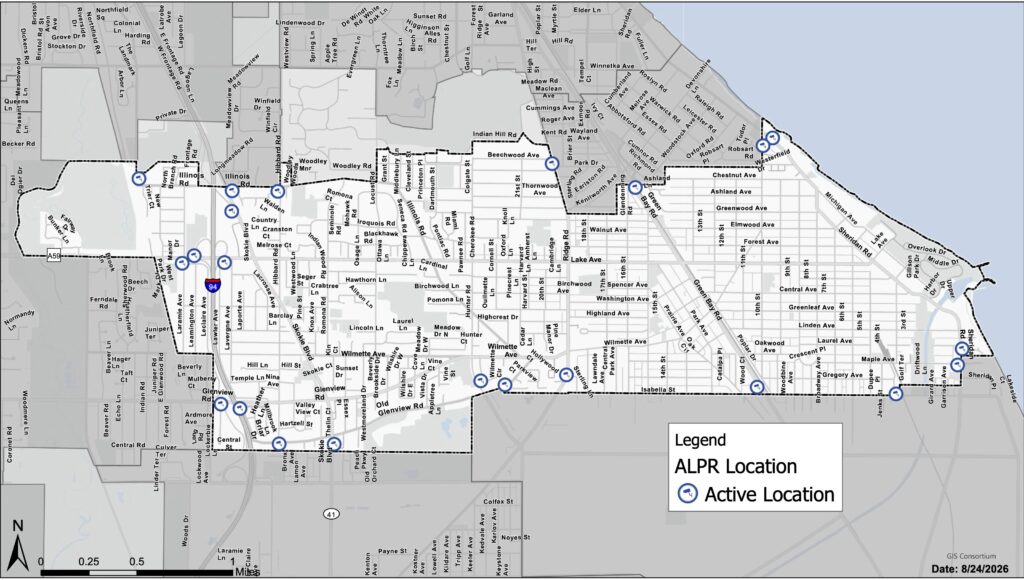
In 2022, Wilmette approved a contract for 22 license-plate readers from Flock Safety. Over the next four years, which included a first renewal in 2024, cameras were placed near entry points to the village, such as the Interstate-94 interchange on Lake Street and along Sheridan Road, where Wilmette police officials suspected criminal activity may enter the village.
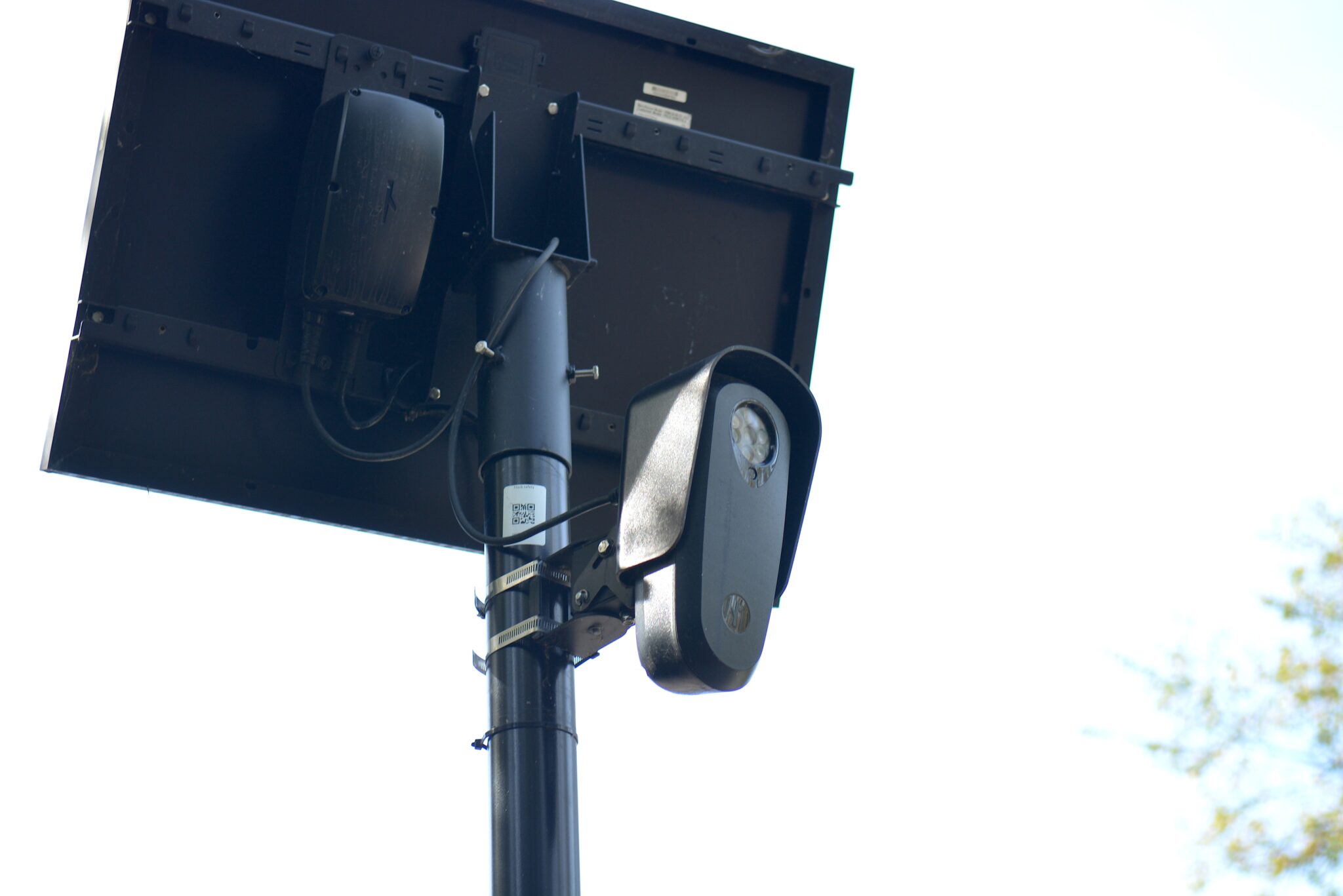
The cameras continuously take snapshots of passing vehicles and enter information, like license plate number, into a database that can, with certain guidelines set by communities that use them, allow the information to be shared with other users of the same system.
Nearby communities Highland Park, Winnetka, Northfield and Skokie also utilize the technology.
But the systems and Flock Safety have generated controversy, amid worries by residents and privacy activists that the surveillance technology can be and has been misused by law enforcement. Local and national incidents have included ALPR information being used to track ex-girlfriends and conduct federal immigration stops. Uses like that are illegal in the state of Illinois.
The Village Board reportedly heard via email from as many as 20 residents who opposed a new contract with Flock.
In Highland Park, which adopted the use of 22 cameras in 2023, activists have gathered more than 1,000 signatures demanding that the cameras be removed.
In Skokie, which has at least 27 cameras affixed to utility poles, residents who spoke at a September Village Board meeting, expressed concerns, leading officials to plan a comprehensive review of the system.
To the Village Board
In their report to Village Manager Mike Braiman and the board, Robinson and Deputy Police Chief Michael Clark said that, while many agencies allow their Flock data to be accessed by any law enforcement agency in the country, and others may limit sharing to Illinois law enforcement agencies, Wilmette does neither.
Instead, Wilmette only shares the data with neighboring communities that have signed a memorandum of understanding that requires them to abide by certain policies. That includes Glenview’s 911 dispatch, Glencoe, Lincolnwood, Morton Grove and Niles.
Other neighboring communities that have not signed on to Wilmette’s MOU reportedly don’t have access to the information, all of which is required to be erased after 30 days.
Many of the village’s policies for the camera data come from recommendations by the American Civil Liberties Union, and during the Nov. 10 meeting, officials praised the policies’ toughness.
“I don’t know that there is any jurisdiction anywhere in the country that has tighter controls of its (license-plate reader) data than Wilmette,” Trustee Michael Lieber said. “We should actually be really proud of the police chief and the previous board … for the thoughtfulness to put these in place.”
During his presentation, Robinson explained that the Flock system and data is regularly audited and those audits have not uncovered any policy violations, misuses or privacy concerns.
Robinson also explained that the cameras were installed with a rise in property crimes, such as car and residential burglaries, in mind. He reported that Flock data has “played a role” in 60% of residential burglary investigations in the community over the past two years.
Also, he credited the cameras for cutting the time it takes to recover a stolen vehicle by more than half, citing the 2018-’19 recovery average of 10.5 days and the 2024-’25 average as 4.06 days.
Robinson said the cameras contributed to many successful Wilmette investigations, including an armed robbery in 2024, residential burglaries in 2025 and 2026, and a missing person in 2026.
Despite the successes, Kennedy does not see the benefits of the technology significantly outweighing the risks it places on certain people.
“Right now a lot of people feel vulnerable,” Kennedy said, “and we are not violating their privacy in a legal sense but I don’t like to do things unless it is overwhelmingly clear that we get more benefit than the harm it could inflict and I just don’t feel that way about this.”
Steen shared similar thoughts and said his hesitations have much more to do with the provider than with the Village of Wilmette.
“For me this all comes down to trust,” Steen said. “I have a strong degree of trust in the Wilmette Police Department and I trust our village. I don’t trust the Flock [Safety] company. And don’t trust the federal government and it hurts me to say that. … If the system isn’t working, then I don’t think I get to the point where it’s more useful to have this data than not.”
The Record is a nonprofit, nonpartisan community newsroom that relies on reader support to fuel its independent local journalism.
Become a member of The Record to fund responsible news coverage for your community.
Already a member? You can make a tax-deductible donation at any time.

Joe Coughlin
Joe Coughlin is a co-founder and the editor in chief of The Record. He leads investigative reporting and reports on anything else needed. Joe has been recognized for his investigative reporting and sports reporting, feature writing and photojournalism. Follow Joe on Twitter @joec2319

Kathy Routliffe
Kathy Routliffe reported in Chicago's near and North Shore suburbs (including Wilmette) for more than 35 years, covering municipal and education beats. Her work, including feature writing, has won local and national awards. She is a native of Nova Scotia, Canada.
The Record is a nonprofit, community news site from former editors of 22nd Century Media
Our daily coverage of your government, schools, businesses and neighbors is not possible without your support.
Latest

The Record: Shortcut
Related Stories