

58-unit development advances, but lack of affordable housing splits Skokie trustees
Plans for a 58-townhome development near the Oakton Yellow Line stop in Skokie are moving forward after a divided Village Board (4-3) supported preliminary approval on Monday.
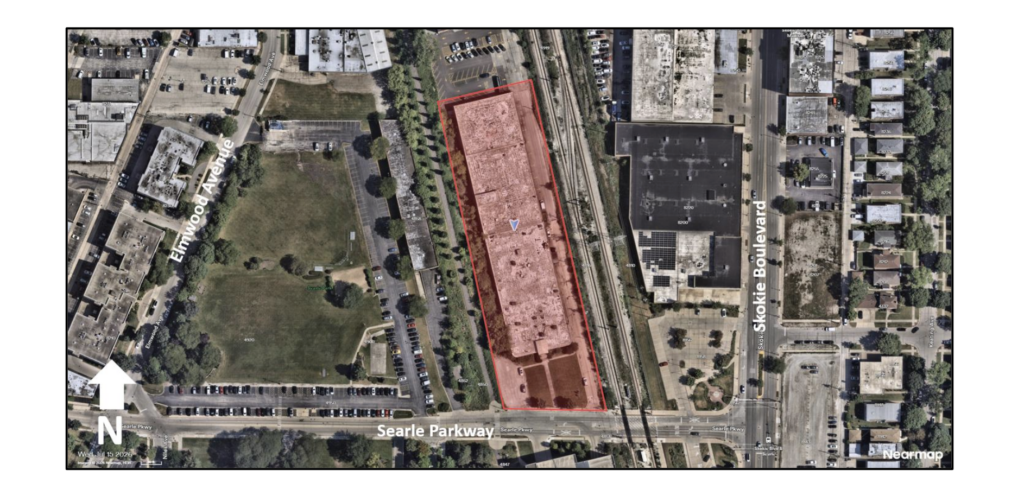
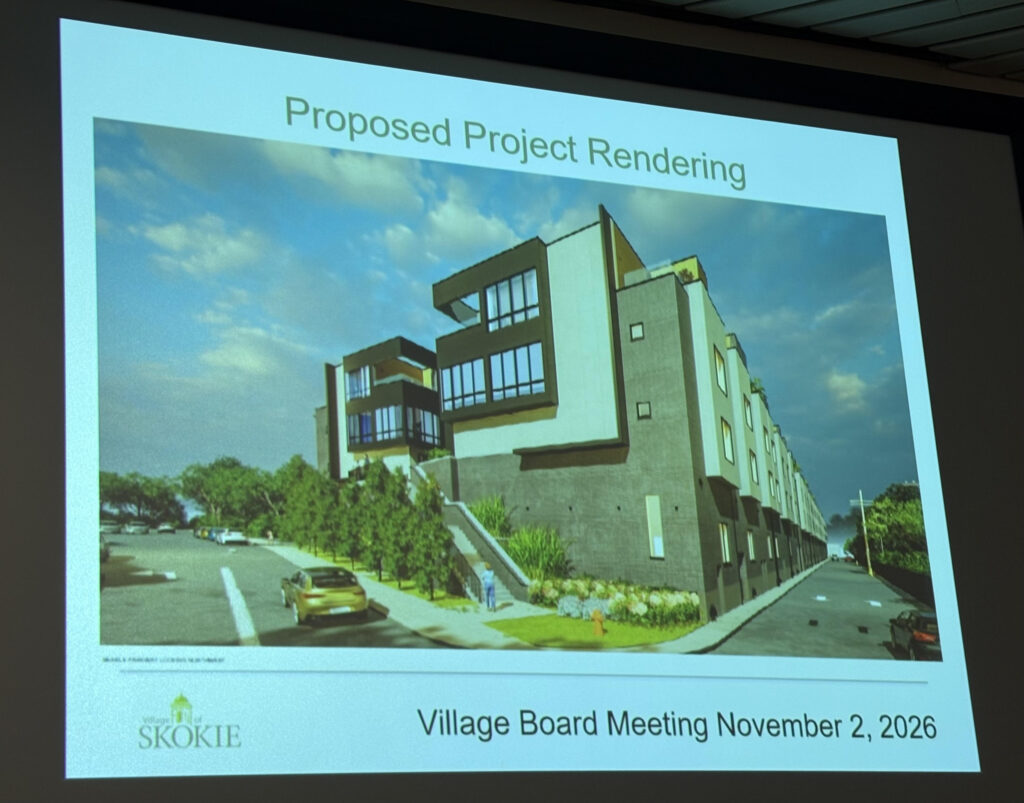
The Millo Group II, a company registered in Skokie, is requesting the trustees’ approval to build a four-floor, 58-unit residential rental complex at 4820 Searle Parkway.
Village staff and the Skokie Plan Commission recommended the Village Board back the project, which would require rezoning the site from “light industry” to a “transit mixed-use district” and consolidating seven parcels at the site into a single 5-acre plot, village documents show.
Much of the Village Board’s discussion during a Monday, Nov. 2 meeting, however, hinged on whether to grant the developer’s request to pay the village $300,000 in lieu of maintaining three affordable housing units, defined as units with below-market rent in line with 60-80% of the area’s median income.
Trustees Alison Pure Slovin, Jim Iverson and Keith Robinson voted in favor of granting the fee-in-lieu and providing a final reading to the project at a future Village Board meeting. Trustees Kimani Levy, Gail Schechter and Lissa Levy dissented.
Mayor Ann Tennes cast the deciding vote in favor of the fee-in-lieu but said the board “has work to do” on its Inclusionary Housing Ordinance, which is designed to require developers provide at least 5% of their residential units as affordable housing. The board will revisit the law in January 2027, she said.
The proposed development would expand on an existing vacant building at the site and provide an interior parking lot with at least 116 spaces; each residential unit would be approximately 3,375 square feet, and all but five units would feature four bedrooms and four bathrooms, village documents show.
Dorel Ardelean, a co-founder of The Millo Group, told the Village Board he has developed upward of 50 properties in the Chicago area and estimated that the four-bedroom residential units in this project would be available for rent for $6,500 a month.
Skokie’s Plan Commission discussed how the site is less than half a mile from the Oakton Yellow Line stop, “as well as the property’s extended vacancy and the potential in redevelopment to reinvest in the site and support continued economic stability and expansion in the downtown area,” village documents state.
The ordinance allows the Village Board to consider and vote on requests from developers who want to pay a fee in lieu of including affordable housing units. The paid fees are supposed to enter a “housing fund” the village created this year to support housing for low- and moderate-income applicants.
Patrick Deignan, Skokie’s director of communications, said only one development has been formally subject to the Inclusionary Housing Ordinance since it was enacted in May 2024 — a 68-townhome development that won the Village Board’s approval in February to pay a fee-in-lieu.
Schechter, a director of a housing-focused nonprofit, questioned why the Millo Group could not include affordable housing units and, following the general guidance that housing costs no more than 30% of one’s income, said that a renter would need a salary of $230,000 to live in this project.
Likewise Lissa Levy said the project would undermine Skokie’s economic diversity priority amid an affordability crisis and argued it would “reduce accessibility” in Skokie because it is located near a train hub but the majority of its residents would likely be able to afford cars.
Levy also criticized the project for primarily offering four-bedroom apartments instead of including smaller units, and she questioned that the company’s market research indicated the development would satisfy Skokie’s housing needs.
Nick Ftikas, an attorney for Delean, said that offering three affordable housing units would mean losing out on more than $163,000 of annual revenue, or $3.9 million of revenue over the course of the company’s 25-year construction loan for the project.
Ftikas said that was more than 10% of the project costs and was “too high of a risk for the bank to feel comfortable” supporting The Millo Group’s loan request.
“If the housing units are provided on site, it’s not that we don’t want to; it’s that we don’t believe we’re going to have the lender give us the money to do the project. So it really becomes a financeability issue and not us trying to avoid an obligation to provide affordable housing,” Ftikas said.
Indicating support for the project, Pure Slovin said “large families are also important” and looking for accommodation in Skokie. Robinson said there are families in Skokie who make $234,000 and may prefer this type of housing.
“On this particular project, I don’t see a way to achieve affordable units in this building unless the entire process is done over,” Iverson said. “Now, that is not something I would support because we assume that if we undo everything, start from scratch, that that will work despite any evidence.
“The fact is what you’ve got as a project that has been approved by a wide array of professionals and it works if we have a fee-in-lieu, and that’s why I support it. I also support making the changes necessary so that we actually do develop new affordable housing in this village.”
Emi Yamauchi, a Skokie resident, said she was appalled her representative would “sell Skokie up so cheaply” and the development would create “another massive luxury bubble” in the village. She added “this Village Board always says the right things, but I think it’s really time it does the right thing.”
Johanna Nyden, Skokie’s director of community development, said the proposal fulfills some of Skokie’s strategic plan as it reuses an existing building and creates housing near transportation but noted this is “very challenging site” to develop given its narrow depth and industrial surroundings.
“It’s a vacant building right now,” Nyden said. “That is not the highest and best use for that property.”
The Record is a nonprofit, nonpartisan community newsroom that relies on reader support to fuel its independent local journalism.
Become a member of The Record to fund responsible news coverage for your community.
Already a member? You can make a tax-deductible donation at any time.

Samuel Lisec
Samuel Lisec is a Chicago native and Knox College alumnus with years of experience reporting on community and criminal justice issues in Illinois. Passionate about in-depth local journalism that serves its readers, he has been recognized for his investigative work by the state press association.
The Record is a nonprofit, community news site from former editors of 22nd Century Media
Our daily coverage of your government, schools, businesses and neighbors is not possible without your support.
Latest

The Record: Shortcut
Related Stories