$1 million payment replaces affordable homes in plan for 245-unit Old Orchard project
When construction eventually finishes and the two office towers near the Old Orchard shopping center in Skokie are converted into apartment complexes, the buildings will not offer any affordable housing units.
The Skokie Village Board voted 4–2 on Tuesday to grant revisions to the previously approved project’s site plan and affordable housing accommodations.
Trustees Gail Schechter, Keith Robinson, Jim Iverson, Alison Pure Slovin voted in favor of the site plan’s revisions. Trustees Kimani Levy and Lissa Levy voted against them.
Instead of providing six residential units, or 5% of the 120 apartments inside the project’s south tower, at a cost of 120% of the area’s median income for 25 years, the property owner — officially listed as 5250 Old Orchard — will pay $1 million into the village’s Housing Fund.
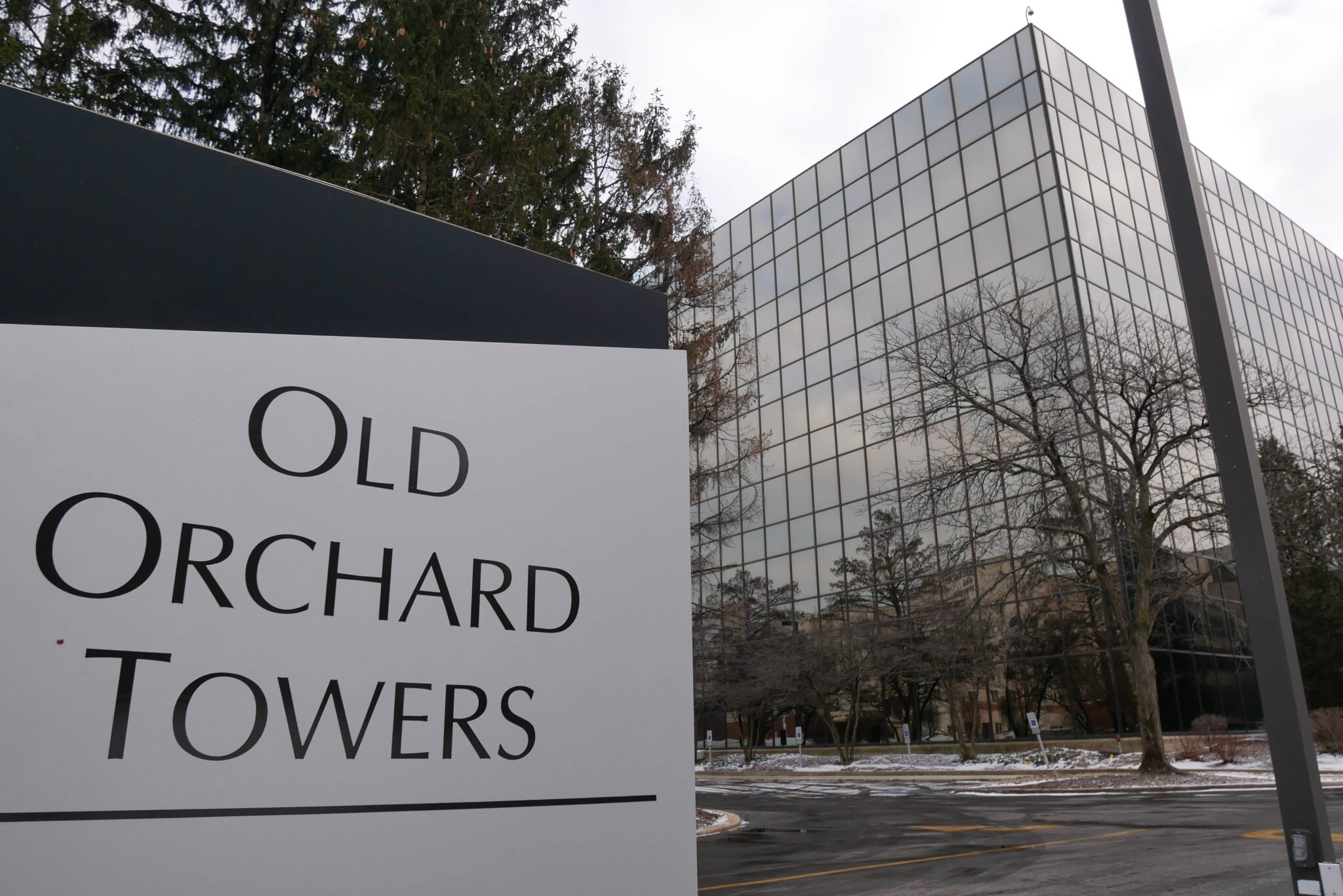
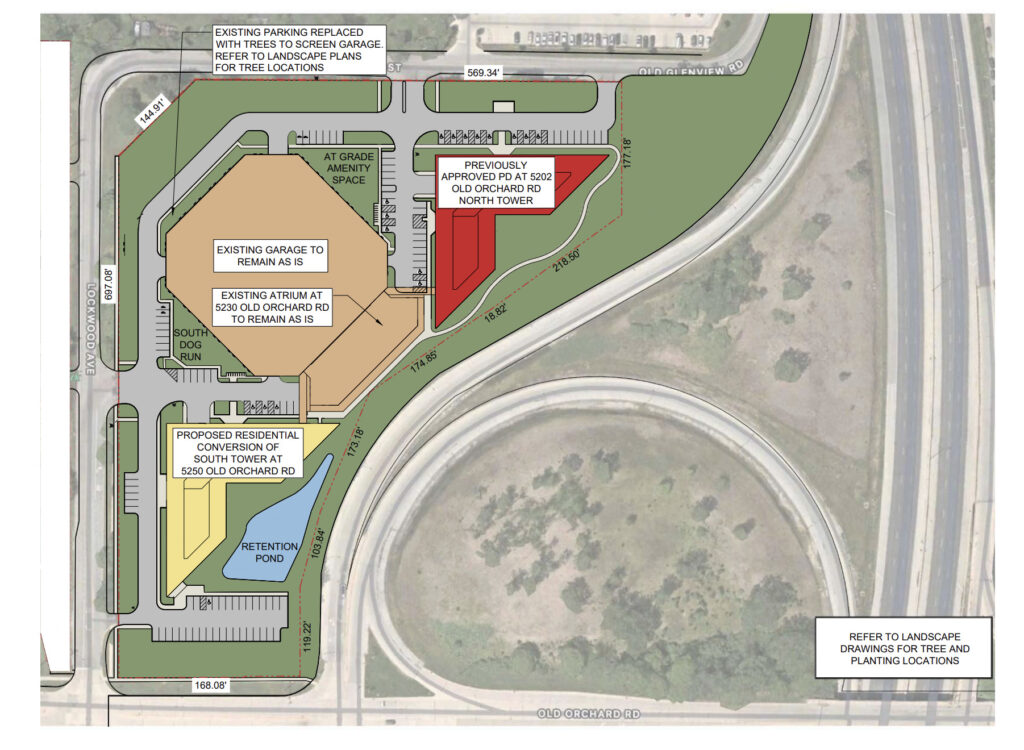
The Village Board originally voted in April 2024 to approve a petition from a different developer, Zeller OOT, to convert the two mostly vacant seven-story office buildings at 5202 and 5250 Old Orchard Road into an apartment complex with 245 units.
Instead of being demolished, the buildings will gain a mix of one-, two- and three-bedroom units and recreational amenities and electric vehicle charging stations. An existing cancer treatment clinic at 5230 Old Orchard Road will remain on site.
Skokie’s Inclusionary Housing Ordinance, passed into law in May 2024, requires that all new residential projects offer at least 5% of their units to applicants at a cost of 60-80% of the AMI, or developers must pay a fee-in-lieu of units to the village’s Housing Fund.
While the affordable housing ordinance had not yet been passed at the time of the site plan’s approval, Zeller agreed in 2024 to offer 5% of the project’s south tower units at 120% AMI.
Trustee Schechter noted on Tuesday that 120% AMI of the Chicago area’s salary would translate to one-bedroom units renting for approximately $2,520 a month — a rate more akin to the market and not affordable for Skokie “in any stretch of the imagination.”
“The only reason I’m favorable to the fee-in-lieu is that this was not subject to our ordinance in the first place,” Schechter said. “I just want to be clear to anyone listening that 120% AMI is not affordable.”
The property owner proposed paying the village $400,000 for its fee-in-lieu once building permits are issued for the north tower, and $600,000 once the north tower is finished and building permits are issued for the south tower.
Alan Lev of the Belgravia Group — a real estate firm that partnered with the developer to take over the project from Zeller — said this request was made because the development has “a lot of front-end-loaded costs.”
Those costs, Lev said, include hiring architects and engineers, expanding onsite amenities and landscaping, and spending $500,000 to relocate the existing office tenants in the North Tower.
“The project at this point is just on the cusp of financially working,” Lev told the trustees. “We have a loan approval from First Bank Chicago and any more kind of tinkering or moving more money in the budget will put the project in peril.”
Lev noted the fee-in-lieu offered surpasses what’s mandated by the village’s affordable housing ordinance, which requires developers pay Skokie $150,00 for each affordable housing unit they are excluding from a new development containing 150 units or more.
Mayor Ann Tennes asked whether the developer could split the fee-in-lieu evenly and pay $500,000 once receiving the building permits for each tower; Lev affirmed the developer could accommodate that.
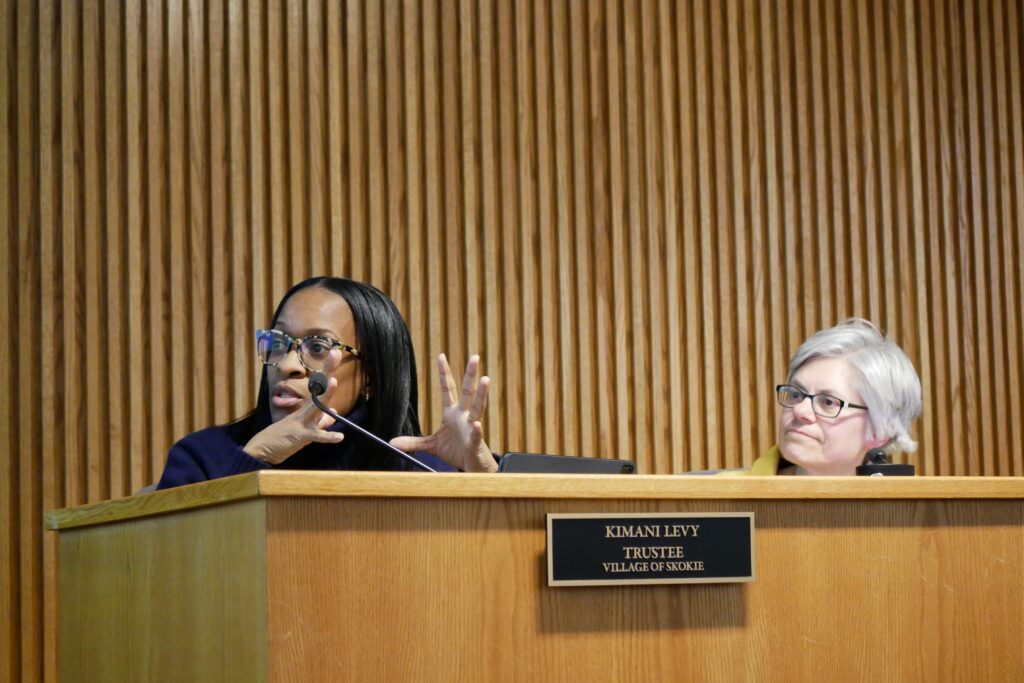
“I appreciate that the fee exceeds the minimum, but above and beyond should be measured by families that are housed and not necessarily the size of the check,” Trustee Kimani Levy said before voting against the revisions. “The outcomes matter more than the optics.”
Lev said he anticipates the project receiving its permits for the north tower in 2-3 months. He expects construction will begin at the north tower this summer and tenants will begin moving into the building in the summer of 2027.
The timeline for when rehab work at the south tower will begin is “totally unknown at this point,” Lev said.
Besides the development’s affordable housing plan, the revisions also concerned the project’s facade, landscaping and elevation.
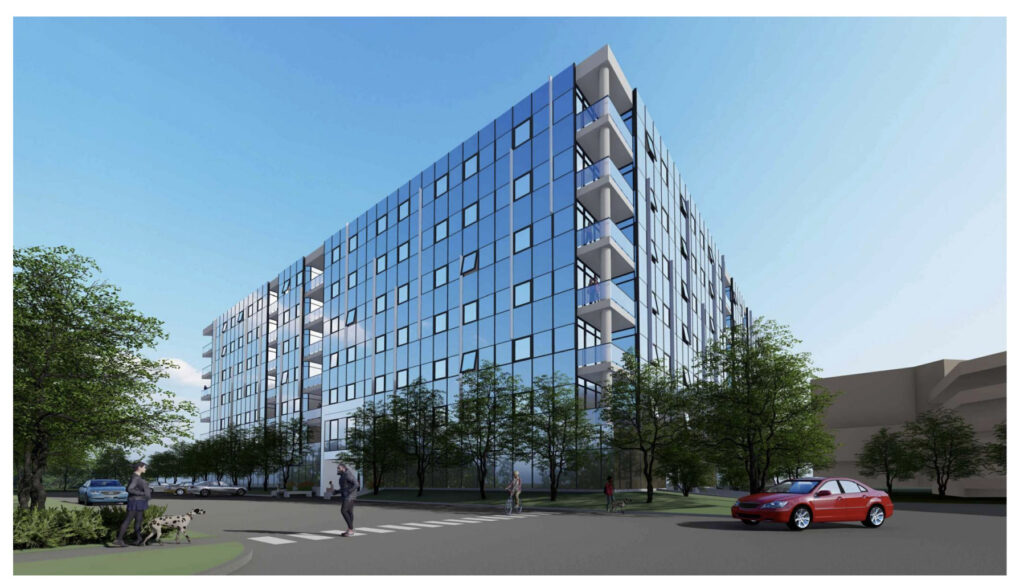
An amenity deck will be removed from the roof of an existing parking garage “due to structural concerns,” first-floor residential units will be relocated to higher floors, additional recreational amenities will enter the first floor and landscape plantings will be added for more screening, said Paul Luke, chairman of the Skokie Plan Commission.
Luke, Skokie’s corporation counsel and Community Development Director Johanna Nyden reviewed the request and it “was their opinion that the modification to the site is in substantial compliance with the intent of the original site plan approval,” village documents show.
Schechter asked why the requested revisions did not send the development’s site plan back to the Skokie Plan Commission for another review.
Nyden responded that the revisions did not increase the development’s density and noted that the site is on Skokie’s “most over-parked spot.” A traffic study showed the site will be “less intensive” with cars compared to when the site was exclusively commercial, Nyden said.
Village documents show that the Skokie Appearance Commission issued certificates of appropriateness after reviewing the proposed changes twice last year.
The Record is a nonprofit, nonpartisan community newsroom that relies on reader support to fuel its independent local journalism.
Become a member of The Record to fund responsible news coverage for your community.
Already a member? You can make a tax-deductible donation at any time.

Samuel Lisec
Samuel Lisec is a Chicago native and Knox College alumnus with years of experience reporting on community and criminal justice issues in Illinois. Passionate about in-depth local journalism that serves its readers, he has been recognized for his investigative work by the state press association.
The Record is a nonprofit, community news site from former editors of 22nd Century Media
Our daily coverage of your government, schools, businesses and neighbors is not possible without your support.
Latest

The Record: Shortcut
Related Stories