Nova festival survivor and murdered hostage’s aunt share their stories at JUF event, with The Record
(Editor’s Note: This article contains details of tragic and violent events. Please take care while reading.)
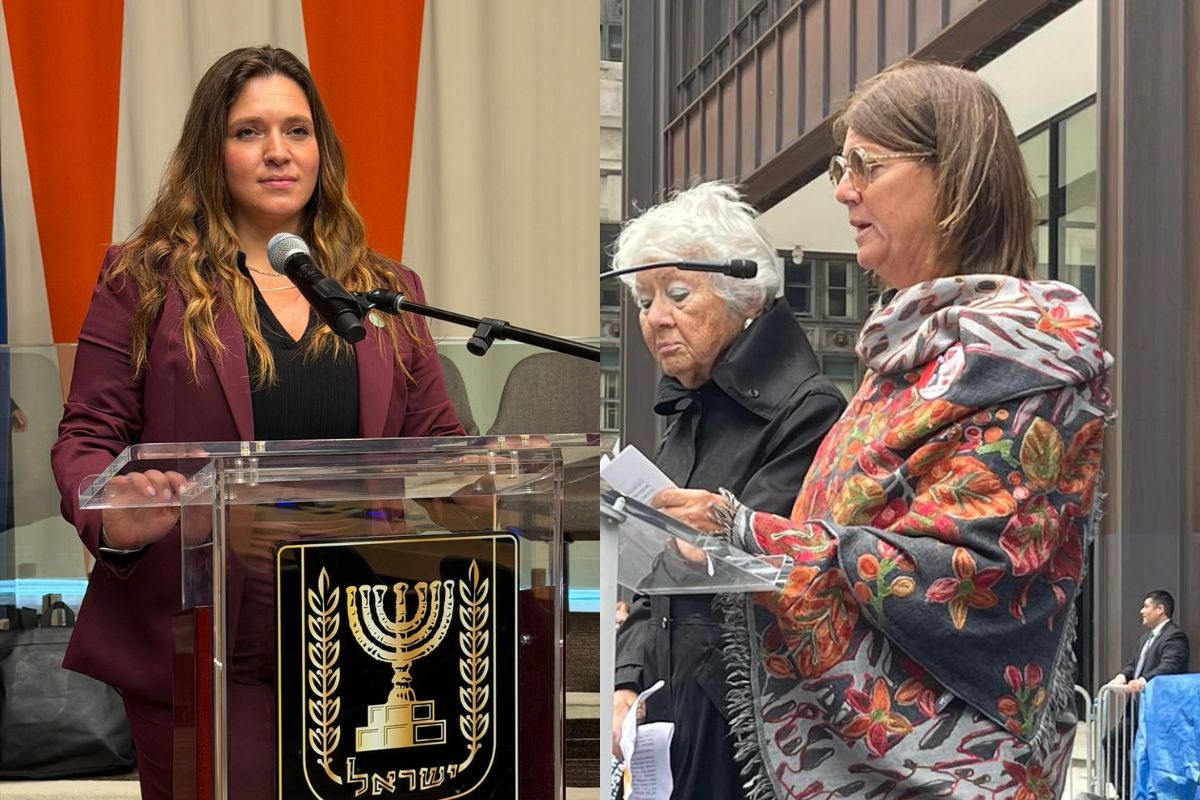
Hundreds of women gathered in Glencoe on Thursday evening, Nov. 13, for a moderated discussion with Noa Beer, Nova Music Festival survivor, and Abby Polin, North Shore resident and aunt of Israeli hostage Hersh Goldberg-Polin, who was murdered while in Hamas captivity.
The event, hosted by Jewish United Fund Women’s Philanthropy, offered attendees a rare opportunity to hear from two women who were directly and tragically impacted by the attacks of Oct. 7, 2023, when 1,200 men, women and children were murdered in Israel and another 254 were taken hostage.
At the time the JUF began planning Thursday night’s event, the release of the remaining living hostages, on Oct. 13 had not yet been brokered. To date, three bodies of deceased hostages are still held in Gaza.
“It’s so important to raise awareness about the hostages that we knew our event had to, in some way, feature this story,” said Elissa Kagan, associate vice president of JUF Women’s Philanthropy. “I hope [attendees] will take away the resilience that the Jewish people have, especially everyone associated with what happened on Oct. 7 …[and] pride in our organization. … We really want people to walk away feeling inspired and motivated to roll their sleeves up and get involved in some way.”
Approximately 365 attendees had registered as of Nov. 12, making it JUF Women’s Philanthropy’s largest outreach event to date in terms of registrants.
Prior to the event, The Record North Shore spoke to Beer and Polin, who have been tireless advocates for the release of the hostages and continue to raise awareness for the events of Oct. 7 and their aftermath.
Abby Polin
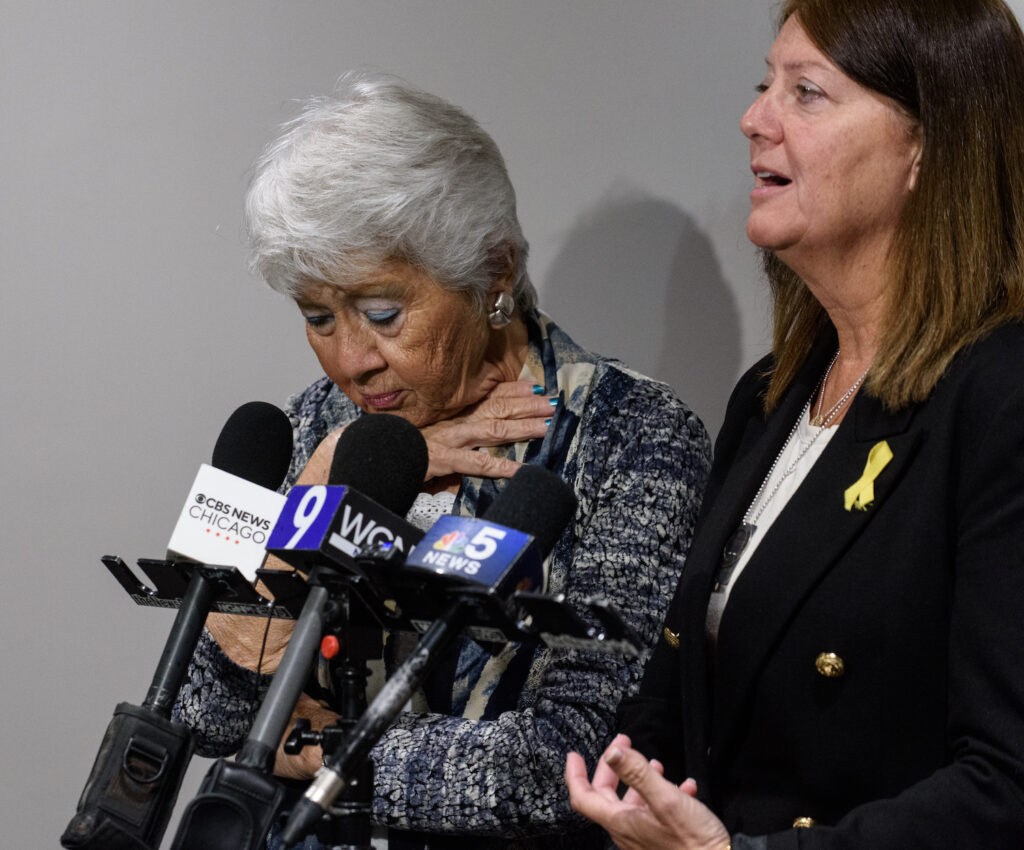
Alongside her brother and sister-in-law, Abby Polin, a member of the JUF Women’s Board, and her mother, Leah Polin, both North Shore residents born and raised in Chicagoland, have, as Kagan put it, “brought voice to the plight of all the hostages.”
Hersh Goldberg-Polin, Abby Polin’s nephew, was celebrating his 23rd birthday, which had just passed on Oct. 3, when he was taken hostage from the site of the Nova Music Festival.
Eleven months later, he was murdered in a Gaza tunnel alongside five of his fellow hostages, according to the Israeli military.
“He was pretty incredible and, really, in his very young age — I don’t even think he ever thought or realized this — had accomplished so much,” Polin said of her nephew. “And the legacy he left is hopefully the good he’s done in the world.
“Like his father, my brother, Jon Polin, said at his funeral, ‘May Hersh’s memory be a revolution for good.’ So, with all this revolution and all this craziness in the world, in Hersh’s case, it should be for good and the world learning to be able to do good deeds and good things to make the world a better place.”
Initiatives to honor the legacies of hostages who were killed in captivity have spread across the United States and locally in communities like Skokie, where a synagogue received the Goldberg-Polin family’s permission to set up Hersh’s Fridge, a kosher, outdoor community fridge open to the public 24/7 to take and share food as needed.
Abby Polin still wears a pin in the shape of a yellow hostage ribbon (which signals hope for their safe return), a dog tag that reads, “Bring them home now,” and a ring that reads, “We will dance again,” as she advocates for the release of the three remaining hostages whose bodies have yet to be returned to Israel for burial.
But even if the pins, rings and dog tags are put away, the work of raising awareness, she said, is far from over. She plans to continue to honor the victims’ legacies and speak on the lasting physical and emotional tolls of that day.
Noa Beer
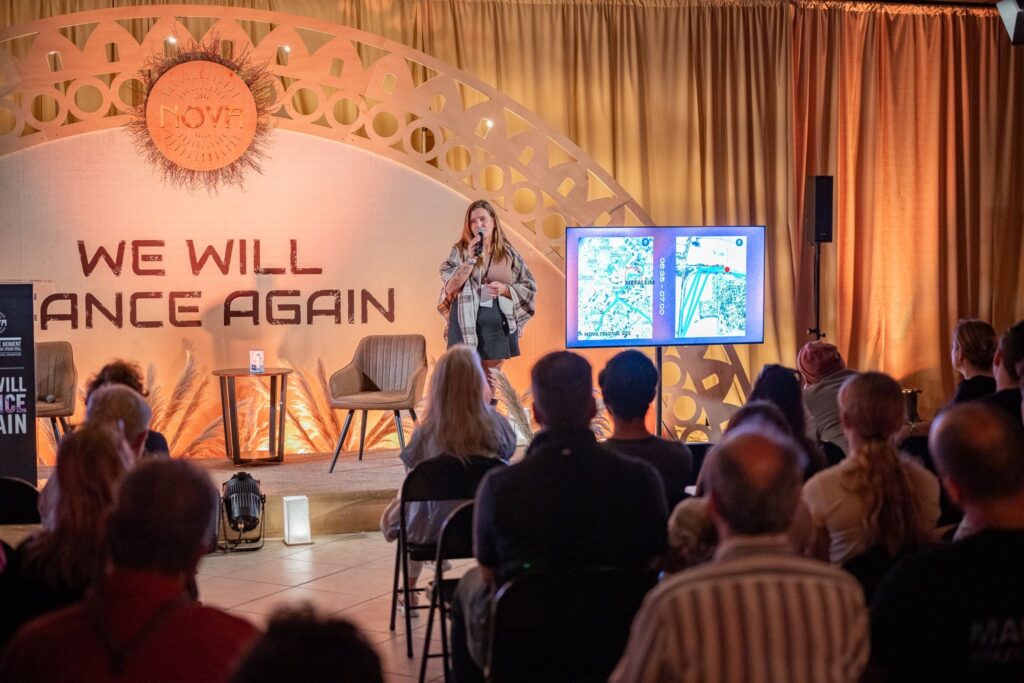
Beer is in Chicago not only for the JUF’s event but for the Nova Exhibition, a traveling, commemorative exhibition documenting the attack on the music festival that is currently at 1800 N Clybourn Ave. through Nov. 30.
She has been traveling with the exhibition through cities like Washington, D.C., Boston and L.A. and sees the exhibition not only as a commemoration but a tool and platform for combating antisemitism.
“We’re just human beings that went to a festival on a Saturday morning and came back, now without 413 of our friends,” she explained of the festival, which drew festivalgoers from several countries. “So, [the exhibition] just shows the human side of it. … I always say, this could have happened at Coachella or Burning Man, but it happened to us.”
For Beer, then a booking agent, Oct. 7 started off rather ordinarily. She took a Hungarian DJ to the site of the Nova Music Festival at 2:45 a.m., the DJ played from 4:45 to 5:45 a.m. and then asked to stay a bit as he was enjoying himself. Beer was happy to oblige, she said, and dance with her friends.
At 6:20 a.m., she went back on the stage, where a friend of hers was playing a set. She used her phone at 6:28 a.m. to take a video for his social media.
“When I stopped filming, I put the phone in my pocket, and the security guard grabbed my hand on stage, and he pointed towards the sky,” she said. “There were hundreds of missiles.”
As Israel’s Iron Dome intercepted them, she told the producer on stage to cut the music and went to find the DJ she had been accompanying. She informed him to lay on the ground until the missiles stopped —typically a minute or two, according to Beer.
But these kept going, she said, for an estimated six or seven minutes. The festival’s security manager told the crowd to evacuate the festival grounds and seek shelter.
Beer and the DJ ran to the car. She drove quickly — anticipating traffic as there was only one road leading out of the festival site — but hers was one of the first cars out.
She drove for approximately 10 minutes when she said the two cars in front of her collided at a bend in the road. As the first car started to turn, the second car rammed into it. She exited her vehicle to check on those in the accident.
“I opened my car door, and that’s when the first bullet flew right next to my face, and then another bullet, and bullets started hitting the car, and I looked up, and about 20 meters in front of me was a man,” she explained. “He was dressed in an [Israeli Defense Forces] uniform, but he was looking at me and shooting at me, which was very confusing.”
Beer instructed the DJ to get out of the car and crouch behind the door.
“I was crouching behind the car door … and then a bullet scraped the inside of my leg,” she said. “I could feel it came from behind. I turned, and there was another terrorist behind me. He was very close to me, and he was looking at me and smiling and shooting.”
Beer said she looked around for somewhere to hide, but she estimates another 20 to 30 Hamas terrorists were approaching from the nearby fields.
“For a moment, I thought that this is it, this is how I die” she said. “And I literally felt like I was dead; if I couldn’t feel any pain, then I’m probably dead. And then a man, one of the people from the cars in front of me, crawled next to me, and then he screamed.”
That is when Beer said she sprung into action. She told the DJ to get back in the car. Others joined — two men got into the backseat along with an injured woman they’d helped who had been hiding underneath another car.
Hamas terrorists blocked the road, so she turned the car around. What she saw next has stuck with her. Hamas had lined both sides of the street.
“People were running in between the cars and falling to the ground, and there was blood on the road, and cars were already burning,” she said, “and I knew that I needed to drive through a wall of bullets, but I had to do it, because if we stay here, we’re dead for sure, and I’d rather die trying than just let death come to me.”
Bullets flew in the car, Beer explained, injuring the people in the backseat.
As she drove to the emergency room, Beer called the festival site to warn them as well as an ambulance, but she said no one at the time seemed to be aware of the situation. Fifteen minutes or so later, however, ambulances began to arrive carrying people from the festival and its surrounding areas.
Beer spent hours at the hospital helping people gather information about their loved ones, handing out water and offering her support, before a volunteer drove her and the DJ back to central Israel.
Since then, she has been speaking out.
“Me and everyone in my car, we survived, and everyone is safe and everyone is well, but no one else from that stretch of road made it out of there that day,” she said. “And I had a lot of survivor’s guilt, and I had a lot of questions that had no answers, like, ‘Why me?’ And, ‘Why did I survive?’ And, ‘Why didn’t I wait another minute?’ And … ‘How come I didn’t help more people?’
“I felt very selfish, and I blamed myself. And then I realized that I have this tool, that I have this ability to tell this story to the world, and that is my purpose. And that’s what keeps me sane: knowing that I’m able to give a voice to the people who were murdered that day, that I’m able to speak for the survivors who are still incapable of speaking or sharing their stories, and that I can make some difference to the world if I keep telling this story.
“If I have to tell it 1,000 times, I will, because I know that’s the only way to make sure something like this never happens again. So, the strength comes from knowing that there’s a purpose to me staying here, and that there needs to be a purpose for me surviving this. And this is the purpose: For me to be able to make a change in the world.”
It’s a sentiment shared by Polin. Two years on, they both expressed the importance of continuing the conversation, for all those impacted by Oct. 7 and, they said, to bring about positive change in the world.
“For people, two years sounds like a long time, but I relive this every day like it happened yesterday,” Beer stressed. “We are fighting for our mental health. It’s important to us to be able to tell that story again and again, to make sure that people don’t forget that this happened, to make sure that it doesn’t happen again.”
Yet, still, there is hope.
“It’s incredible to see the people who went through what we went through — and that our whole lives have become to spread love and spread light,” Beer said. “And, to make sure that no more hate is spread in the world.”
The Record is a nonprofit, nonpartisan community newsroom that relies on reader support to fuel its independent local journalism.
Become a member of The Record to fund responsible news coverage for your community.
Already a member? You can make a tax-deductible donation at any time.

Zoe Engels
Zoe Engels (she/her) is a writer and translator, currently working on a book project, from Chicagoland and now based in New York City. She holds a master's degree in creative nonfiction writing and translation (Spanish, Russian) from Columbia University and a bachelor's in English and international affairs from Washington University in St. Louis.
The Record is a nonprofit, community news site from former editors of 22nd Century Media
Our daily coverage of your government, schools, businesses and neighbors is not possible without your support.
Latest

The Record: Shortcut
Related Stories