Trustees favor dedicated bike lanes, altered trail crossing, more for Lake Avenue
Progress on a project that Wilmette officials believe is an “opportunity to make some transformational changes” to the village’s roadway system continues to travel forward.
Wilmette trustees during their Tuesday, Oct. 28 meeting directed staff to move ahead with four design elements for the much-anticipated Lake Avenue Improvement Project.
As previously reported by The Record, Wilmette was awarded a $5 million grant in early 2024 to make improvements to Lake Avenue between Green Bay and Sheridan Roads.
“The purpose of this project is to improve bicycle and pedestrian safety along Lake Avenue by incorporating recommendations from the master bike and active transportation plan, which is consistent with complete street initiatives that require us to look at opportunities to make corridors multimodal as part of any improvement,” Melissa McGee, of Christopher B. Burke Engineering, told trustees during the meeting.
McGee later added that additional project goals include improving safety at the intersection of Lake Avenue, 11th Street and Wilmette Avenue, addressing poor pavement conditions and addressing aging water main infrastructure as part of the roadway improvements.
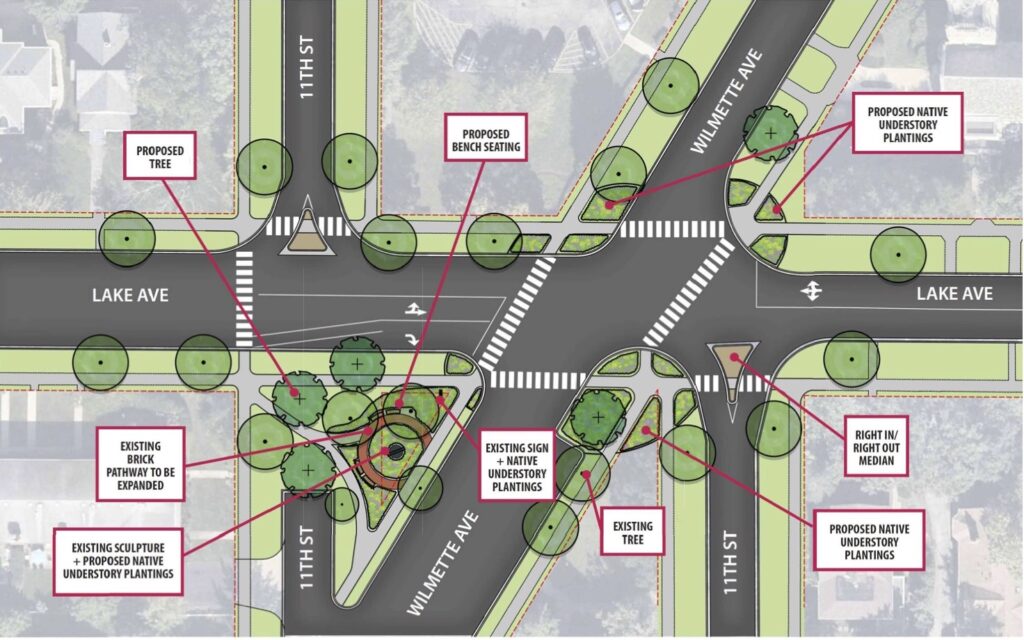
The first design point trustees reached consensus on is what was described as an enhanced stop-controlled intersection at Lake, Wilmette and 11th, a point that Brigitte Berger-Raish, Wilmette’s engineering and public works director, described as a “complex, five-legged intersection that has a very high accident history.”
According to McGee, the Illinois Department of Transportation categorizes that intersection in its current iteration as a “high safety tier,” a designation that classifies the intersection in the agency’s second-highest listing for safety improvements.
Project planners reviewed five years of crash data in the scope area and determined that 93 collisions have happened during that span, McGee said, noting that approximately 33% of those accidents occurred at the Lake, Wilmette and 11th intersection.
The data, McGee told the board, “speaks to the need to make improvements at the intersection.”
The proposed improvements would remove access from the southwest leg of 11th Street and convert access at the northwest and southeast legs of 11th to right-in, right-out movements and would convert the southwest leg of 11th to a cul-de-sac, McGee said, noting that doing so eliminates the left-turn conflict points at the street legs.
This “enhanced stop-controlled intersection” would reduce the number of vehicle conflict points from 80 to 24, according to village documents.
Planners also say that adjustments to curb alignment at several corners will also improve pedestrian safety by “increasing visibility and reducing crosswalk distances.”
McGee told the board that the improvements would have no impact to trees or parking and would not require any right-of-way acquisition.
The pedestrian crossing distances would be shortened by a third, and this plan would be less impactful to the adjacent historic district. It also has the smallest preliminary estimated constructed cost compared to other considerations for the intersection, McGee added.
Updates will also include a realignment of the Green Bay Trail crossing. The trail will be shifted slightly to the east to cross Lake Avenue perpendicularly, officials said.
The two existing crosswalks will be consolidated into one. Planners say doing this will also shorten the crossing distance, enhance visibility of pedestrians and bicyclists and provide more distance between the railroad tracks and the crossing. The pavement will also be marked green to reinforce the trail crossing.
“Painting these areas provides the benefit of a clear visual clue for drivers to know there’s bike facilities here,” McGee said.
Dedicated bike lanes
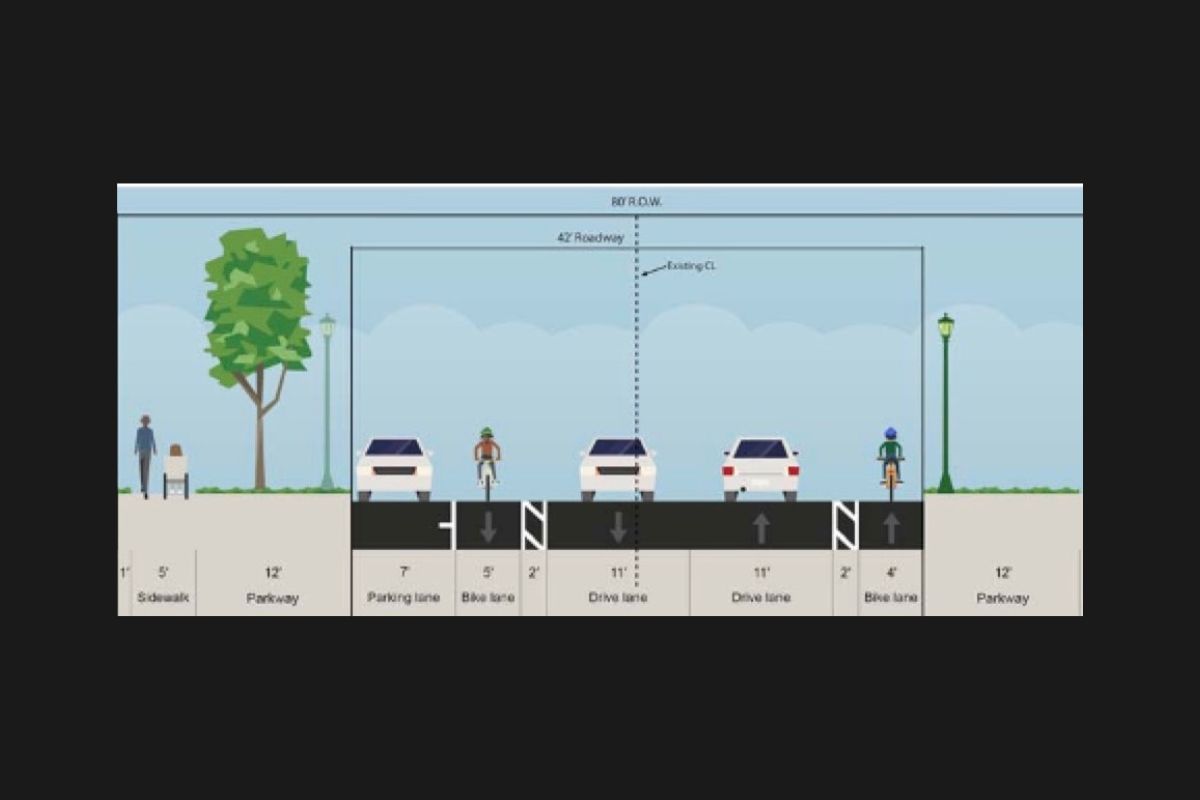
The third design element trustees favored is preparing dedicated striped bike lanes on Lake from Green Bay Road to Wilmette and 11th.
This new road configuration will feature dedicated striped bike lanes with a striped parking lane along the north side of Lake Avenue, according to project information posted on the village’s website.
Officials say this element will bring in a “road diet,” a term generally used to refer to transportation planning that reduces the number of vehicle lanes on a road to make way for other modes of transportation.
Designs call for converting the current four lanes of travel to two, one in each direction, as a way to calm traffic by “slowing traffic speeds and organizing traffic into single lanes,” per village documents.
The portion of Lake Avenue from Wilmette and 11th to Sheridan Road will largely remain how it exists today, officials said, but noted a striped lane line for the existing parking on the north side of the street and some curb extensions at “key intersections” will be added.
Berger-Raish said that officials opted to break this into two different design elements because the geometry of Lake Avenue changes from the west section and the east section.
The west side, from roughly Green Bay Road to Wilmette Avenue, is wider, Berger-Raish said, noting that is why officials are proposing dedicated bike lanes with a striped buffer there.
East of there, from Wilmette Avenue down to Sheridan Road, changes are mainly related to adding bike pavement markings.
The proposed bike lanes between the Green Bay Trail and Wilmette Avenue will provide an “important connection between highly utilized routes,” McGee said.
Wilmette’s transportation commission previously voted against including bike accommodations, but the village’s municipal services committee and village staff recommend incorporating the accommodations as they were included in the 2021 approved master bike and transportation plan and connect the existing bike network from the Green Bay Trail to Wilmette Avenue, which connects to Plaza del Lago, McGee said.
From here, officials are next hoping to submit draft project reports to IDOT for design approval in late 2025. Phase II design work is then anticipated to begin sometime in late 2026 with the hope of construction planned for either 2028 or 2029.
The Record is a nonprofit, nonpartisan community newsroom that relies on reader support to fuel its independent local journalism.
Become a member of The Record to fund responsible news coverage for your community.
Already a member? You can make a tax-deductible donation at any time.

Martin Carlino
Martin Carlino is a co-founder and the senior editor who assigns and edits The Record stories, while also bylining articles every week. Martin is an experienced and award-winning education reporter who was the editor of The Northbrook Tower.
The Record is a nonprofit, community news site from former editors of 22nd Century Media
Our daily coverage of your government, schools, businesses and neighbors is not possible without your support.
Latest

The Record: Shortcut
Related Stories