

West Nile infection rates at ‘historic’ levels in North Shore
Local agencies are alerting residents of a “historic” surge in the presence of West Nile virus in area mosquitoes.
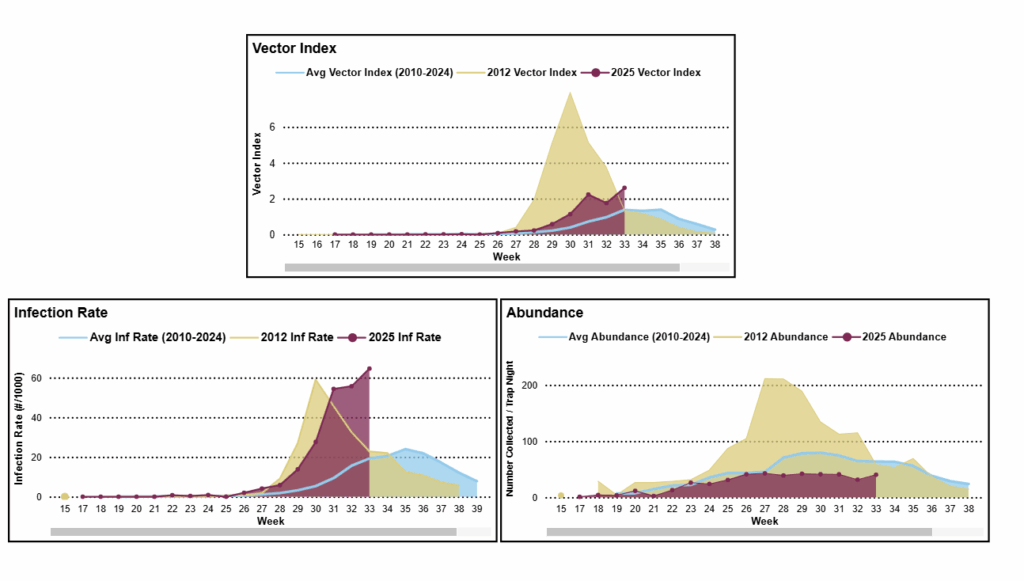
According to data from the North Shore Mosquito Abatement District, 6.5% of recently trapped mosquitoes tested positive for West Nile virus — the highest infection rate in the district’s 20-year history of testing (previous high: 5.9% in 2012, the last outbreak year).
Though the West Nile infection rate is high, the quantity of mosquitoes is “quite low,” keeping the risk to humans “moderate” at this time, said Mark Clifton, executive director of the mosquito abatement district.
The Cook County Health Department has identified two human cases of West Nile virus, neither of which came out of the North Shore abatement district coverage area. The City of Chicago has reported three such cases.
Human cases of West Nile typically are more prevalent in August and September.
Clifton and his team are recommending residents remain vigilant through the surge, which his team predicts will last two to three weeks. He expects rates to then drop through the end of mosquito season (September).
“If you are ever going to wear DEET, now is the time,” Clifton said. “It’s about preventing interaction between you and mosquitoes, because one in 10 will have West Nile.”
West Nile virus is a disease transmitted by mosquito bites that causes fever, headache, body aches, vomiting, diarrhea or rash, according to the CDC. Although it can be asymptomatic, about 1 in every 150 people affected develop a serious illness, which in some cases can be fatal.
The North Shore Mosquito Abatement District sets mosquito traps throughout its coverage area each season. The district then tests the trapped specimen, tracks West Nile data, communicates with the community and adjusts abatement efforts.
The district combines two measurements — infection rate and mosquito “abundance” — into a third measurement, vector index, to track West Nile risk. The most recent vector index is 2.61, lower than the threshold for a “high risk” designation (3.01), but higher than the average vector index at this time of year (1.38). The district’s highest vector index of 7.92 was recorded in July 2012.
A surge in West Nile is being tracked across Chicagoland.
The Cook County Health Department reported on Aug. 12 a “high” risk of human infection. The department’s data shows that 74% of recent mosquito samples (which are made up of hundreds of mosquitoes) tested positive for West Nile virus. That number eclipses numbers from 2012, the last outbreak year.
Clifton said the higher temperatures are likely contributing to the higher West Nile infection rates.
“West Nile and other diseases are driven a lot by temperature,” he said. “Warm temperatures make everything (in the mosquito development process) happen faster. … Warming average temperatures could cause a more severe situation. This summer we’ve had multiple heat waves and even the nights are very warm.”
Seeing West Nile rates begin to climb this summer, Clifton said, the district increased its larva control treatments in July “to further reduce adult mosquito emergence.”
The abatement district recommends using an EPA-registered insect repellent when outside, as well as wearing proper attire (loose-fitting long sleeves and pants) and removing potential sources for pooling water on and around your home.
Among its services, the district also inspects properties for mosquito activity upon request.
The Record is a nonprofit, nonpartisan community newsroom that relies on reader support to fuel its independent local journalism.
Become a member of The Record to fund responsible news coverage for your community.
Already a member? You can make a tax-deductible donation at any time.

Joe Coughlin
Joe Coughlin is a co-founder and the editor in chief of The Record. He leads investigative reporting and reports on anything else needed. Joe has been recognized for his investigative reporting and sports reporting, feature writing and photojournalism. Follow Joe on Twitter @joec2319
The Record is a nonprofit, community news site from former editors of 22nd Century Media
Our daily coverage of your government, schools, businesses and neighbors is not possible without your support.
Latest

The Record: Shortcut
Related Stories