
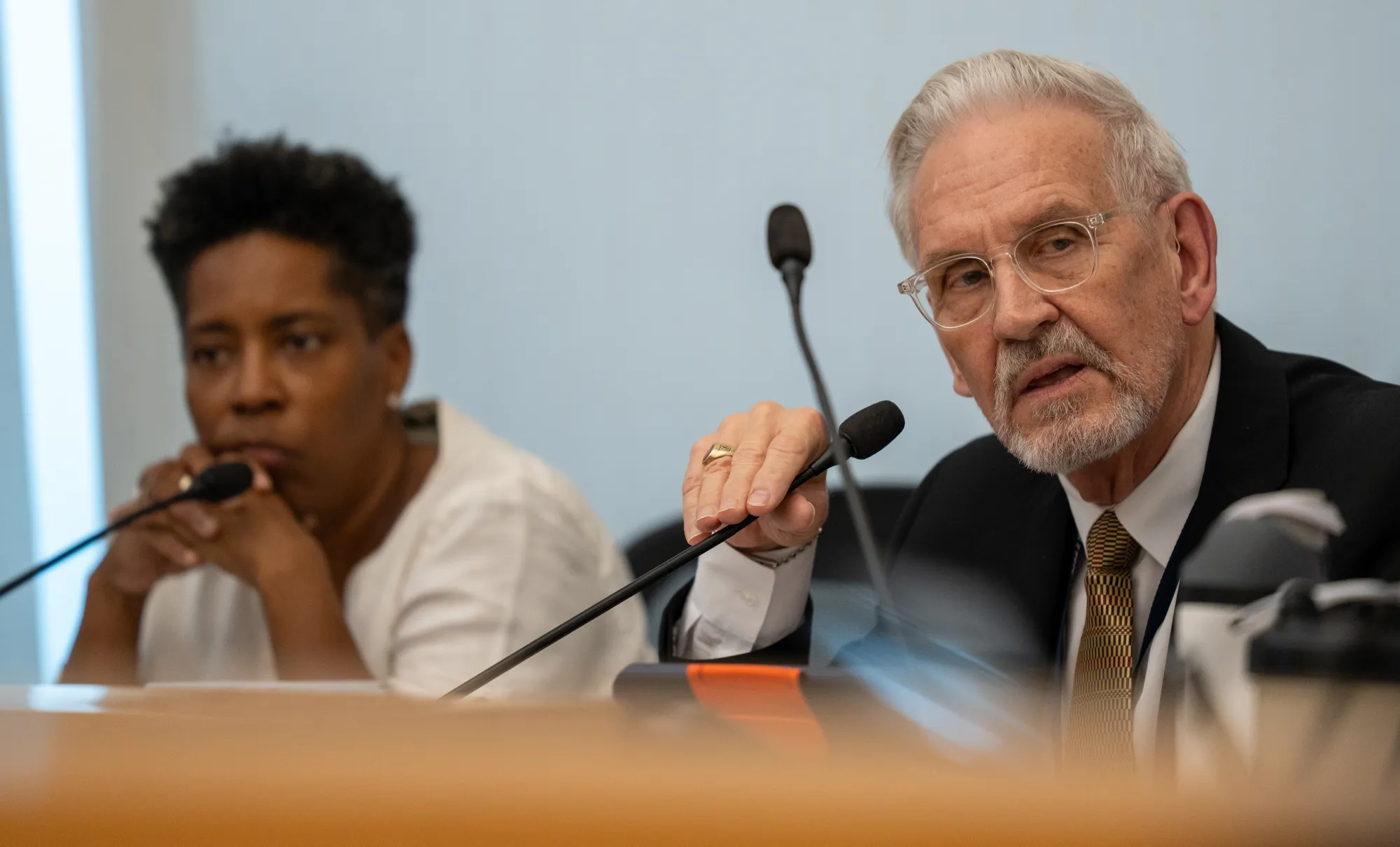
District 65 administrators propose closing two schools, cutting programs and staff
Plan for sweeping cuts also puts School Age Child Care program on the chopping block
(Editor’s Note: Hope Perry reported this story for Evanston RoundTable, a neighboring independent newsroom. It was shared with The Record as part of an ongoing collaborative effort.)
Earlier this month, Evanston/Skokie District 65 administrators unveiled a plan to cut approximately $20 million from the budget, primarily by closing Dewey and Lincolnwood elementary schools, reducing staff and axing some nonmandated programs.
The plan proposes the elimination of the School Age Child Care program after the current school year. According to the slideshow presented to School Board members Oct. 13, SACC costs the district $1.95 million per year.
“We do not see a viable pathway to get the program to break even,” Assistant Superintendent Stacy Beardsley said, noting that the district would have to raise the program’s price by 35% to do so.
The slideshow also said that “directly operating childcare is not typical of public school districts.” The district estimated annual savings from cutting the program at $400,000.
“It’s more than just a nonmandated program. It’s a program that really affects families,” Natalie Copper, the Dawes Elementary SACC site coordinator, told the RoundTable during the meeting.
The next cut proposed by administrators was a total restructuring of the district’s early childhood education program.
“Early childhood education and the strong foundation it provides children is critical. At the same time, maintaining various program options requires significant district resources,” one slide said.
Under this plan, District 65 would retain its Preschool for All program and continue to serve students with individualized education programs. Preschool for All is administered through a grant from the state of Illinois.
The plan would also “relinquish” Head Start and Early Head Start programs, which are administered by federal grants.
“Importantly, our hope is that Head Start and Early Head Start programming can continue serving children and families here in Evanston, even if District 65 is no longer the direct provider,” the district slideshow says. “Less than 10% of grantees in the State are public school districts.”
According to the presentation, the district’s early childhood education programs currently cost $4.9 million annually. Making the proposed cuts would save $1.5 million in local dollars, plus another $550,000 in transportation costs.
These changes would go into effect in fall 2028 — not next school year.
“I think it’s brutal,” District 65 parent Lindsey White told the RoundTable during a meeting recess.
“I think cutting a vibrant program like [the Joseph E. Hill Early Childhood Center] is devastating. My daughter went through the program. I know how special the humans are who educate people in this building and how many kids are positively served through the services,” White said. “And it’s a huge loss for a family.”
School closures
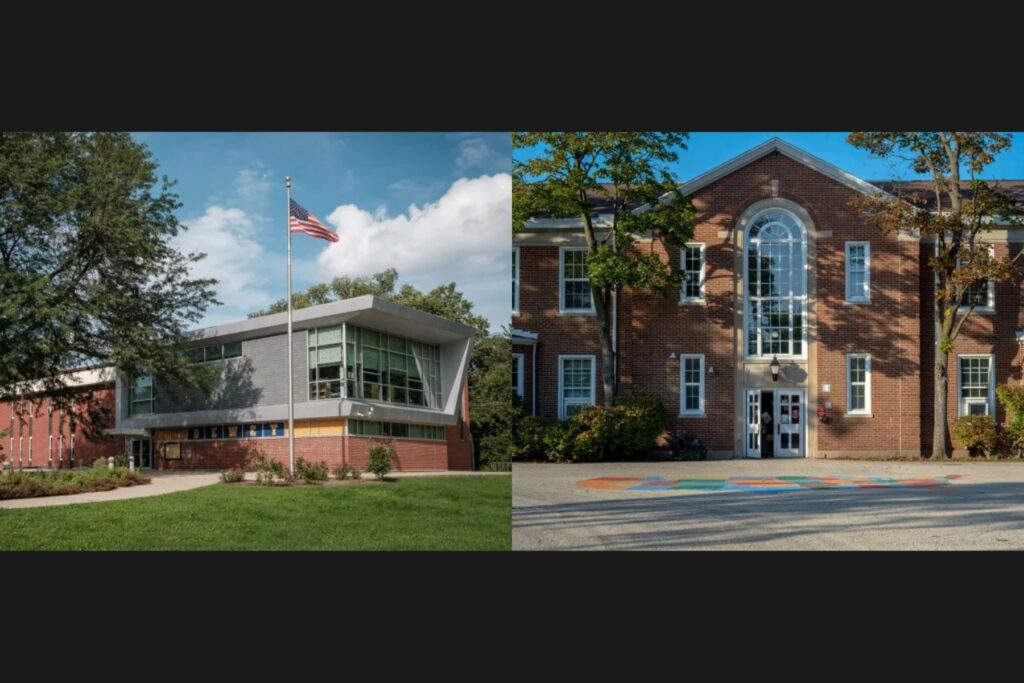
According to the district’s presentation, closing Lincolnwood and Dewey would result in an estimated $2.9 million in combined annual savings and $58 million in future maintenance savings over 20 years.
Administrators proposed that the board vote to advance the plan at its Nov. 9 meeting, before holding mandated school closure hearings in December. Three hearings must be held for each school proposed for closure.
According to the presentation, the district selected Lincolnwood for closure for several intersecting reasons: Haven Middle School feeder pattern schools, as they stand, require the greatest capital expenditures, and their collective enrollment has decreased by 33% in the past decade; Haven feeder schools currently serve an average of 281 students each; the majority of Lincolnwood students could also be absorbed into Willard Elementary School; and Lincolnwood’s campus could be renovated or rebuilt.
The district provided a similar rationale for the selection of Dewey, citing that enrollment in Nichols Middle School feeder pattern schools has also decreased by 33% over the past decade; Dewey has comparatively fewer marginalized students (defined as English learners, low-income students and students with individualized education programs); and its campus could instead serve as a “swing” school to house students from other buildings as those buildings are renovated.
“Dewey has limited outside space and slightly fewer classrooms, and breakout spaces than other Nichols K-5 buildings,” the district’s presentation said.
The closure of the two schools would mean that 713 students — including 329 categorized as marginalized — would need to change schools, according to the district.
This consolidation would lead to an estimated 75.7% K-5 building utilization; though until boundaries are finalized, numbers are subject to change.
Beardsley said the plan’s goal is to minimize student transition and impact. The two-way Spanish/English immersion program at Dewey will move to Lincoln Elementary as a cohort — approximately one-third of native Spanish speakers and bilingual students in Dewey TWI already live within Lincoln boundaries, according to the district.
The district also proposed relocating Lincolnwood’s STEP program for students with an autism spectrum disorder to Orrington as a cohort, while middle school students would remain in their current schools until graduation and all TWI students would remain in their programs.
In addition to school closures and the elimination of some programs, the plan includes significant staff cuts, which the district said would save more than $11 million.
The slideshow noted that the district would be “maintaining all programs within the instructional day” and that there would be “no full elimination of any school-based staff role.”
District 65 Chief Financial Officer Eric Miller said the district would cut costs by going back out to bid for transportation contracts, as well as cutting some busing for pre-K families.
Miller said the district could also increase revenue by raising student fees for families who do not qualify for free or reduced-price lunch, as well as pursuing more Medicaid reimbursements and maxing out grants for Title I schools.
The cuts would also allow the district to put aside additional funds for capital improvements each year, amounting to at least $4.7 million annually.
Next steps
In closing the presentation, the district proposed a referendum to cover capital needs — including the potential construction or complete renovation of two schools — in November 2028.
Interim Superintendent Eric Witherspoon acknowledged that the plan offered a lot of information but said it also presented an opportunity for the district to plan ahead for the future.
“You heard us mention the possibility of a referendum,” he said, adding that he knows the community is not yet ready to approve a referendum, and that district needs to prove it can be a good steward of the community’s schools.
“With this package, we can prove that,” Witherspoon said.
Following the presentation, the board took a brief recess before returning to discuss the plan.
Board member Andrew Wymer acknowledged the breadth of the proposal.
“The scope of this is sobering,” Wymer said.
For a detailed play-by-play of the Oct. 13 board meeting, you can check out the RoundTable’s live blog. The district’s full proposed plan and the data behind it can be accessed at this link.
The Record is a nonprofit, nonpartisan community newsroom that relies on reader support to fuel its independent local journalism.
Become a member of The Record to fund responsible news coverage for your community.
Already a member? You can make a tax-deductible donation at any time.
The Record is a nonprofit, community news site from former editors of 22nd Century Media
Our daily coverage of your government, schools, businesses and neighbors is not possible without your support.
Latest

The Record: Shortcut
Related Stories