What ‘Works’?: Glencoe weighing what to do with aging public works facility
The Glencoe Village Board has a big decision on the horizon regarding the future of the village’s public works facility;
Should they spend millions of dollars refurbishing the current site? Or should they spend millions of dollars to build a new facility on the edge of town?
At the Village Board’s Committee of the Whole meeting on Wednesday, Aug. 19, trustees heard results of the first phase of an ongoing space needs analysis to determine potential solutions for space concerns at both the public works facility and Village Hall.
Adam Hall, assistant village manager, said staff asked Williams Architects, of Itasca, to focus on the public works facility first “given [its] location and the importance to the village.”
Current Facility
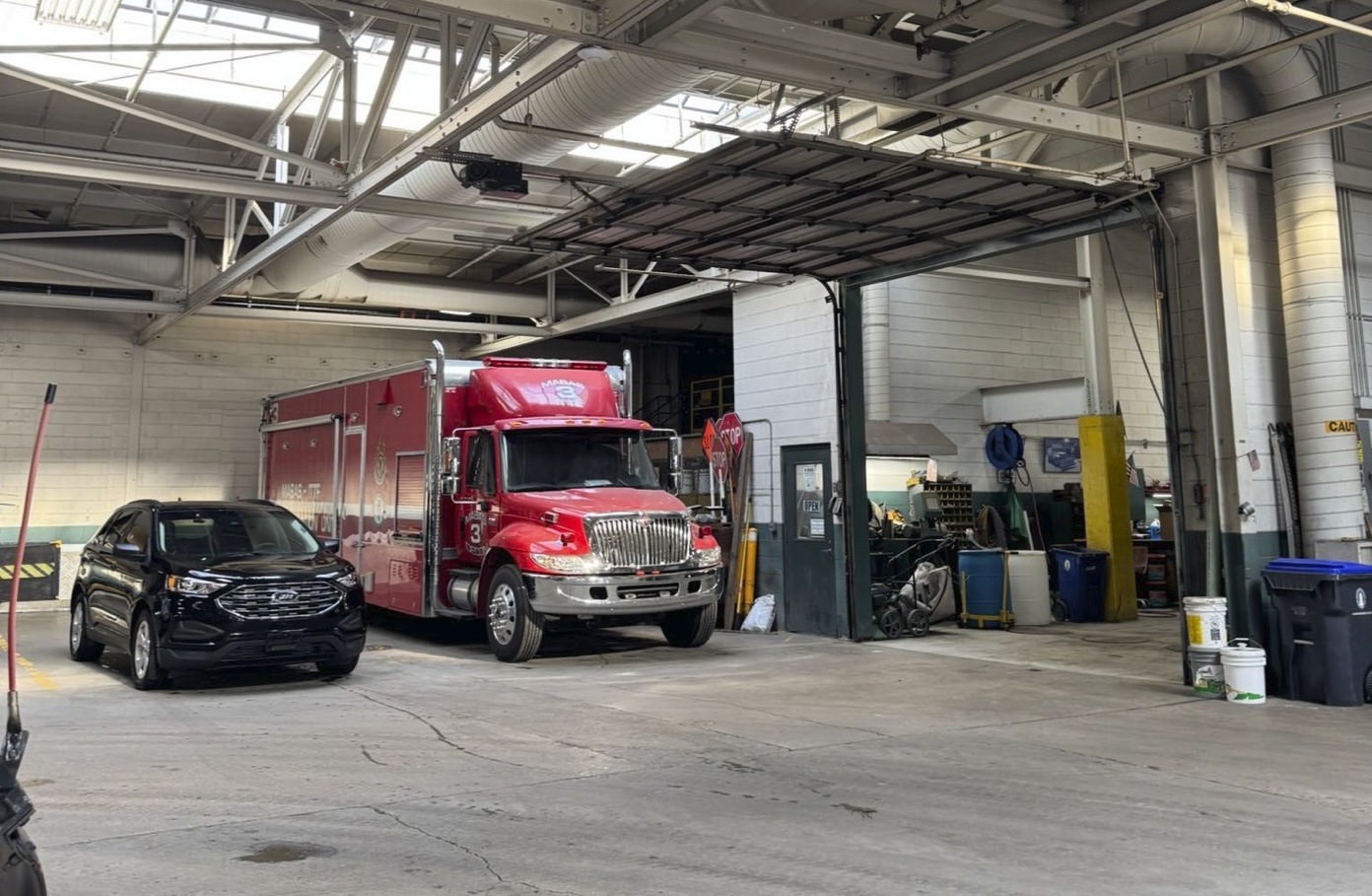
Hall said the existing 30,000-square-foot facility — located adjacent to Village Hall at 320 Hazel Ave., built in 1955 and expanded in 1997 — has seen a number of challenges in recent years.
“There is some operational strain at the facility,” Hall said. “There are divisions that are not located at the facility that do operation work.”
Andy Dogan, with Williams Architects, highlighted some other issues with the building, including masonry deterioration.
“If you walk into that facility, walk around the facility, you’re going to see a number of cracks in masonry,” he said, attributing that to the building’s age and not being constructed to sustain varying temperatures. “None of those cracks are, from what we are able to determine, at this point affecting the structural integrity of the facility to the point where we see a serious concern.”
Other issues with the building reportedly include corrosion of exposed steel on the interior, damage caused from public works vehicles and air quality filtration.
“Again, nothing serious enough to say this is a serious incident or occurrence that warrants closure of the building or immediate fixes, but there are things of concern,” Dogan said.
While remodeling the building is an option, Dogan said it would still cost millions of dollars. A cost analysis done by Williams estimated that remodeling or building a new facility on the existing site would cost between $26-$32 million, a cost Dogan said would not include the relocation of everything in the building to a temporary site.
He also said the existing footprint means that the current facility cannot support another addition.
“You’re doing a wonderful job of maintaining the facility,” he said, adding, “Having said that, there are just things inherent in any structure that gets to this age, combined with evolving uses and changing needs to operate public works and serve your residents well, that are hard for a 70-year-old facility to overcome, no matter how it is maintained.”
Potential New Facility
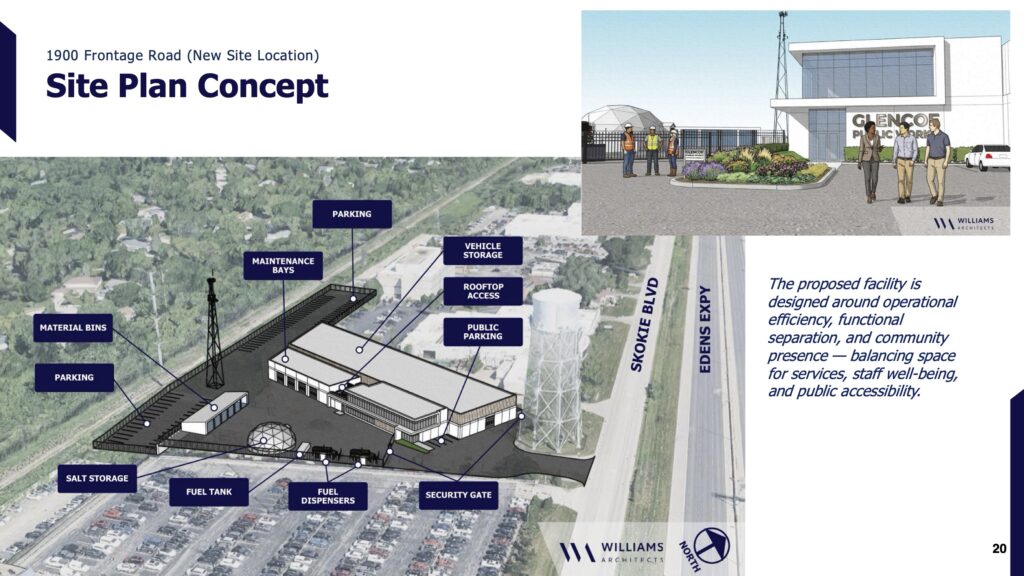
In a presentation, Williams showed a “high-level” concept for a new public works facility at 1900 Frontage Road, adjacent to the Glencoe water tower.
Kim Nigro, with Williams, shared concept designs for a split-level 54,000-square-foot public works facility that includes a nearly 29,000-square-foot garage, maintenance areas, a lunch/training room, and workshops for specific departments.
The proposed second floor would contain a storage mezzanine area, office space for public works leadership, additional office space and mechanical equipment.
Nigro said the concept proposes Frontage Road access, fuel tanks, public and employee parking, and security gates that would limit access to vehicle storage.
She added that the area does contain a ComEd right of way and the Village has had preliminary talks with ComEd on an easement agreement that would allow the village to use that area.
“It’s a really important part of the feasibility of this site working,” Nigro said of the ComEd right of way. “We could use some of that space for staff parking.”
In all, the concept for a new facility is estimated between $23-$27 million. But Dogan clarified, if the village decides to pursue the new facility, that number would be refined as materials for construction are determined and the concept is fine-tuned.
What To Do?
Village President Howard Roin began discussions by saying that Glencoe has very little space that is available for development. He asked Dogan if Williams had investigated whether the Frontage Road location would be of interest to developers.
Dogan said that Williams had not studied that, but in his opinion, the site would not be attractive to a developer because of “constraints” at the site, including the lack of a sidewalk and high-voltage transmission towers adjacent to it, neither of which would be of concern to a public works facility.
Village Manager Phil Kiraly added the Frontage Road site has been owned by the Village for more than 100 years and at one point was the location of the village’s incinerator.
“It’s worth noting that we have had discussions with neighboring communities about the possibility of working together to construct a site outside of Glencoe’s boundaries,” he said, adding that those discussions did not go anywhere.
Roin added that one advantage of relocating the public works facility is that the village could potentially redevelop the existing one into a multiuse building, something the village reportedly has discussed for years.
Trustee Georgia Mihalopoulos asked Williams if they have evaluated the potential for any surprise issues at the potential site.
Dogan responded that they do know they will have to build an underground stormwater management system, and that more studying needs to be done to see if there may be issues with the soil.
“It is absolutely necessary to do more due diligence on this site, understand the soil conditions, understand the environmental remediation that may be required there,” he said.
Trustee Michael Rosenblat asked about future planning for the site, regarding advancements in technology and new public works practices.
“These buildings last forever,” he said. “What’s going to happen 30 years from now? Are our vehicles going to be different?”
Kiraly addressed Rosenblat’s question by saying that, in the past, as the needs of public works have changed, staff have been reallocated and areas that were once used for one purpose have now been adjusted for another.
“What are vehicles going to generally be like 10 years from now is easier to predict than 20 years from now,” he said. “But I think we have a pretty good sense of the work that we do today may be, generally, the same as the work we do 10 years from now. But the work we do 20 years from now may be different.”
Dogan followed up Kiraly’s comments by saying their approach would be guided by flexibility.
“To be able to have that large vehicle storage garage, yes, it is developed with sizing of the majority of your fleet in mind,” he said. “It is also flexible for future uses. It’s a wide open space…and I feel that we’re putting a higher degree of [flexibility] into this concept plan at this point.”
The representatives from Williams said they would return to the Village Board in the fall with the results of their study on Village Hall space needs, plus any additional information they learn about the public works facility.
The Record is a nonprofit, nonpartisan community newsroom that relies on reader support to fuel its independent local journalism.
Become a member of The Record to fund responsible news coverage for your community.
Already a member? You can make a tax-deductible donation at any time.

Peter Kaspari
Peter Kaspari is a blogger and a freelance reporter. A 10-year veteran of journalism, he has written for newspapers in both Iowa and Illinois, including spending multiple years covering crime and courts. Most recently, he served as the editor for The Lake Forest Leader. Peter is also a longtime resident of Wilmette and New Trier High School alumnus.
The Record is a nonprofit, community news site from former editors of 22nd Century Media
Our daily coverage of your government, schools, businesses and neighbors is not possible without your support.
Latest

The Record: Shortcut
Related Stories