
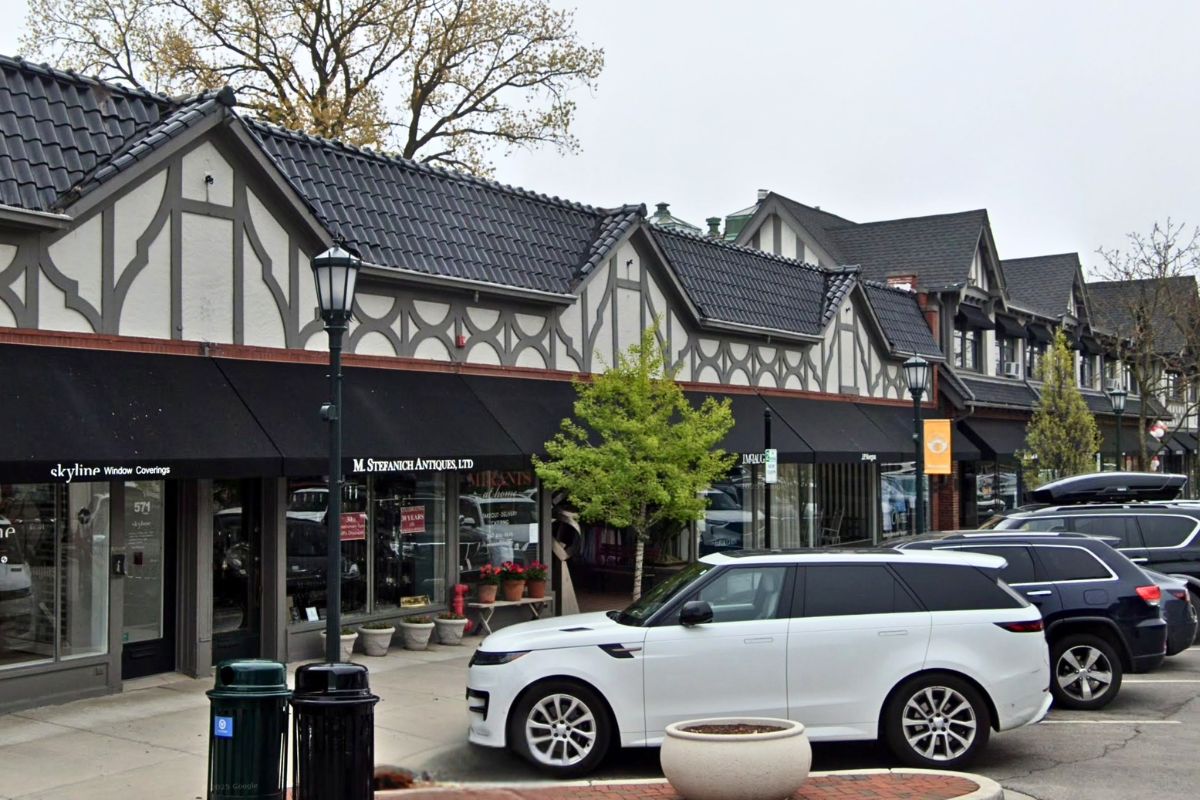
Upgraded fees, fines and enforcement are among Winnetka’s plans for parking relief
Winnetka officials are once again at a crossroads with an age-old conundrum.
Village trustees during their Tuesday, Aug. 4 meeting put the current parking-related issues throughout town back in the driver’s seat as they talked through potential avenues to solve ongoing struggles.
And although officials noted that Winnetka has faced parking challenges for nearly half a century, trustees believe there is a path to solutions that won’t be “more complicated than it has to be.”
The Village Council’s discussion was in part spearheaded by a March meeting earlier this year when several local business owners addressed trustees to urge action on the “ongoing challenges” facing Winnetka’s key shopping and entertainment districts.
Local business owners during that March session argued the impact of major construction projects in the area, most notably the ongoing development of One Winnetka at Lincoln and Elm, as well as persistent parking struggles, were “severely hampering” customers’ willingness to patronize businesses in the immediate area.
Winnetka Village President Bob Dearborn pledged at the end of the session to earmark time during a future Village Council session to review the village’s parking situation and start working on a plan to address concerns.
‘A Symptom of Success’
Village staff while presenting to the council earlier this month noted Winnetka’s three business districts — Elm, Hubbard Woods and Indian Hill — “continue to thrive” and are “vibrant and healthy.”
But Lauren Parisi, the village’s economic development manager, said “still parking should be managed proactively.”
Both Parisi and Hannah Lipman, Winnetka’s deputy village manager, led the parking presentation during the August meeting, walking trustees through current conditions, field observations and a series of potential remedies.
Winnetka currently issues parking permits for business employees, Class A permits, as well commuters, which are designated as Class C permits. Designated spaces are reserved for these permit-holders within each of Winnetka’s three business districts, Parisi said.
Right now, Winnetka charges $10 for Class A and $100 for Class C permits. Nonresidents are charged $220 for Class C, which are renewed on a biannual basis. Class A permits are renewed annually.
One factor that village staff believe is contributing to parking struggles is that more permits, of both classes, are being issued than available spaces.
Per Parisi, the village believes there are approximately 540 existing parking stalls reserved for Class A permit-holders; however, more than 1,000 permits have been issued. That turns out to 88% more permits being issued than existing stalls, Parisi said.
The “most extreme case,” per officials, is Winnetka’s Indian Hill district, where over 200% more permits are issued than existing stalls — only 46 parking spaces with 140 issued permits.
Issuance of Class C permits is similar but “not as severe of a discrepancy,” officials said.
An additional factor, according to Parisi, is that renovations took place at the Hubbard Woods parking garage and the West Elm parking lot at the former post office site.
Key Concerns, Possible Solutions
Officials said that village staff have received an “increasing number” of parking-related concerns, particularly within the three business districts.
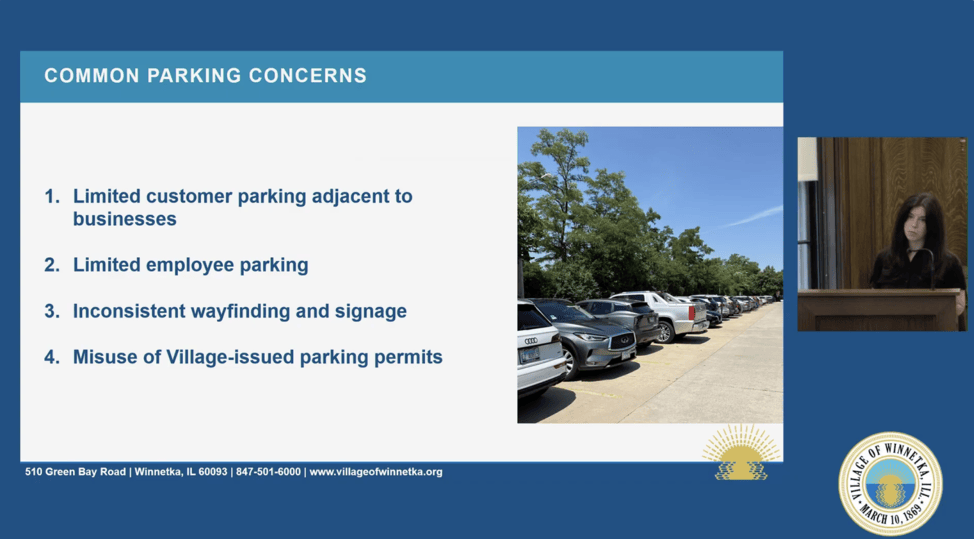
Parisi and Lipman detailed four common complaints that have come up the most: limited customer parking near businesses, limited employee parking, limited parking signage and the misuse of parking permits by students.
Lipman told the council there are some potential “short-term” solutions staff could look into right away, but that it’s unlikely one measure will prove to be the ultimate fix.
“No solution is going to solve all of the problems,” Lipman said. “We have vibrant districts and that is a good thing, so there’s probably always going to be some challenges but there are things we can do to definitely lighten that burden.”
Those shorter-term opportunities, Lipman said, include continuing to hold discussions with businesses to review parking regulations, reviewing and updating permit fees and fines, and considering updates to enforcement policies and procedures to address violations.
More specifically, addressing violations could include escalating fines for repeat offenders.
Additionally, improving the village’s permit-distribution process is also on officials’ mind.
Village staff have also considered leaning more heavily on technology. A mobile app platform for commuters could be an option, Lipman suggested.
Trustees showed support for several of the staff’s recommendations.
Trustee Bridget Orsic called the $10 permit fee for Class A “pretty quaint,” saying she feels like “that’s an easy one to raise because at that price people would not even think about it.” She noted an increase, perhaps to $25, that “might serve to take a few of those passes off the market.”
Trustee Tina Dalman felt strongly about the council thinking about how much of the village’s parking landscape is being dedicated to commuter parking. She noted that some of the village’s “best customer parking is right now being reserved for commuters.”
Trustees Kim Handler and Rob Apatoff both said they believe significant strides could be made by simply being stricter on enforcement.
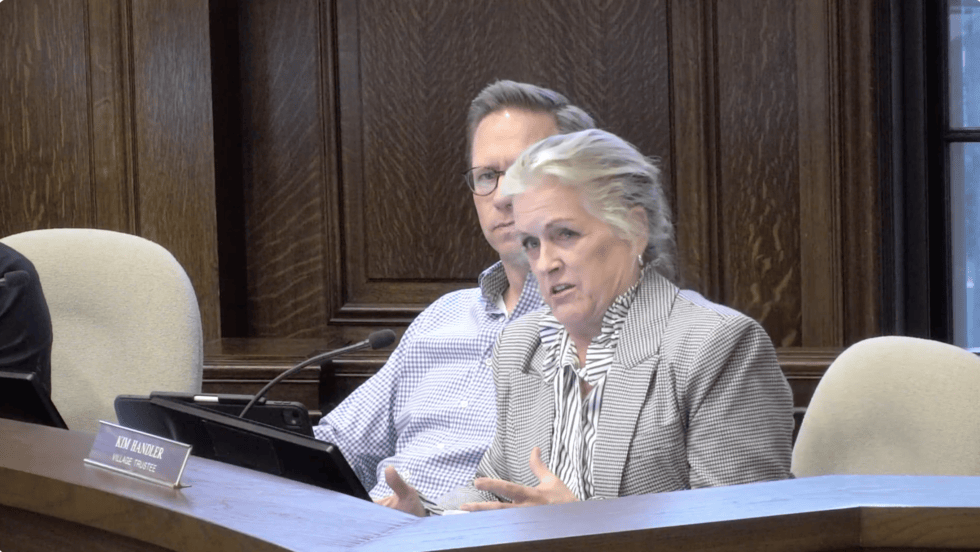
Handler said she feels a “huge step is just enforcing what we have in place,” noting that she doesn’t “want to make this more complicated than it has to be.”
While acknowledging that “business has really upped” and that Winnetka is “almost at capacity as far as retail,” Apatoff said people sometimes “take advantage of our leniency.”
“I think you’ll be shocked if we start enforcing what we have and being a little tougher on it,” he added.
Dearborn called the town’s parking struggles a “complicated issue” while noting that it’s somewhat a product of a “successful economy and successful business districts.” He encouraged village staff to act on the proposed solutions that might be most easily implemented.
“I think we can look at some of these issues,” he said. “Let’s not wait, let’s keep moving.”
The Record is a nonprofit, nonpartisan community newsroom that relies on reader support to fuel its independent local journalism.
Become a member of The Record to fund responsible news coverage for your community.
Already a member? You can make a tax-deductible donation at any time.

Martin Carlino
Martin Carlino is a co-founder and the senior editor who assigns and edits The Record stories, while also bylining articles every week. Martin is an experienced and award-winning education reporter who was the editor of The Northbrook Tower.
The Record is a nonprofit, community news site from former editors of 22nd Century Media
Our daily coverage of your government, schools, businesses and neighbors is not possible without your support.
Latest

The Record: Shortcut
Related Stories