
‘Only the Love That Matters’: Loss, grief and Wilmette’s Sister Tree
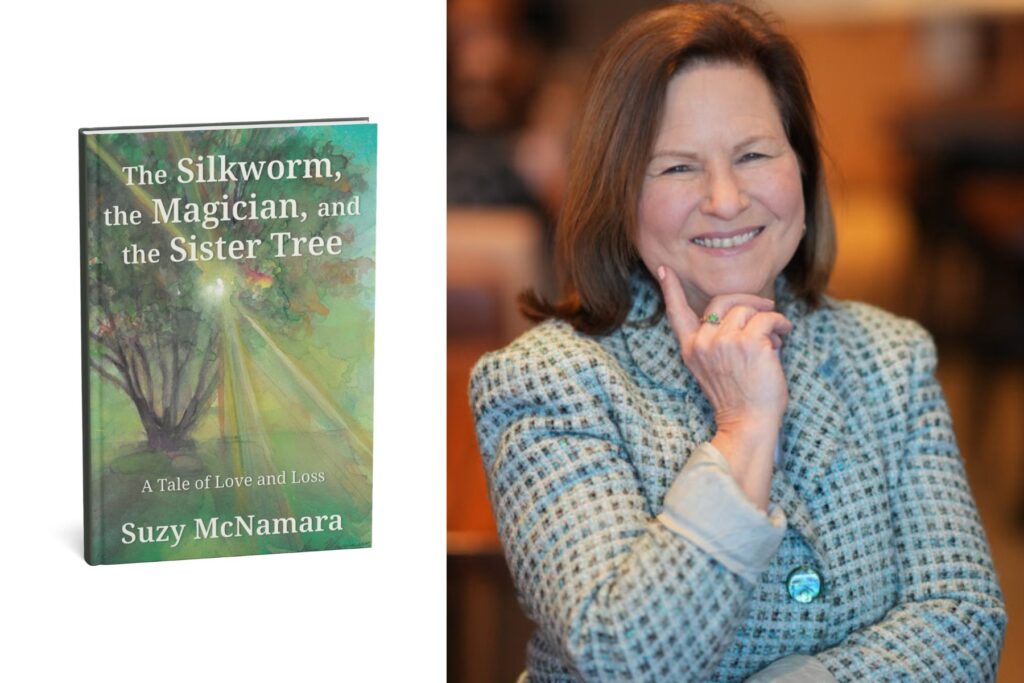
After losing her husband of more than 30 years to early-onset Alzheimer’s disease in December 2024 and, just months earlier, her sister and lifelong best friend, Wilmette resident Suzy McNamara turned to the page as a way to process her grief and connect with others navigating caregiving and loss.
The results are her June 2026 memoir, “The Silkworm, the Magician, and the Sister Tree: A Tale of Love and Loss,” and a growing community rooted in shared loss, remembrance and hope.
That community also transcends off the page to Wilmette’s Gillson Park at the “Sister Tree,” a magnolia that has quickly transformed from a personal memorial for McNamara’s sister into a public monument honoring all lost sisters.
Exploring loss
As she grappled with both losses, in writing her memoir, McNamara said she wanted to speak to those who have been caregivers for someone they love and those navigating grief — two experiences that can be profoundly isolating.
“It was kind of hard for people to understand, seeing somebody who looked so young and handsome and vital but was really suffering, with significant decline, cognitively,” McNamara said of her experience caring for her husband. “So, it can be very isolating as a caregiver when people don’t really understand what you’re going through.
“… I’m very, very honest in my recounting of the experience because I knew that was the way to make other caregivers feel understood, … to help them feel less isolated.”
McNamara shared a tactic for caregivers to adopt even in the face of isolation: Acknowledge your own accomplishments, especially when those around you aren’t able to do so.
“You feel beaten down when you’re a caregiver, feel like you’re making mistakes,” she said. “If you’re caring for somebody with a terminal disease, the person that you’re caring for is not going to get better, and so you don’t have that feeling of accomplishment or like you’re helping the person you love get better because that’s … very unfortunately, not happening.
“And then if you’re caring for somebody with Alzheimer’s, the person that you’re caring for loses the ability to thank you and to give you some sort of validation. … And then, if you’re caring for somebody, I think especially with early onset, the outside world is not telling you you’re doing a good job because they don’t understand how hard it is. So, it’s really important for caregivers to learn, when they make it through the day, to just congratulate themselves for doing that. … The mistakes don’t matter. It’s only the love that matters.”
As part of her personal healing, McNamara said, writing helped her process the grief that had been walled up within her — a consequence of the walls she built to protect her heart as she watched her husband become “less and less of himself over time” and focused on taking care of him.
“I had this need to turn something good out of all of that tragedy, all of that heartbreak, all of the trauma,” she said. “I felt like this was my way of having something good come out of that, and the good would be connecting with other people who had gone through something similar and helping them to heal along with me, because I was healing, too.”
Sisters
McNamara’s grief was essentially doubly walled-in as she had just lost her younger sister, her confidant.
“When she died, I really did not know what to do,” McNamara said. “I did not know how to function in a world that she wasn’t in. … I called her about two years before Bob, my husband, died. I was walking through Gillson Park, and there was a tree that we had dedicated to my father there, and I was yapping to her on the phone about plans I’d made for my husband’s funeral because I did know that he was going to pass away, and she had said, ‘Oh, just put me there when it’s my time. Put me at dad’s tree.’
“And we laughed because we were going to be old ladies together … and I was like, ‘Oh, of course,’ you know, whatever, because that was not even a possibility. So when she died, I had no idea how to make it through the day and no idea what to do to properly honor my best friend, but I did know that she wanted to be at the tree.”
Now, on the tree, a plaque honors her sister, Elizabeth Muslin, with a line from their favorite song, Frank Sinatra’s “Fly Me to the Moon.”
Now, my sister’s tree, I love to visit because my sister is surrounded by these beautiful women, and we make it a little bit of a ceremony.”
Suzy McNamara on visiting the Sister Tree
At the time of her sister’s passing, McNamara’s husband was in his final stage of Alzheimer’s. McNamara said she would go to the tree and try to talk to Muslin, though she could “barely even look at the plaque” in the first couple of months after Muslin’s passing as she “did not want to accept that she was dead.”
But over time, and supported by community, that began to change.
“A woman came up to me one morning … and she said, ‘Oh, I’m so glad you’re here. You know, I come here every day, and I was wondering about this woman because she seems young,’” McNamara shared. “And I said, ‘Oh, it’s my sister, she just died a couple months ago.’ And she said, ‘Well, my sister just died, too.’ And I looked at this woman, and I said, ‘Tell me about your sister.’
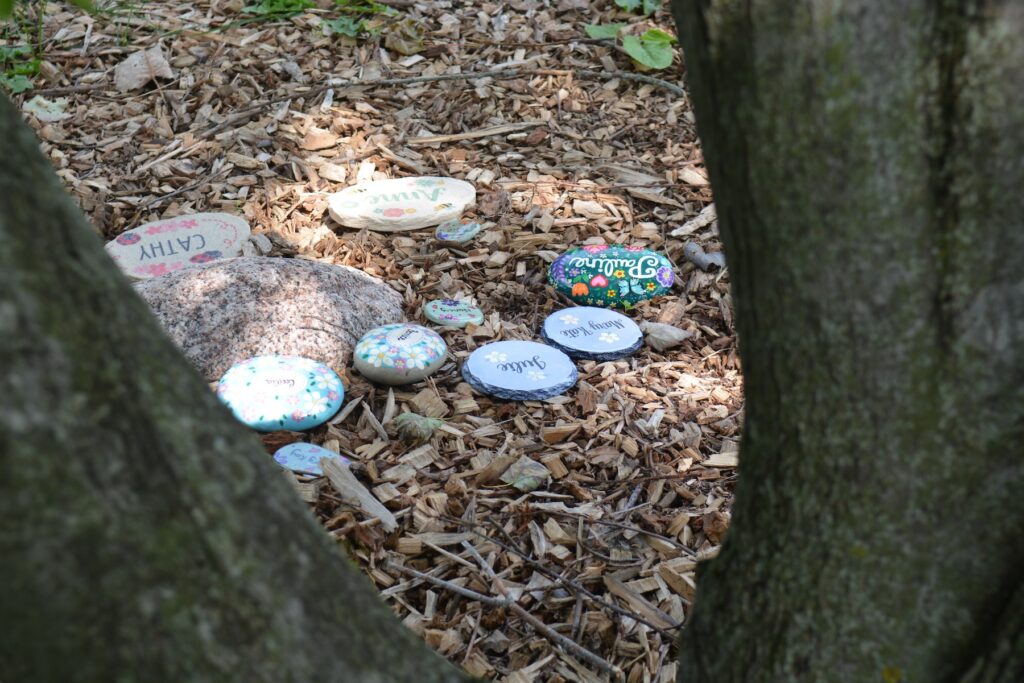
“So, she told me the story of her sister, which was incredibly heartbreaking. And I think I was just overtaken by the spirit of my sister, who was so incredibly humble and generous, and I said, ‘Well, let’s make this a tree for your sister, too. Bring something for her. Bring flowers or a stone, whatever you want, and make it for your sister, too.’”
McNamara said she became “energized” by this new project, uniting those who had lost their sisters and inviting them all to put a stone with their sister’s name on it under the Sister Tree.
“Now, my sister’s tree, I love to visit because my sister is surrounded by these beautiful women, and we make it a little bit of a ceremony,” she explained. “We walk down with the sister, and put the stone for her sister that she lost, and I say a couple prayers, read a poem, whatever the sister would like, sometimes we sing a song, and then I ask them to tell me about their sister, and it has been incredibly comforting and joyful.”
Nurturing Hope
As she builds community by sharing her memoir with others and through Sister Tree, McNamara welcomes the opportunity to hear other people’s stories, describing the exchange of stories and community-building as her way of “finding some good in all of the tragedy” that she and her children endured.
Now, McNamara has renewed hope as she carries her husband’s and sister’s love within her — a resounding hope she wants to convey to others who are navigating grief.
“For somebody who’s going through grief, one thing that I’ve learned over time is, first of all, grief takes its time with you. You can’t run away from it. … You have to face it; you have to work through it,” McNamara said. “But eventually, now I’m starting to really feel, the vastness of the love that I had for my husband and for my sister, and the vastness of the love that they had for me really are within me. I’m beginning to be able to access that feeling, but that takes time, and I still have a ways to go, of course.
“So, I want to give people hope that they will come to that feeling that the person is still very much within them. And, wherever our loved ones are, they’re rooting for us to be happy. … As hard as this life is, it is a gift. And the people that we lost very much want us to find happiness in this life. I think about that a lot, every day.”
The Record is a nonprofit, nonpartisan community newsroom that relies on reader support to fuel its independent local journalism.
Become a member of The Record to fund responsible news coverage for your community.
Already a member? You can make a tax-deductible donation at any time.

Zoe Engels
Zoe Engels (she/her) is a writer and translator, currently working on a book project, from Chicagoland and now based in New York City. She holds a master's degree in creative nonfiction writing and translation (Spanish, Russian) from Columbia University and a bachelor's in English and international affairs from Washington University in St. Louis.
The Record is a nonprofit, community news site from former editors of 22nd Century Media
Our daily coverage of your government, schools, businesses and neighbors is not possible without your support.
Latest

The Record: Shortcut
Related Stories