
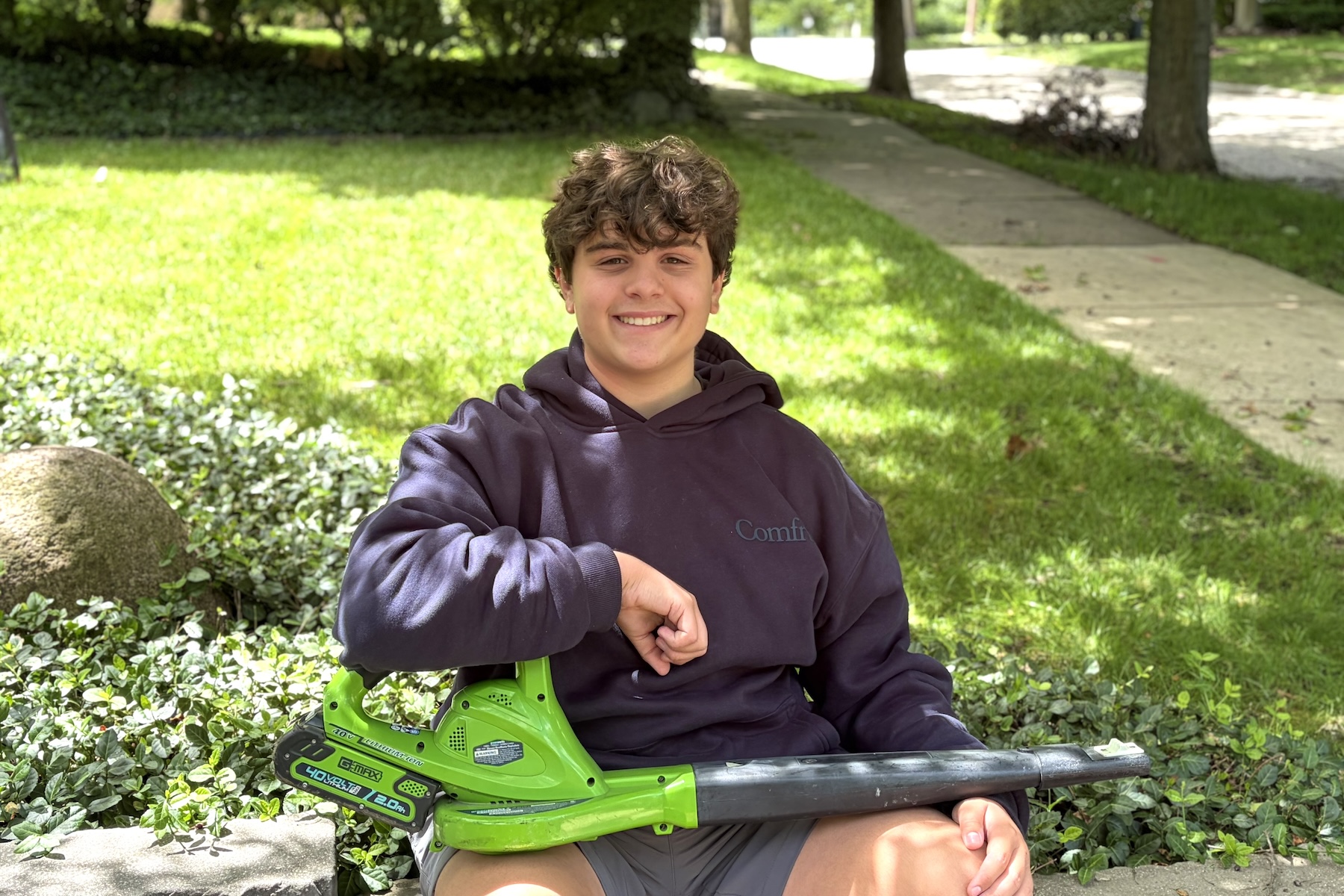
New Trier student turns down the volume in classrooms with Ban the Blower project
While Thomas Franklin, a rising senior at New Trier High School, didn’t set out to make noise, he did set out to measure it, and his findings are now reshaping policies at dozens of schools across Illinois.
In March 2024, Franklin noticed something that he said seemed obvious once he paid attention:
Gas-powered leaf blowers outside classrooms.
“We keep a lot of the windows open during the day, especially when it’s nice outside to get [fresh] air inside,” Franklin said of the New Trier environment as he provided one example of a noteworthy landscaping distraction. “I was in English class … and the leaf blower noise outside just got way too loud. We had to close the windows, and that happens so often in class. … It definitely interrupts my train of thought.”
Franklin spoke to his friends, who shared his frustration with the distraction and inspired him to take action and create Ban the Blower, an initiative that, per the website, “seeks to raise awareness about the negative impacts of gasoline-powered leaf blowers” and “eliminate the use of gasoline-powered leaf blowers,” particularly during school hours.
As Franklin undertook research on the impact of classroom noise on students’ learning, he uncovered that the World Health Organization recommends background noise levels of less than 35 decibels to allow for proper learning conditions. From outside a classroom, however, gas-powered leaf blowers can produce noise levels of 60 to 65 decibels within the classroom.
“I also learned that not only do leaf blowers affect high school students, they also specifically hurt students with neurodivergencies [including ADHD] or special needs … and young children,” Franklin added.
He even conducted his own survey among peers at New Trier, finding that more than 50% of those surveyed noticed gas-powered leaf blower noise at least once per month, and that same percentage of students said they found them distracting. Thirty percent of students surveyed said the noise was so problematic that a teacher had to close a window.
With that information, Franklin saw how prevalent the issue was, so he began writing a blog on the Ban the Blower website to raise awareness for the issue, and he wrote his own policy brief, published last month.
Armed with an arsenal of knowledge on the matter, he began reaching out to school districts across Illinois to lobby for change. And the leadership at these school districts is listening, with multiple school districts, including Kenilworth District 38, adding or considering new policies related to gas-powered leaf blowers during school hours.
“It’s showing me that districts really do care about their students, and this whole thing has taught me that change doesn’t always have to start with something that’s really big,” Franklin said. “It can start with a person asking a question and also questioning something that everyone has accepted as normal.”
But, at just 17 years of age, Franklin isn’t stopping there.
He was set to meet with State Rep. Robyn Gabel on Monday, June 22, to discuss the prospect of legislation to combat the issue of classroom noise from gas-powered leaf blowers.
This summer, he’ll also be taking on a research position at Northwestern University’s SoundBrain Laboratory to explore auditory neuroscience under the chair of communication sciences and disorders.
And last, though certainly not least, Franklin is working with a fellow high school student from out of state on a prototype of a deployable noise device that would measure sound levels across school campuses. While Franklin hasn’t spoken to school districts about the device quite yet, he is hoping he can deploy them across schools as soon as the 2026-’27 school year.
With the data collected by the devices, he wants to author a research paper that can be presented to school boards.
As Franklin looks toward the future, his determination and passion for turning up the volume on this issue, and turning down that of the gas-powered leaf blowers, is clear.
“It’s really important that people know how much it affects cognition and reading comprehension, especially for students with special needs and disabilities,” Franklin said of the matter. “It’s really important that people understand that it’s a big issue and, if they can, reach out to local boards and try to make change.”
He added, “This whole thing is mainly about equitable learning conditions for students. … It’s making schools accessible for everybody, and then everybody has fair chances to learn and to thrive in different school environments. If something is so simple as banning gas-powered leaf blowers on campuses, it can make so much change, that’s why I’m going for. If I can do something so simple and make a change, then it’s just very fulfilling.”
The Record is a nonprofit, nonpartisan community newsroom that relies on reader support to fuel its independent local journalism.
Become a member of The Record to fund responsible news coverage for your community.
Already a member? You can make a tax-deductible donation at any time.

Zoe Engels
Zoe Engels (she/her) is a writer and translator, currently working on a book project, from Chicagoland and now based in New York City. She holds a master's degree in creative nonfiction writing and translation (Spanish, Russian) from Columbia University and a bachelor's in English and international affairs from Washington University in St. Louis.
The Record is a nonprofit, community news site from former editors of 22nd Century Media
Our daily coverage of your government, schools, businesses and neighbors is not possible without your support.
Latest

The Record: Shortcut
Related Stories