Whistles, Flags & Labubus: Skokie seals time capsule to commemorate 2025 for the future
“It is the year 2000. Last weekend there was a Peace and Harmony Rally at Niles West High School. It was in response to a Ku Klux Klan demonstration. It was wonderful to see so many community members come together and discuss the value of one another and to celebrate their differences.”
Those were words from a John Middleton Elementary School student in a 25-year-old letter addressed to the future and included in a time capsule the Skokie Heritage Museum opened last summer.
The museum on Sunday, June 7, sealed a brand new time capsule for village residents to open in the year 2050, a capsule that includes more letters and materials that aim to capture what 2025 looked and felt like, Stephanie Guthrie, the museum’s coordinator said.
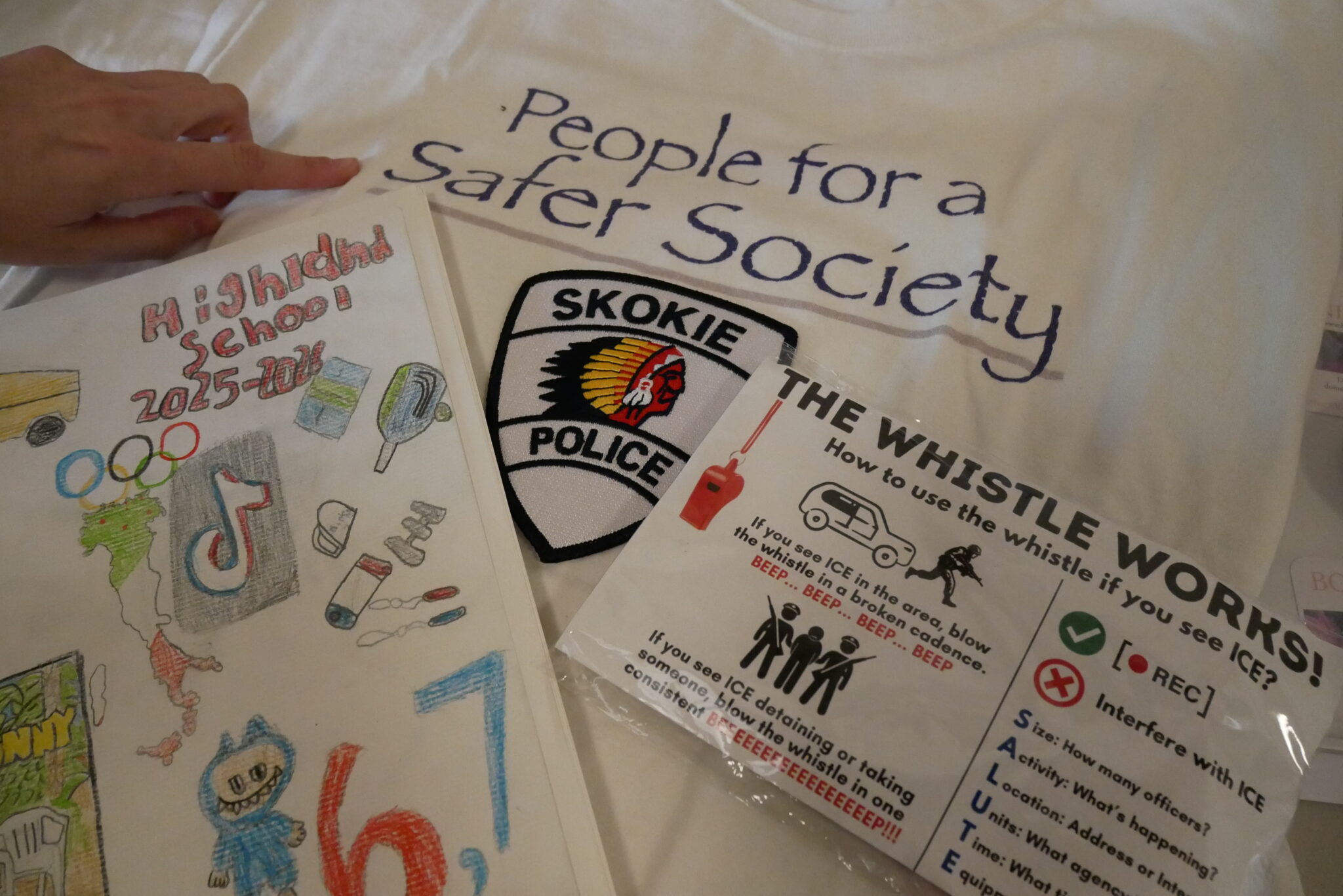
Among other things, the capsule — which was organized by the museum, Skokie Historical Society and Skokie Public Library — features an ICE-watch whistle, Bears’ Caleb Williams sports card, Labubu doll, U.S. penny and menus from local restaurants.
Newspapers, artwork and letters put in the capsule reflect anxieties about climate change and artificial intelligence, and curators prioritized adding physical media amid concerns coming technology will render today’s digital files impossible to access, Guthrie said.
“When you think of an artifact in a museum, an artifact is really one part object or material thing, and one part story,” said Emily England, the manager of the Skokie Heritage Museum, of determining what to put in the capsule. “And so, what are those stories?”
Skokie’s time capsule from the year 2000 housed roughly 260 items, an inventory shows. A VHS tape-recording of a discussion from a local public access television show about the creation of the time capsule offered people’s predictions for the future, Guthrie said.
The show reportedly got a lot of predictions right, including the rise of computers in education and government. But other predictions, like the prospect people would no longer have safety concerns over school shootings, did not bear out.
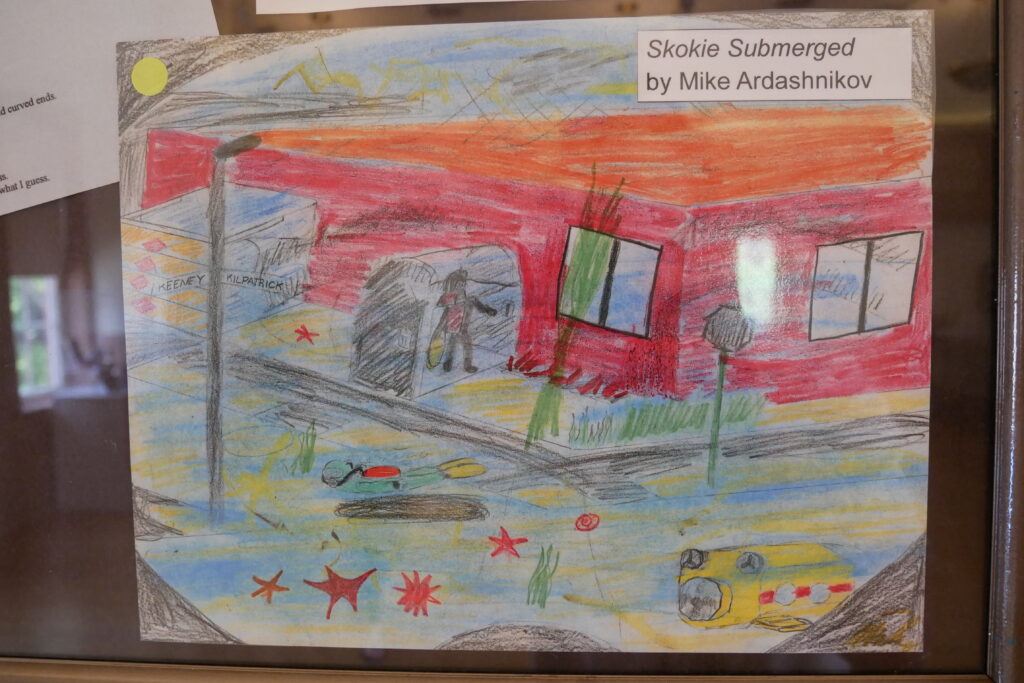
A series of children’s drawings also provided different visions for 2025. The illustrations depicted idyllic nature, volcanic armageddon and even the village submerged underwater — which England noted kind of came true when a water main broke in February last year.
Dick Witry, president of the Skokie Historical Society, noted the year-2000 time capsule included a menu from the now-defunct downtown diner Pat’s Place that showed residents could get a plate of scrambled eggs, bacon and toast with coffee for just $2.75.
To prepare for the newest time capsule, volunteers collected menus from 42 local restaurants and Witry and John Zouras the Skokie Historical Society ‘s treasurer, drove around town to photograph key plots of land he anticipated may look drastically different in 25 years.
Those areas included the land east of the Skokie Sports Park, where the Skokie Park District is proposing building new fields, and St. Lambert Catholic Church.
Witry, who is a member of the St. Peter and Lambert Parish, supposed it was possible in the next 25 years that the congregation could consolidate by using just their St. Peter’s Catholic Church building.
England said she wanted the time capsule to include both the letters to the future, like students and local school leaders addressing their future counterparts, and items reflective of the year’s cultural zeitgeist — hence the Labubus.
But she highlighted the time capsule has inherent limitations. As a result of its size (16 inches wide by 30 inches tall), England said they have to play a game of Tetris to fit everything in.
Curators must also contend with peoples’ biases over what they consider valuable to include, and it is possible that certain files, like those on flashdrives, won’t be readily accessible in 2050, England said. She noted that the National Archives still recommend that historians use microfiche to store things like newspaper collections since the technology is still reliable.
Regardless of what Skokie looks like in 25 years and how the time capsule will be received, England and Guthrie both emphasized their gratitude to all the items people donated.
“It’s been really heartwarming, that whole process and just really highlights how awesome Skokie, the community, is,” England said. “The people here are just delightful.”
Notably, the fifth grade John Middleton Elementary School student who wrote a letter to the future in 2000 included at least one other prediction for the future that has come true:
“In the future I think Skokie will continue to have a diverse population,” the student wrote in 2000.
“As time goes by, the population of more neighborhoods will look like Skokie. I think that a wider variety of people (different races, religions, cultures, sexes and sexual orientations) will have opportunities to be leaders and role models in governments and all areas of business.”
The Record is a nonprofit, nonpartisan community newsroom that relies on reader support to fuel its independent local journalism.
Become a member of The Record to fund responsible news coverage for your community.
Already a member? You can make a tax-deductible donation at any time.

Samuel Lisec
Samuel Lisec is a Chicago native and Knox College alumnus with years of experience reporting on community and criminal justice issues in Illinois. Passionate about in-depth local journalism that serves its readers, he has been recognized for his investigative work by the state press association.
The Record is a nonprofit, community news site from former editors of 22nd Century Media
Our daily coverage of your government, schools, businesses and neighbors is not possible without your support.
Latest

The Record: Shortcut
Related Stories