
County’s major Oakton Street project in Skokie to begin soon
Skokie officials formalized a deal with Cook County Monday night that will continue to pave the way for a multimillion dollar project set to reimagine a key stretch of roadway in the village.
Trustees during their April 6 meeting approved an intergovernmental agreement with the county that lays the groundwork for a series of significant adjustments to a nearly two-mile stretch of Oakton Street.
The agreement, which the board unanimously green-lighted, officially establishes that the county will serve as the lead agency for the project and also be responsible for the design, bidding, construction and construction engineering, Village Manager John T. Lockerby said.
Construction for the improvements will begin within two months, village officials said on Monday.
The Cook County Department of Transportation and Highways has for years made clear its plans to renovate a portion of Oakton Street that runs through the village.
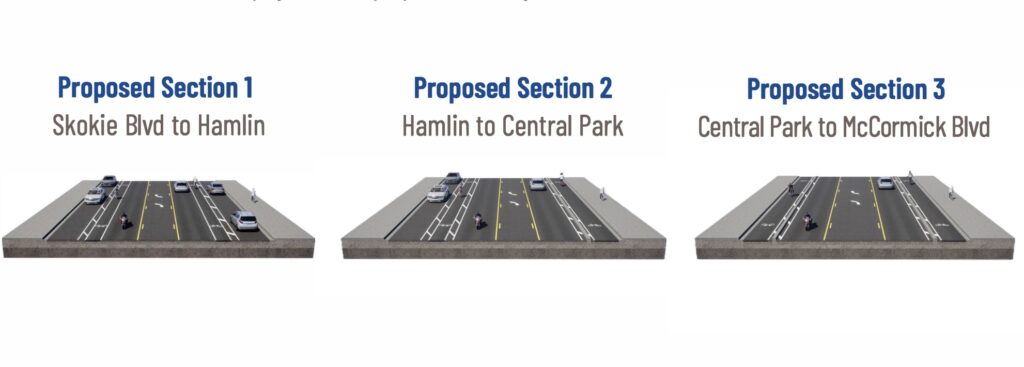
Specifically, the project will target the 1.8-mile corridor between the intersections of Skokie Boulevard and McCormick Boulevard. County officials previously described this stretch of roadway as one that “provides access to vital institutions in Skokie, including schools, parks, recreation centers and numerous businesses.”
Proposed changes from the county include a modification of the existing lane configuration to shift from two lanes to one lane in each direction (with a center left turn lane), on-street bike lanes and parking along “the majority of the corridor,” roadway resurfacing, updated pavement markings and upgrades to the CTA bus stops, per county documents.
Representatives from the county hope the changes will increase safety and connectivity for both vehicular and pedestrian users, provide pedestrian crossing enhancements and offer dedicated bicycle space and increased parking supply.
According to Patrick Hastings, Skokie’s director of public works, the project is estimated to cost approximately $4.16 million and will largely be funded by Cook County.
Skokie’s tab for the work is currently expected to come in at just over $95,000, which Hastings said in a village memo includes “costs associated with resurfacing portions of Knox and Kilbourn Avenues, streetscape elements, decorative pavers, greenspace enhancements, and related construction engineering.”
After the project is completed, per Hastings, Cook County will maintain the updated stretch of Oakton while Skokie will be responsible for maintenance of streetscape elements, landscaping, sidewalks and routine maintenance within the protected (separated) portions of the bicycle lanes.
The agreement approved with the county lists Skokie’s overall financial obligation for the project not to exceed $150,000.
Lockerby told the board that the county has held public meetings within the community to gather feedback on its plans for the roadway while also working closely with Skokie’s public works and engineering staff throughout the process. He noted that part of that has been ongoing conversations on how to best prevent delays and deal with ongoing maintenance issues that could arise.
Cook County has a new deputy-level director of the transportation department who’s been “extremely responsive and attentive to the issues” Skokie has brought forward, Lockerby said.
Student crossing
During discussion among the board on Monday, Mayor Ann Tennes shared community concerns regarding north-south crossing, and vice-versa, leading to Elizabeth Meyer School. While noting that crossing Oakton can be “challenging,” she asked how the new road design will prioritize safe passage for children and families who choose to walk to school.
Lockerby said the crossing at Oakton Street and Tripp Avenue will utilize rectangular rapid flashing beacons, a recently adopted technology for unsignalized crossings that are user-actuated and feature flashing warning lights to increase driver alertness, yielding rates and the visibility of pedestrians.
The signals will also be used at the crossing near East Prairie Road. Additionally, design plans call for what Hastings described as a “pedestrian refuge” at Oakton and Hamlin Avenue.
Trustee Lissa Levy noted safe pedestrian crossings are of even greater concern given that Skokie School District 73.5, which includes the nearby Elizabeth Meyer School and Oliver McCracken Middle School, will be losing its bus service.
“It is of increasing and really existential crisis for many parents whose children are going to be crossing, so I think this is just going to be a place where we’re going to have to monitor pedestrian activity and safety for these students, especially for Elizabeth Meyer, whose kids are kindergarteners and preschoolers,” she said.
Other concerns
County officials say that throughout the process they’ve worked to gather community feedback related to the plan. Per county documents, frequent feedback has included concerns related to reducing travel lanes from two to one in each direction.
A response to that feedback listed by the county argues that the project will maintain existing travel lanes at the Skokie Boulevard and McCormick Boulevard intersections, keeping the most heavily traveled intersections with the same flow.
The county also argues that operations along the corridor will remain “very similar to existing conditions” and will only grow by approximately 5-7% based on its projected traffic volumes.
Resident David Dalka during the public comment portion of the meeting, expressed concerns about the plan, saying it will hurt small businesses while also arguing it will work against the board’s goal of bringing more traffic toward downtown.
He called the plan “bad for Skokie, bad for business, bad for taxes and just plain bad.”
While noting that the plan is Cook County’s and not the village’s, Tennes said she shares some of the concerns related to small businesses that Dalka stated. Tennes asked village staff to be especially attentive to the village’s small business community throughout the process.
Oakton Street as a whole is largely controlled by Cook County but the village does oversee a portion of it.
Approximately 15 years ago, Skokie officials chose to execute a jurisdictional transfer for a section of Oakton, meaning at that time, Skokie took over ownership for the section of the street from Long Avenue to Skokie Boulevard.
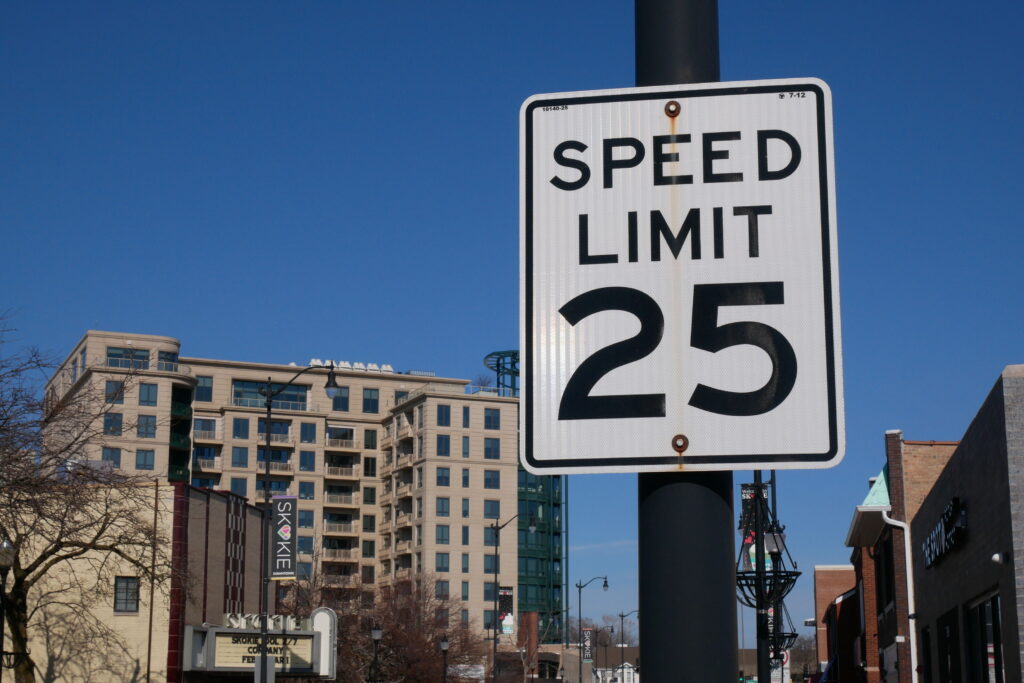
Tennes said that was done with the intention to gain control of Oakton in downtown Skokie, adding that transfer was a big reason why the village was able to lower the speed limit down to 25 mph there.
Cook County still maintains jurisdiction from Skokie Boulevard east.
Hastings during the meeting said county officials want “this project to be the first out the door for Cook County’s construction season.”
“We’re hopeful for that,” he added.
The Record is a nonprofit, nonpartisan community newsroom that relies on reader support to fuel its independent local journalism.
Become a member of The Record to fund responsible news coverage for your community.
Already a member? You can make a tax-deductible donation at any time.

Martin Carlino
Martin Carlino is a co-founder and the senior editor who assigns and edits The Record stories, while also bylining articles every week. Martin is an experienced and award-winning education reporter who was the editor of The Northbrook Tower.
The Record is a nonprofit, community news site from former editors of 22nd Century Media
Our daily coverage of your government, schools, businesses and neighbors is not possible without your support.
Latest

The Record: Shortcut
Related Stories