
Community urges Skokie trustees to pass policy on how local police should respond to immigration operations
Last November, amid a surge of federal immigration enforcement activity in the Chicago area, more than 100 people rallied outside Skokie Village Hall and filed into its council chambers to demand trustees codify a stance against what they saw as unlawful and amoral operations.
The Village Board voted then to amend its code to clarify that federal immigration agents cannot access village-owned property without a warrant.
Now, hearing renewed calls from residents concerned about ICE returning to the area in force, trustees will discuss a new ordinance during their March 16 Committee of the Whole meeting that would provide Skokie police more guidance on how to respond to federal immigration actions.
The discussion will take place in part because Trustee Gail Schechter moved to introduce an ordinance during the board’s March 2 regular meeting that she said aimed to “protect our residents, our workers, our students, our worshipers and our visitors” from Immigration and Customs Enforcement and Customs and Border Protection.
Trustee Lissa Levy and four members of the public joined Schechter during that meeting in requesting the village move quickly to assure local law enforcement will respond to the scene of suspected federal enforcement activity and take measures to protect public safety.
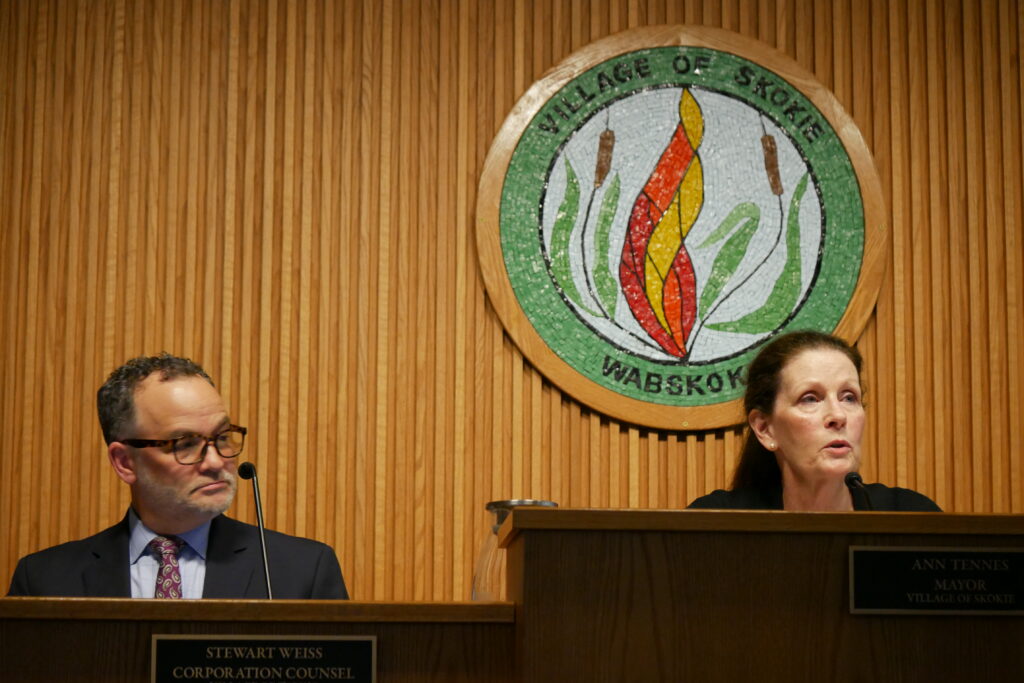
Yet Mayor Ann Tennes, other trustees, corporation counsel Steven Elrod and Village Manager John Lockerby expressed reservations about giving a first reading on March 2 to an ordinance the village did not draft, and indicated they wanted more time to work on the issue.
“Unfortunately these are horrible times, difficult situations for individuals, for families, for communities, for employers and for municipalities and state governments under the realm of the federal government,” Lockerby said.
“And so I wish there was a magic solution that could be discussed, but there will absolutely be a discussion framed, but the next steps or actions that this board can take in providing very direct direction to village employees is very difficult to put into the village code,” Lockerby said, noting that local municipalities do not have direct oversight over federal officers.
Tennes asked Schechter repeatedly on March 2 to amend her motion so that the board and village staff could gain more time to have a “robust discussion” about the ordinance.
Schechter agreed to modify her motion on the basis village staff consider the language of the ordinance she introduced, and that the trustees give a reading to an ordinance during their April 6 board meeting that aims to formally advise how local police respond to ICE and CBP.
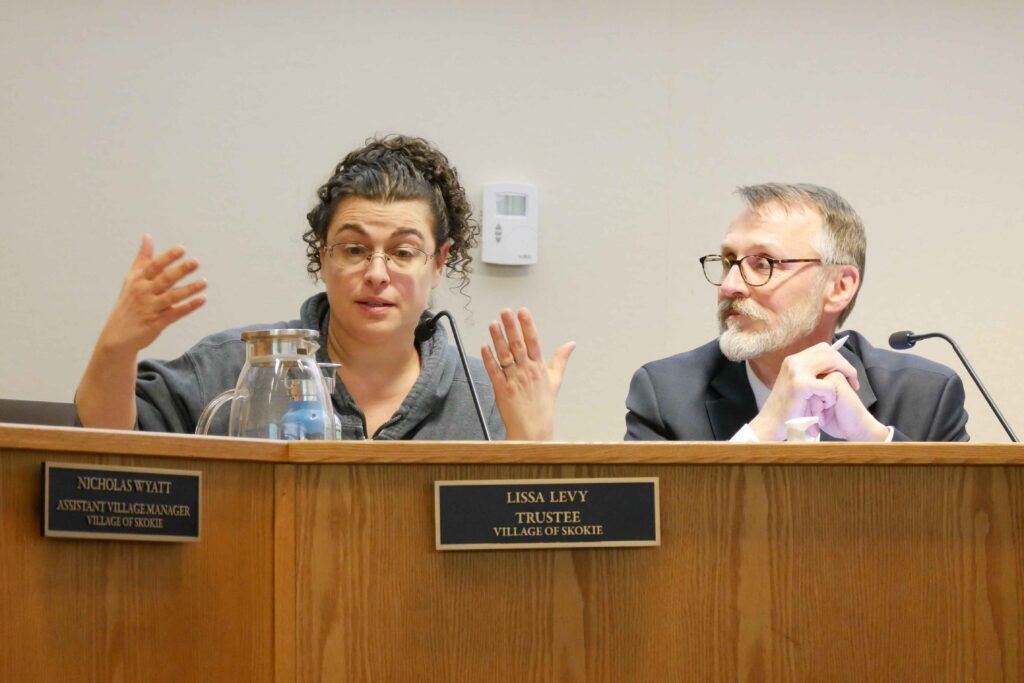
The trustees will meet at 5:30 p.m. at Village Hall on March 16 for their Committee of the Whole meeting. Elrod noted the earliest the board could give a first and, if successfully motioned, final reading to the new ordinance pertaining to federal immigration enforcement would be April 6.
After the board’s discussion, some Skokie residents, like Carrie Bradean, called on the village not to “water this down and put forward a nothingburger,” and to act thoughtfully but swiftly as “delays will result in more destroyed lives, lost lives.”
“This ordinance is very clear in giving clear guidance about what the police must do. It is not about, go and intervene and put yourself in great danger and determine which (force) is excessive. That’s not what’s in that ordinance,” Bradean said of Schechter’s draft ordinance.
“If we cannot write an ordinance and direct our police officers to go verify if masked gunmen spraying people with chemical weapons are in fact federal agents or just some random Proud Boys, then what do we have police for? I’m sorry; I’m very upset. That is the bare minimum.”
Agents could return this month
The U.S. Department of Homeland Security’s Operation Midway Blitz began last fall with a wave of immigration enforcement activities in and around the Chicago area. According to The Marshal Project, a nonprofit news agency, the federal operation tallied more than 1,600 arrests.
Multiple agencies told The Record in October 2025 that immigration agents had apprehended Skokie residents. A spokesperson for ICE, however, denied in an email to The Record on Oct. 31, that its agents made any arrests in Skokie.
We’re just saying please show up and turn on your body cameras. Please show up and ask for identification, and I’m not sure why that would be controversial.”
Lissa Levy, Skokie trustee on a potential village ordinance
Kimberly Polka, a Skokie resident, played a video to the trustees during an Oct. 21 Village Board meeting that appeared to show a federal agent confronting her after she apparently stopped to observe a federal immigration operation near a landscaping truck in Evanston.
During that meeting, Skokie Police Chief Jesse Barnes instructed residents concerned about witnessing ICE activities in the village to call 911 and said an officer supervisor will respond to the scene.
Barnes said Skokie officers will liaison with those on scene and prevent an escalation of force, but Skokie police cannot guarantee they can get ICE officers to identify themselves or their activities and “information is not flowing in either direction” between local police and federal agencies.
A few months later, federal agents shot and killed two people in Minneapolis, Minnesota, while conducting Operation Metro Surge, another immigration enforcement campaign that, according to The White House, led to more than 4,000 arrests.
A source with the Department of Homeland Security told the Chicago Sun-Times last fall that up to 1,000 agents — or four times as many as were in Chicago during Operation Midway Blitz — could return to Chicagoland in March 2026.
‘Harm’s way’
Polka was one of several residents who returned to the council chambers on March 2 to express fears that Skokie police “will do nothing” if ICE agents detain or threaten residents in the village because, she said, the department lacks “clear guidance.”
Lockerby said Skokie police officers are trained on policies and procedures developed by the village, and requiring Skokie police officers to potentially intervene in federal operations, which are dictated by other policies, could put those officers “in harm’s way.”
“One of the things that is being talked about by many people who are frustrated with the federal government and the Homeland Security and specifically the Border Patrol employees is the way that they’re interacting with the people they meet with, our neighbors,” Lockerby said.
“The challenge there is that the federal government is responsible for the oversight of that. And because of the frustration, people are talking about municipalities becoming that oversight and then that means, perhaps, the police officer would be in the position, in the field, of making a judgement call of whether or not what is occurring before their eyes is within federal protocol.”
He added, “And our village employees are not trained on that. Our village employees are trained on our protocol, including our police officers,” before noting that it’s “very difficult” to resolve the community’s frustrations through a municipal ordinance.
In response to Schechter’s motion, Trustee Alison Pure Slovin said she was not comfortable approving any ordinance that Skokie’s legal team had not reviewed, and Trustee Keith Robinson agreed the board needs to “lean on counsel” to educate the board and community.
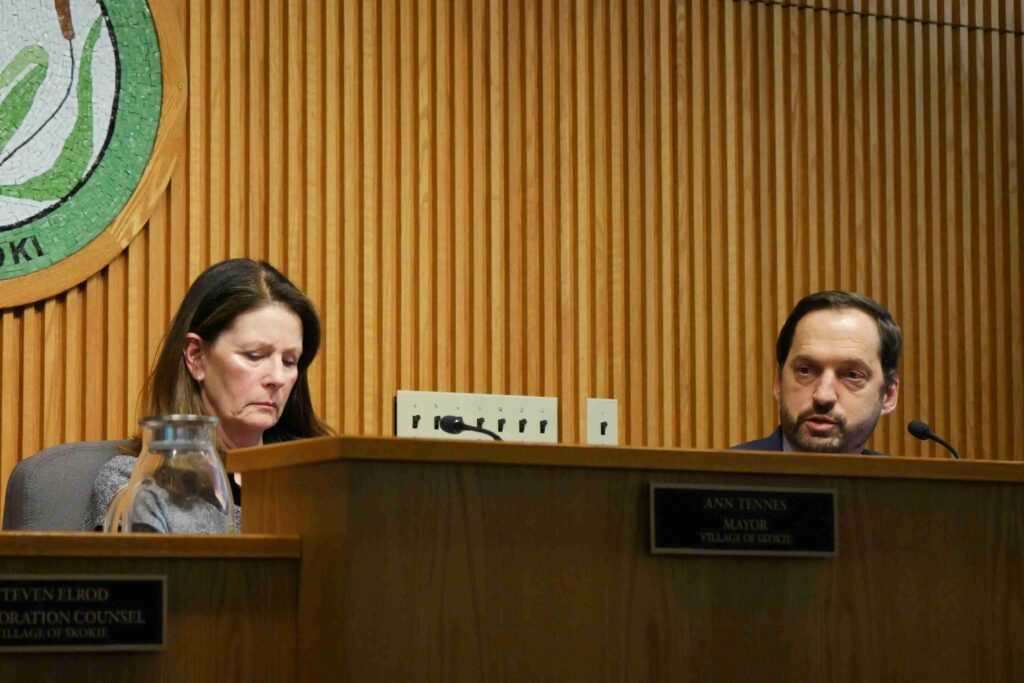
Before the board voted unanimously to discuss a new ordinance at their next Committee of the Whole meeting, Levy acknowledged that the village is in “uncharted territory” and “emotions are running high,” but she believed giving direction to Skokie police is feasible.
“When we find ourselves in a situation like this, I agree we don’t have jurisdiction over the federal government, all we have jurisdiction over is making sure we’re preserving the dignity of our community and we are not asking for officers to put themselves in harm’s way,” Levy said.
“This ordinance is asking them for official documentation of what’s being seen, and so that doesn’t sound to me like we’re asking anybody to go above the law or interfere with federal enforcement, we’re just saying please show up and turn on your body cameras. Please show up and ask for identification, and I’m not sure why that would be controversial.”
The Record is a nonprofit, nonpartisan community newsroom that relies on reader support to fuel its independent local journalism.
Become a member of The Record to fund responsible news coverage for your community.
Already a member? You can make a tax-deductible donation at any time.

Samuel Lisec
Samuel Lisec is a Chicago native and Knox College alumnus with years of experience reporting on community and criminal justice issues in Illinois. Passionate about in-depth local journalism that serves its readers, he has been recognized for his investigative work by the state press association.
The Record is a nonprofit, community news site from former editors of 22nd Century Media
Our daily coverage of your government, schools, businesses and neighbors is not possible without your support.
Latest

The Record: Shortcut
Related Stories