

King Pong: Aiming at a world record, Niles North students code and play massive game of Pong
It’s hard to think of a simpler game than Pong.
First released in 1972, the famous video game mimics table tennis and involves two players sliding their “paddle,” which appears on the screen as a vertical line, up and down to volley a 2-D ball of pixels across a screen.
Simple.
But Niles North High School recently decided to complicate things — and likely made history during the process.
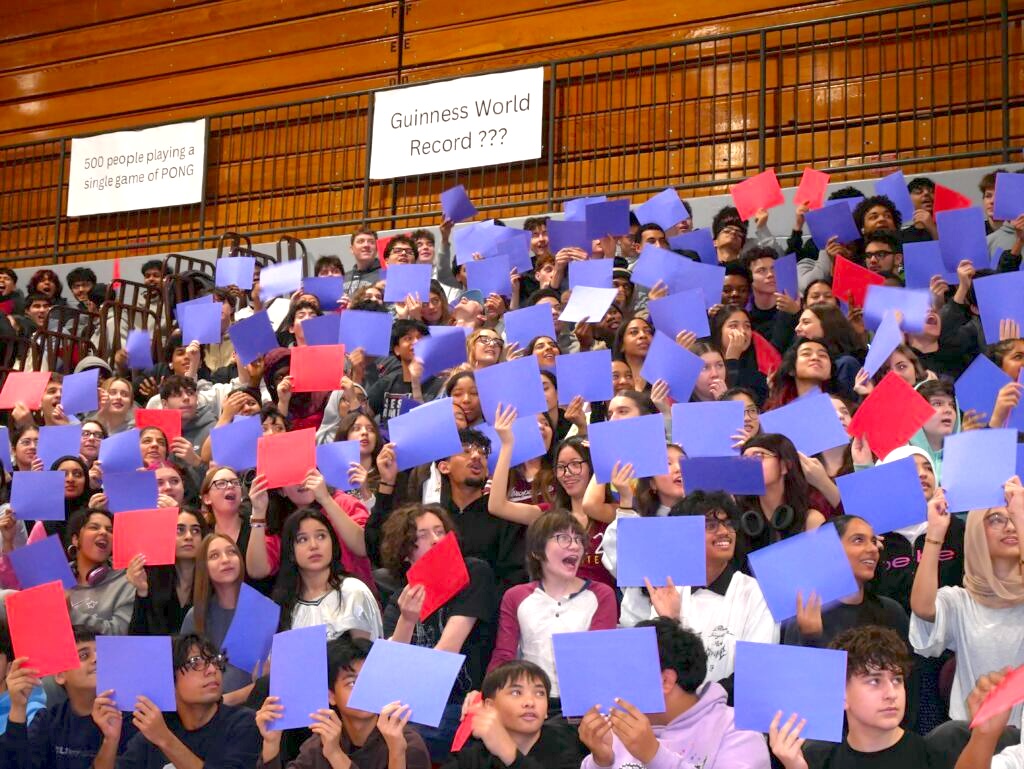
Students from one Niles North computer science class on Friday executed a 500-player version of Pong using cameras, colored pieces of paper and code they spent more than a year developing.
David Ruth, the teacher who facilitated the project, documented the game demonstration and plans on submitting it to Guinness World Records as proof of what he believes was the record for greatest number of people ever playing a single game of Pong.
The students who filled Niles North gym bleachers on Jan. 9 flipped sheets of paper back and forth haltingly at first, their eyes fixed on the game projected on a large overhead screen.
But when they caught on to how the papers, red on one side and blue on the other, moved the digital Pong paddles depending on which color on each side was predominantly aimed at cameras, the 250-player teams erupted in screams and cheers as they traded points.
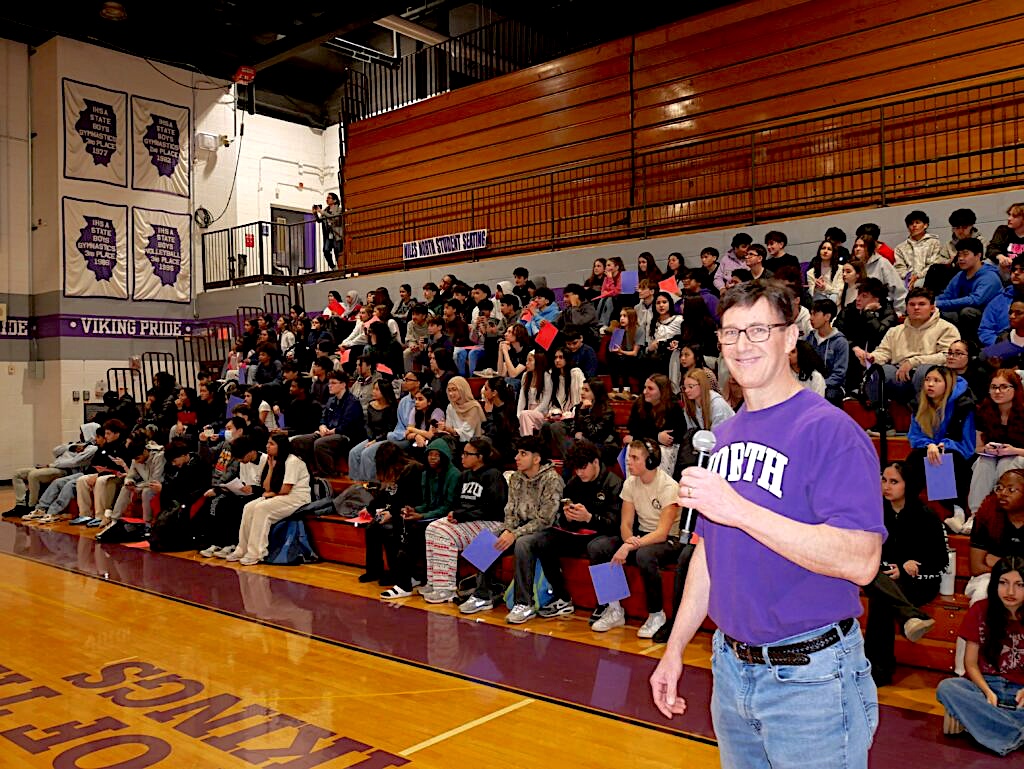
“I think seeing the joy on people’s faces, that excitement as well, that’s kind of one of my goals as an engineer — to facilitate the enjoyment and happiness of people with what we make,” Munhib Siddiqui, one of the students who helped design the Pong project, said.
Ruth, who has taught computer programming at Niles North for 30 years, said he helped students code versions of Pong from scratch before. But since this is his last year before retirement, he wanted to tackle something special, a project that would show their talents to the entire school community.
Siddiqui and another Niles North student, Haktan Erel, enrolled in Ruth’s advanced app development course last year and helped prototype the 500-player Pong game. The class started by writing code that would enable players to move the Pong paddles using hand signs, they said.
But the resolution of the camera footage was too low to register specific hand shapes, so the students wrote code that moved the Pong paddles up if there was more red in the crowd and down if there was more blue — effectively converting sheets of paper into video game controllers.
When the project wasn’t finished by the end of the 2024-2025 school year, Siddiqui and Erel enrolled in the class again this year to see it through.
The class broke up into groups to tackle portions of the project. One team was stuck for weeks on the right paddle alone before they realized a single symbol in their program’s code was pointing the wrong way, Siddiqui said.
They eventually got their Pong prototype to work with one player competing against another. Then, they expanded it to a row of 25 versus 25, but that was the furthest the class got.
Ruth and his students entered the gymnasium on Friday with 500 pieces of tape demarcating where players should sit in the bleachers, unsure if the game would even work at that scale.
But it did.
The first game was a rout, with Team Science beating Team Humanities 7-1. While the students in the crowd struggled how to move their paddles to block the Pong ball on screen, it was proof enough that the computer science class’s game worked.
The second game was even better, with both students and teachers shouting when points were defended or scored. Team Humanities completed its revenge with a 7-6 victory.
“It went better than I ever could have possibly expected,” Ruth said. “The way things were going this morning, putting this together, it was one of those things — you never know if it’s going to work until you see it work, and it’s good to be put in that position.”
Chris Powell, Niles North High School District 219’s director of engineering and computer science, emphasized the project helped students apply what they learn in the classroom in a “real-world” environment and scale — possibly even inspiring other students’ interest in the field.
“Typically in a class you would program something and play it yourself, maybe the person next to you would play it. But to have 500 people play it, it’s like a real test of how, career-pathway-wise, this could be scaled up,” Powell said. “This is what companies do.”
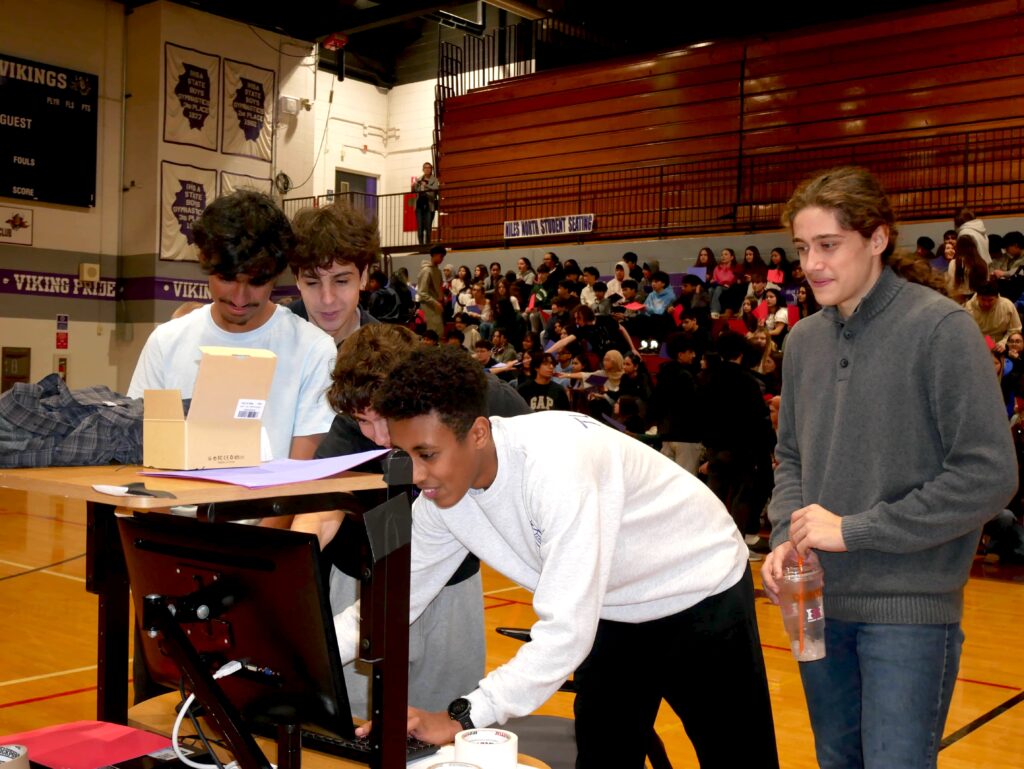
Erel, who was just one of several students huddled around a laptop during the game, said he was “surprised” and “exhilarated” to see the project they had worked on for so long prove functional.
But he was happy, too, he said, for Ruth and the added bonus of likely breaking the world record. The pre-existing record for most people who have simultaneously played a game of Pong? 440.
“Who doesn’t want a world record?” Erel said.
The Record is a nonprofit, nonpartisan community newsroom that relies on reader support to fuel its independent local journalism.
Become a member of The Record to fund responsible news coverage for your community.
Already a member? You can make a tax-deductible donation at any time.

Samuel Lisec
Samuel Lisec is a Chicago native and Knox College alumnus with years of experience reporting on community and criminal justice issues in Illinois. Passionate about in-depth local journalism that serves its readers, he has been recognized for his investigative work by the state press association.
The Record is a nonprofit, community news site from former editors of 22nd Century Media
Our daily coverage of your government, schools, businesses and neighbors is not possible without your support.
Latest

The Record: Shortcut
Related Stories