
Amid pushback, Highland Park commission wavers on support for townhome plan on Solo Cup land
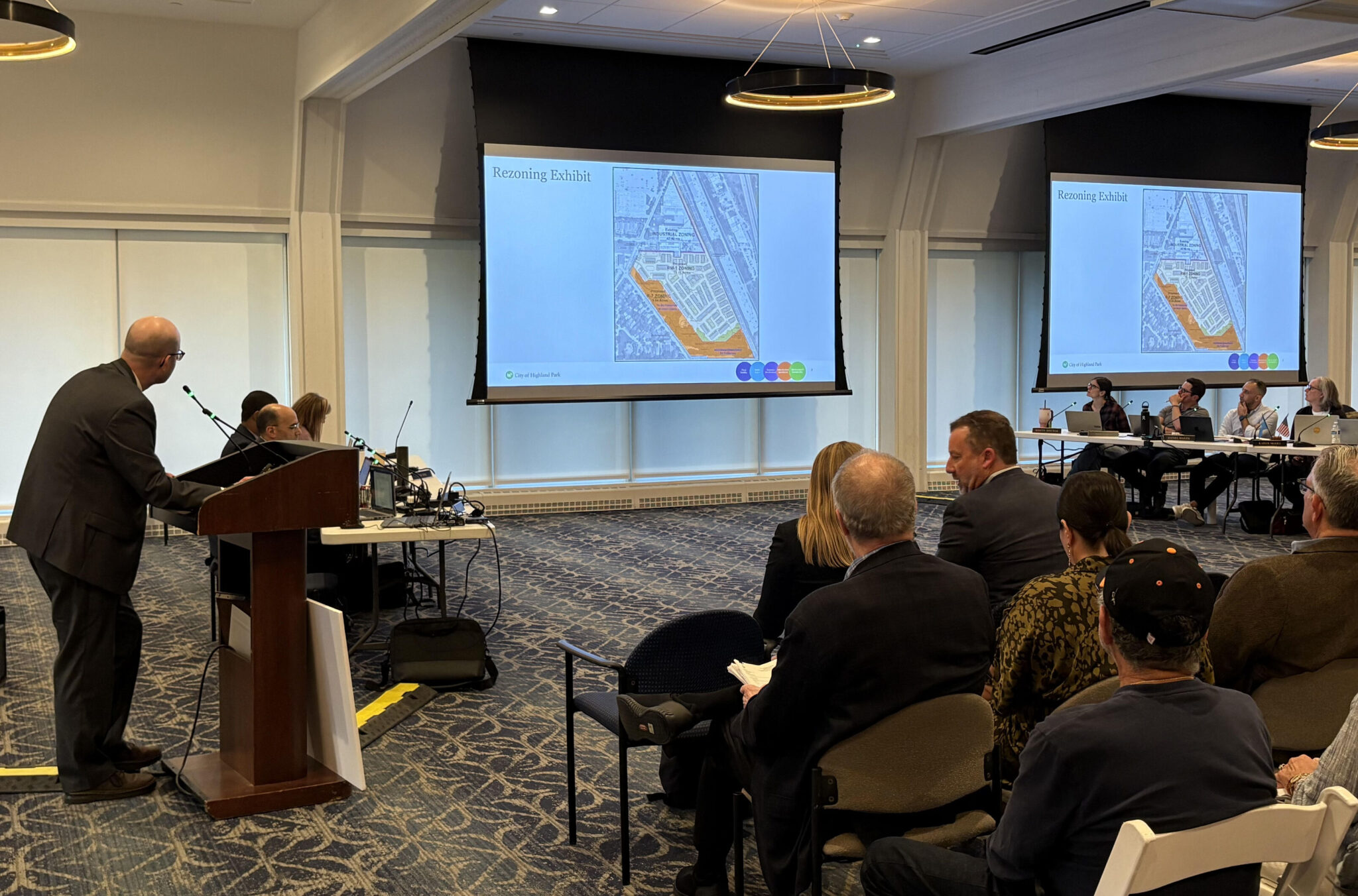
Expressing still-unresolved concerns about a townhome development’s density and design, Highland Park officials sent the developer back to the drawing board on Tuesday for the fourth and possibly final time.
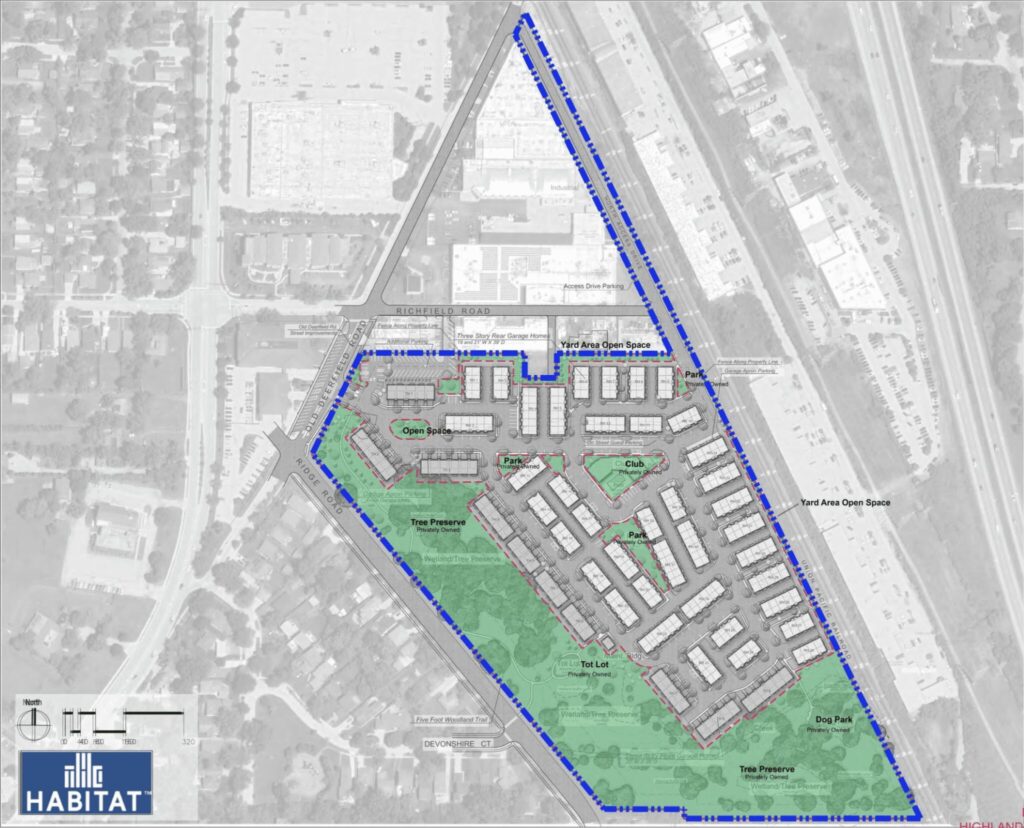
The Habitat Company, a Chicago-based developer working on behalf of Red Cup Land Company, has petitioned to rezone the former Solo Cup property — 28 acres of vacant land at 1700 Deerfield Road — from industrial to residential and build a 232-townhome residential community.
The commission voted 4-3 in July to request city staff draft conditions for recommending approval, but declined to hold a final vote on Tuesday after a nearly four-hour meeting in The Moraine drew 30 public comments from skeptical residents.
“For a proposal to merit consideration for this big of a downzoning, in my opinion, it would need to be outstanding in every respect; it would be something that we have not questioned the way we have questioned this development,” Commissioner Steven Kerch said.
The Highland Park Plans and Design Commission will meet again at 7 p.m. on Sept. 9 for their sixth and likely final public forum on the project. The proposed development will then go before Highland Park City Council on a future date with or without the commission’s recommendation.
If the city approves, The Habitat Company will move forward with the residential community designed to include a clubhouse with a pool, 690 parking spaces across surface spaces and garages; and nine acres of open green space featuring a dog park, public “Tot Lot” and walking trail.
The plot of land in question is located just west of Route 41 and south of Deerfield Road, neighboring the Highland Park Police Station. Residential neighborhoods exist a couple hundred yards to the west, off Ridge Road, and to the south, starting with Grove Avenue.
Echoing concerns from residents, Kerch argued there’s too little open space in the developed portion of the lot, the design creates an enclave “not harmonious” with the surrounding area, and it fails to provide enough public benefit in exchange for a code variance Habitat seeks for the height in homes.
Commissioners David Fettner and Ken Henry both indicated they’re close to supporting the development but are concerned about traffic the new homes would add to the area, particularly as the reopening of Sherwood Elementary School was not accounted for in the independent traffic study.
Commissioner Daniel Mantis countered that he’d be reluctant to strike the development down, noting this is the second time he’s seen an application for the plot. It’s frustrating to him, and likely to developers, too, he said, that the city lacks a clear road map on what it wants developed at the site.
“Highland Park does not have an up-to-date master plan,” Mantis said. “So absent an indication from the city on where we want things to go, we’re asking a developer or developers to come up with your best idea, let us kick it around, and that is an impossible idea to expect someone to meet.”
Numerous Highland Park residents voiced concerns about the site’s density, potential traffic congestion on Ridge and Old Deerfield Road, whether the increase in population would burden city services and local schools, and why the developer hasn’t communicated the rent or sale cost of the units.
Residents also expressed concerns the townhomes would be occupied by “transient” renters not committed to the community, the site would lower surrounding property values, construction would unearth microplastics from the Solo Cup facility and that its crosswalks will be unsafe.
“I live on Ridge Road. When there’s the rush hour, you got both lanes, both north and south, packed,” Jeff Zun said during Tuesday’s public comment section.
“What if God forbid I have a heart attack, or my next door elderly who’s an elderly woman has the same problem? How are they going to get an ambulance in there?” Zun asked. “This is crazy. You got too many projects in one area here and I hope somebody doesn’t pay for it with their life.”
Karl Burhop, the city’s senior planner, noted the development was reviewed by the city’s park district, police department, fire department and three surrounding school districts with no objections.
Kathie Jahnke Dale, a partner with The Habitat Company, emphasized that the developer has accommodated multiple rounds of feedback and argued it would be inappropriate for the developer to share its internal finances as to why it seeks 232 townhomes over a lesser suggestion like 178 townhomes.
“We’re really not sure what else we can do, because it’s not shaving down to that 178, that’s no project,” Jahnke Dale said. “You get a vacant site for another 15 years. You do not get this project at 178.”
“So we need more information,” she continued. “What would it be other than opening up, showing you our pro forma? Because that’s entirely inappropriate of a request and not something that even speaks to the standards. We’re talking about the standards of the site plan and what we’re proposing.”
The former Solo Cup plot has now gone through multiple iterations of proposed developments ever since Solo Cup sold the land in 2009 and all of Solo Cup’s buildings were demolished by 2015.
Red Cup Land Company previously proposed turning the plot into an industrial center with 300,000 square feet of warehouse and distribution space, but that plan drew pushback as it would have encroached upon nearby sensitive wetlands and removed heritage trees.
A 500-unit housing development was then proposed in 2018, but the community also raised concerns about its scale, traffic and neighborhood fit, according to a presentation from The Habitat Company.
More recently, Habitat made accommodations like reducing the development’s density to 232 townhomes from 240, increasing buffers along the property line abutting a railroad track, increasing the space between buildings to 15 feet, and reducing the parking on the site to 690 spaces from 714.
As a reported public benefit, 14 parking spaces will be available for the City of Highland Park and 12 will be non-exclusive spaces, slightly more than what was previously offered.
The plan also includes 53% more trees than required by code, multiple townhome color schemes and facade types, a 1,430-linear-foot public access walking trail through preserved wetlands and added parking for industrial businesses on Richfield Road, according to The Habitat Company.
Habitat will now have two weeks to respond to the latest direction city commissioners gave on Tuesday.
The Record is a nonprofit, nonpartisan community newsroom that relies on reader support to fuel its independent local journalism.
Become a member of The Record to fund responsible news coverage for your community.
Already a member? You can make a tax-deductible donation at any time.

Samuel Lisec
Samuel Lisec is a Chicago native and Knox College alumnus with years of experience reporting on community and criminal justice issues in Illinois. Passionate about in-depth local journalism that serves its readers, he has been recognized for his investigative work by the state press association.
The Record is a nonprofit, community news site from former editors of 22nd Century Media
Our daily coverage of your government, schools, businesses and neighbors is not possible without your support.
Latest

The Record: Shortcut
Related Stories