
2 more District 65 schools may close as part of $20-million budget cut
Three public information sessions scheduled
(Editor’s Note: Hope Perry reported this story for Evanston RoundTable, a neighboring independent newsroom. It was shared with The Record as part of an ongoing collaborative effort.)
Evanston/Skokie District 65 administrators announced on Monday that they will formally present plans in October to slash $20 million from the budget and close at least two more school buildings.
Those plans will also include reducing purchased services and examining nonmandated programs, according to district leaders.
The district on Monday did not name any specific schools that could face closure.
“I am going to be asking the board that by November — certainly by the end of November — we agree to approve and set this plan in motion. And I can tell you, at that moment, the crisis will be over,” interim Superintendent Eric Witherspoon told the School Board on Monday, Sept. 14.
District 65 has been fending off a structural deficit for several years, and projections from the previous chief financial officer estimated that the board would need to make about $11 million in cuts over the next two years to balance the budget.
Last year, the School Board ultimately approved the closure of Kingsley Elementary School, following an earlier vote to close the Dr. Bessie Rhodes School of Global Studies in Skokie. Both buildings shuttered after last school year.

In agreeing to close Kingsley, board members also agreed to revisit the possibility of closing Lincolnwood Elementary this fall if certain financial benchmarks were not met. Last spring, the board also approved more than $6 million in budget cuts in an attempt to combat the deficit.
But on Sept. 14, administrators said more aggressive cuts are still needed.
According to a presentation from Chief Financial Officer Eric Miller and Assistant Superintendent Stacy Beardsley, district expenses are far outpacing revenues. Total spending is rising by 5.8% each year, Miller said, while revenues are increasing by just 2.9%.
Personnel costs make up more than 70% of the district’s budget, and jumps in staffing expenses are contributing to the upward trend. The district’s compensation pool rose by $8.95 million between fiscal years 2026 and 2027 (school years 2025-26 and 2026-27), and an analysis of healthcare benefits showed they are increasing by approximately 12% each year, according to Miller.
Adding to the challenges, District 65 served 7,808 students in the 2015-’16 school year. This year, tentative numbers indicate an enrollment of about 5,900 students, putting school utilization around 64%, Beardsley said. Staffing levels, however, have not aligned with enrollment decline.
Beardsley pointed to a discrepancy between District 65’s staff-to-student ratio and that of peer districts. District 65 has just 8.5 students for every one licensed staff member — including teachers, instructional coaches and others like speech language pathologists. That is 20% more than peer districts, which operate with an average of 10.6 students per staff member, Beardsley said.
The district also reportedly employs a disproportionate amount of nonlicensed staff, such as janitors and paraprofessionals, when compared with peer districts — 10.6 students per staff member to 23.5 for peers.
The ratio of students to administrators, at 90:1 in 2024, was similarly out of step with peer districts until recently (now 140:1), according to Beardsley.

Witherspoon said the district will engage with the community in the coming days before presenting a full-fledged plan to the School Board on Oct. 13.
Officials will host three public-information events for families: at 6 p.m. Tuesday, Sept. 22, at Chute Middle School; 6 p.m. Wednesday, Sept. 23, at Haven Middle School; and 6 p.m. Thursday, Sept. 24, at Nichols Middle School.
Board discussion
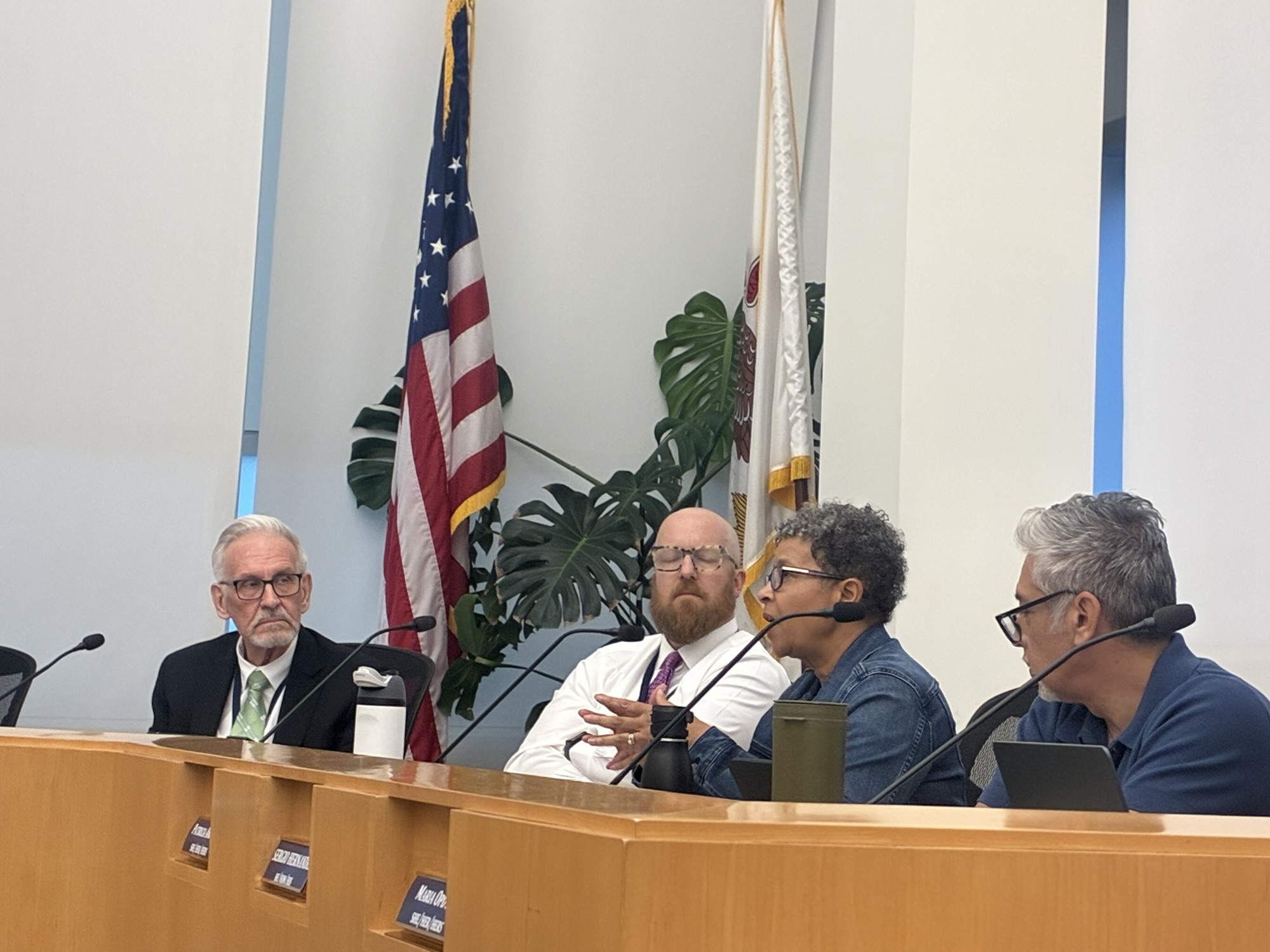
In the ensuing conversation, School Board member Andrew Wymer praised the work of administrators.
“Even though this is hard news and challenging news, I appreciate the way you’re seeing the lay of the land. And in a way, that inspires confidence for me that we have a path forward here,” Wymer said.
“I just want to name that this is a huge number. We know the pain of closures. … I know that, like Dr. Witherspoon said, this will impact everybody. This will have reverberations,” he continued.

Board member Mya Wilkins expressed a similar sentiment, saying that while she had many feelings, she was ultimately “hopeful” for the district.
“I know that these aren’t easy decisions. I know the $20 million is a big number, and they’ll have really big impacts. We’ll have to make sacrifices as a whole community. But I am so, so looking forward to the light at the end of the tunnel,” Wilkins said.
At the same time, board member Maria Opdycke argued the board already went through a similar process last year, when she said the amount of cuts necessary was “underrepresented” compared with the numbers presented Monday.
“Then we had a budget, and then we missed the budget,” she said, referring to last month’s board meeting when Miller revealed that fiscal year 2026 would end with a significantly higher deficit than projected.
Opdycke said that going forward, the district needs to stick to its budget, and that if there are “overruns” in certain areas, cuts will have to be made elsewhere.
Witherspoon said the October plan will “right-size” the district.
The Record is a nonprofit, nonpartisan community newsroom that relies on reader support to fuel its independent local journalism.
Become a member of The Record to fund responsible news coverage for your community.
Already a member? You can make a tax-deductible donation at any time.
The Record is a nonprofit, community news site from former editors of 22nd Century Media
Our daily coverage of your government, schools, businesses and neighbors is not possible without your support.
Latest

The Record: Shortcut
Related Stories