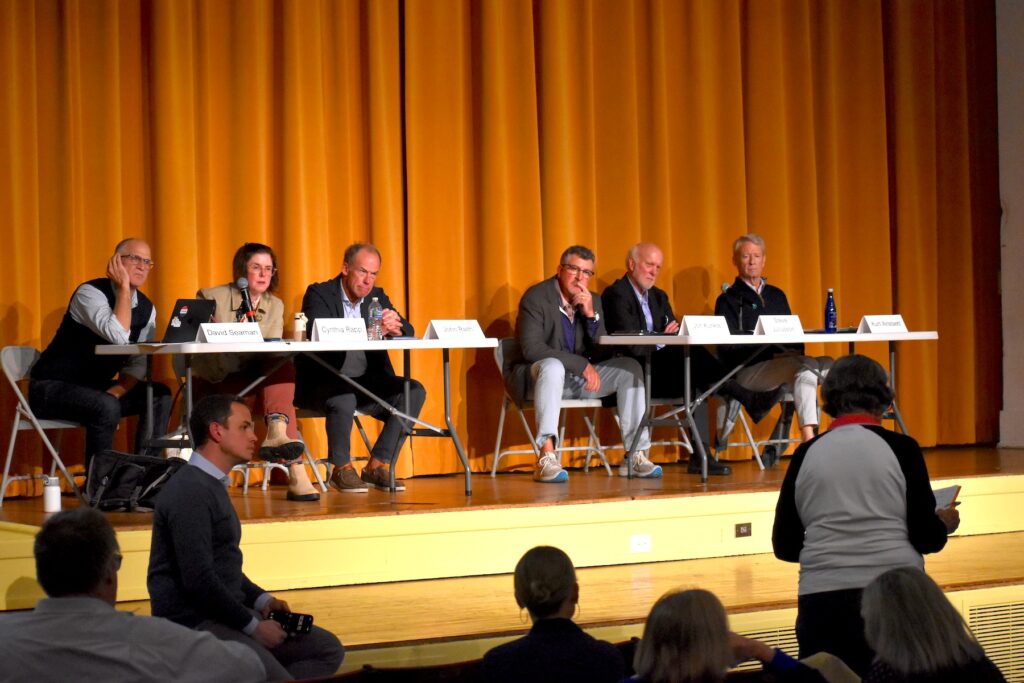

40% emissions reduction a cornerstone of Winnetka’s first climate action plan
Furthering its commitment toward a sustainable future, the Winnetka Village Council has unanimously adopted a climate action plan that officials said will enable lower greenhouse gas emissions over time.
The climate action plan was presented to the council at its regular meeting on Tuesday, July 21, when Village President Bob Dearborn said the plan was “aspirational in nature and meant to be a guide used in coordination with community partners,” which include the Winnetka Park District and Winnetka D36 Schools.
Village Sustainability Manager Elyse Steiner said the primary goal of the plan is to provide a detailed framework for measuring, planning and reducing greenhouse gas emissions overtime.
The plan includes three “core elements: establishing a historic emissions baseline, setting time-bound long-term emissions reduction targets, and identifying strategies to implement in order to achieve those targets.
Steiner, though, also noted that the plan does not include other types of environmental protection actions that the Village may take.
“This climate action plan demonstrates the community’s commitment to addressing climate change and making appropriate infrastructure investments and transitioning to cleaner energy over the long term,” she said. “It will serve as a roadmap for decision-making and resource allocation, and progress can be measured over time to maintain accountability.”
Behind the Plan
Steiner presented data on the village’s greenhouse gas emissions, using information from 2022. According to the data, 55% of the village’s emissions came from residential buildings, followed by 23% from transportation and 16% from commercial buildings. The remaining 6% came from a combination of industrial buildings, institutional buildings and waste.
The climate action plan is proposing reducing emissions by 40% below 2022 by 2040. Steiner said that’s a goal that is similar to Winnetka’s neighboring communities, and called it, “a realistic, attainable and achievable, yet ambitious goal.”
Within the plan are four areas — buildings and energy, transportation, waste, land and forestry — that each hold objectives to aid in the reach of the 40% reduction goal. Those objectives include retrofitting buildings, installing efficient lighting, purchasing electric vehicles and planting more trees.
Going forward, Steiner said the Village’s Environmental, Forestry and Sustainability Commission will work with the village manager’s office to identify and prioritize the initiatives. Those proposals, she said, will eventually come to the Village Council for approval.
Steiner said there will also be a public dashboard on the Village’s website so residents can track the progress of the plan’s goals.
‘A Beginning’
During public comment, King Poor, a member of the EFSC, praised the climate action plan.
“This is really an important public commitment by the Village about our commitment to preserving the environment and sustainable living,” he said. “It’s really heartening to see.”
Peter Eck, chair of the EFSC, echoed Poor’s comments.
“To me, it all goes back to trying to be really focused and deliberate with our work and making sure that we are delivering the greatest benefit to the community,” he said. “And I think this just gives us a wealth of information to guide that work and to put us in a position to be very deliberate and strategic.”
Trustees also voiced support for the plan, with Trustee Kim Handler, the council’s liaison to the EFSC, noting that the plan “is a beginning rather than an endpoint.”
“I think this is a great start for the community,” she said. “I’m excited that Winnetka’s going to take a leadership role here and adopt a plan like this.”
Though he supported the plan, Trustee Scott Myers encouraged the Village to go further than the recommendations.
“I think we can be more aggressive here,” he said. “I think that I look for [the EFSC] to push us, and I think us to push ourselves, to live up to the commitment that we made to the residents.”
The Record is a nonprofit, nonpartisan community newsroom that relies on reader support to fuel its independent local journalism.
Become a member of The Record to fund responsible news coverage for your community.
Already a member? You can make a tax-deductible donation at any time.

Peter Kaspari
Peter Kaspari is a blogger and a freelance reporter. A 10-year veteran of journalism, he has written for newspapers in both Iowa and Illinois, including spending multiple years covering crime and courts. Most recently, he served as the editor for The Lake Forest Leader. Peter is also a longtime resident of Wilmette and New Trier High School alumnus.
The Record is a nonprofit, community news site from former editors of 22nd Century Media
Our daily coverage of your government, schools, businesses and neighbors is not possible without your support.
Latest

The Record: Shortcut
Related Stories