

Review board delays Northfield TIF recommendation, but opposition speaks out
The first formal rendering of opinion on Northfield’s intensely debated plan to spur economic development via a tax increment financing district will have to wait a few more weeks.
At the conclusion of a two-plus hour meeting Wednesday, July 15, the joint review board, a statutorily created body designated to formally review TIF district proposals, held off on issuing its recommendation regarding the village’s potential designation.
Members of the review board, many of whom were clear in their skepticism of the Village’s plan, cited the desire for additional time to further review the subtleties of the proposal.
The board will meet for a second time, likely during the week of Aug. 10, to reach its conclusion. According to state law, the board must issue its recommendation no later than 30 from the July 15 meeting. An exact date for the second meeting has not been set as of publication time.
As previously reported by The Record, Northfield trustees in late June voted to adopt two ordinances advancing their consideration of establishing a TIF district in the village.
What is a joint review board?
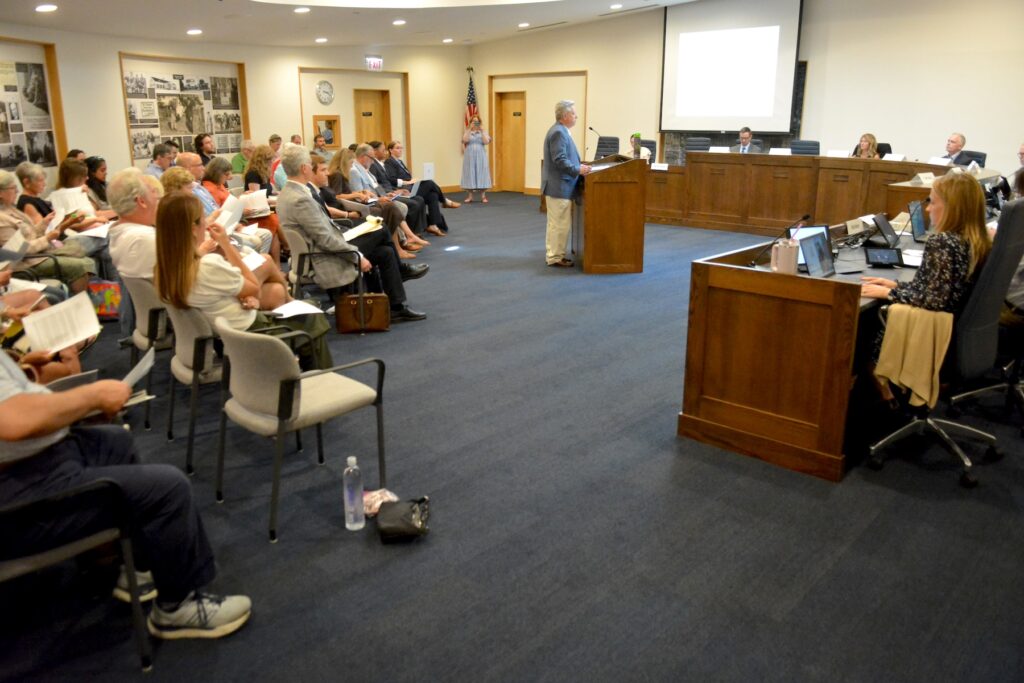
The formation of a joint review board, per Illinois state law, was required as a subsequent measure to trustees’ approval three weeks ago.
Joint review boards include representatives of the overlapping taxing bodies within a municipality’s proposed TIF boundary.
The board’s primary purpose, as detailed during the July 15 meeting by Greg Jones, the village’s attorney, is to evaluate and review key public documents related to a TIF proposal, including the eligibility report and the redevelopment plan and proposal.
Per Jones, the board is ultimately responsible for making a determination on whether it believes the proposed TIF district meets the necessary criteria to be created. Its role comes in an advisory capacity, meaning the joint review board is not the body responsible for establishing a TIF. Northfield’s Village Board is the final decision-maker in the process.
The joint review board tasked with examining Northfield’s case features representatives from: Avoca School District 37, Sunset Ridge School District 29, New Trier High School District 203, Cook County, Northfield Park District, Winnetka Park District, Village of Northfield, Oakton Community College and Winnetka-Northfield Public Library District.
Representatives from New Trier and Northfield townships were also slated to be a part of the board but neither were present during Wednesday’s meeting.
As its first order of business, the board selected Northfield resident and District 29 School Board member Charlie Pick as its public member. The inclusion of a public member is a requirement of state law. Pick’s selection bucked a nomination from the village — Northfield resident Debbie Papas.
Officials then tabbed Johnson, one of New Trier High School’s top administrators, as the chair of the board.
‘We see it differently’

Although the board did not cast a formal recommendation on the TIF proposal, several representatives expressed their hesitations about the village’s plan.
A main concern among board members was the need for more time to comprehensively review the proposal and potential options, other than a TIF district, that may be viable alternatives.
“I think everybody can get behind development but it is difficult when we feel like we’re under the gun and there’s a lot of pressure to digest a huge amount of information on the subject and not have really vetted any kind of alternatives,” Pike said.
Similarly, Winnetka Park District Executive Director Shannon Nazzal said the park district’s board of commissioners was hoping for more time as well.
“Our board would appreciate more time to be able to look at more information and get more details,” she said.
Bill Byron, of the Northfield Park District added that, for his organization and its board, it’s “really been a timing issue.”
“The sequence of certain meetings just hasn’t allowed our board to have the thorough discussion I think they’d like to have before being prepared to make a recommendation,” he said.
In addition to concerns on timing, the contingent of the board representing local school districts also brought forth apprehension regarding property tax implications.
Johnson said that “New Trier is in strong support of having a vibrant community center and understands the rationale of improving the downtown area” and that “a strong business community and strong schools go hand in hand.”
But, he added, that while the district “shares that goal, we see it differently of how this can be accomplished.”
Johnson continued to say that property taxes fund approximately 91% of New Trier’s $148-million annual budget.
“It is important for our board of education at New Trier that anything that can impact property tax payers be thoughtfully considered before it moves forward,” he added.
Echoing a similar tone, James Eichmiller, superintendent of D29, said one of the biggest concerns a school district can have is educating new students without receiving additional funding that would come through growth and new construction.
“The main concern that the district has at this time is the prospect of educating new students without new funding,” he said.
Avoca, Sunset Ridge and New Trier also collectively retained a financial advisor to “conduct an independent review of the village’s TIF eligibility study and redevelopment plan.”
As part of Wednesday’s meeting, Joe Pilewski, of Pilewski Financial, presented his findings from an analysis of the village’s proposal, which the districts said ultimately reached the conclusion that “the proposed TIF should not be approved.”
Pilewski argued that the proposed redevelopment area the village is proposing is “already experiencing meaningful private redevelopment.”
He also suggested in his findings that there are “financially viable alternatives to address” Northfield’s infrastructure needs. One of the methods he noted during his presentation was the use of a Special Service Area incentive.
Northfield’s pro-TIF case
Northfield leaders for years have examined how to enhance the town’s primary business district. And, earlier this year, as reported first by The Record, village officials began exploring the possibility of a TIF district.
Over the course of what’s now been several public meetings across multiple months, town officials have stated their desire to boost growth in the Happ and Central corridors, saying the area has several issues that stagnate community growth, such as deteriorating buildings, aging water mains and declining property values.
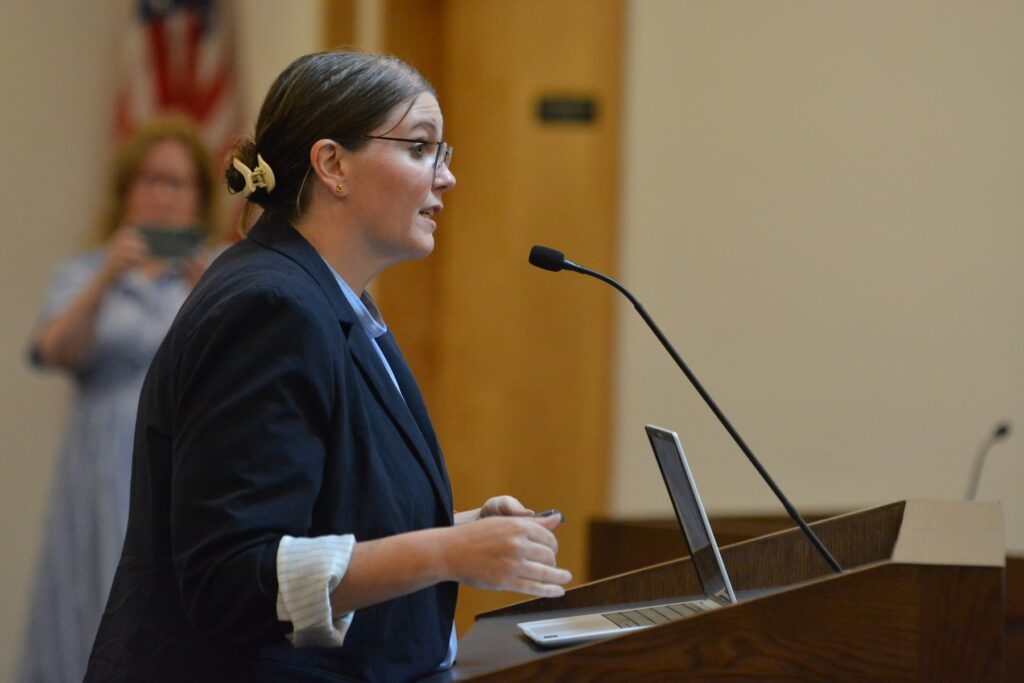
Caitlin Johnson, senior vice president of SB Friedman, the village-contracted consultant firm exploring the TIF plan, addressed the joint review board Wednesday to offer background on the plan.
The proposed redevelopment project area consists of 141 parcels, 106 acres and 76 primary buildings and is generally located along Willow Road and Central Avenue and extends down Happ Road, per Johnson. The southern extent is Winnetka Road and the northern border is Pine Road.
Johnson told the board that the goal of the TIF is “to support redevelopment as a mixed-use district.” That includes, she said, facilitating improvement of existing structures and facades as well as improvements on public infrastructure.
The TIF is also a tool to implement Northfield’s 2040 Vision Plan and a tool to “coordinate available federal, state and local resources,” Johnson said.
When a TIF district is put in place, the property taxes collected from that district area are frozen. More properties are developed, and property values tend to increase. The extra tax dollars generated from those increased property values are the “increment” that fund improvements to roads, buildings and more within the district.
Areas must meet certain criteria to qualify for tax increment financing. SB Friedman reviewed village documents and recent private investment data and concluded that — based on signs of aging infrastructure (87% of area’s buildings are more than 35 years old) and slow economic growth — the redevelopment area Northfield is proposing is eligible for a TIF district.
Residents urge a ‘much more careful look’

Eleven members of the public spoke during the public-comment portion of the meeting on Wednesday, with the near-entirety of commenters detailing concerns that closely mirrored the ones shared by members of the joint review board.
Sean Hofherr, who with his wife, Arielle, owns Hofherr Meat Co. in downtown Northfield, cautioned that the proposal deserves a deeper review than it’s received so far.
“We are not here to oppose economic development in the village center,” he said. “Northfield’s commercial corridor is an important part of what makes our community work and thoughtful investment benefits everyone — but a TIF is a serious tool. It redirects property tax revenue for up to 23 years. We think it deserves a much more careful look before this board gives its endorsement.”
Kathy Estabrook, who is on the village’s Plan and Zoning Commission but clarified she was speaking as a resident, said establishing a TIF district would be “too quick” of a decision given the recent rezoning changes made in the village.
She argued those changes have thus far done what they were intended to do: spark development in the downtown area.
“Let’s let the rezoning do what it’s designed to do and then if we need the TIF, let’s revisit it then,” she said. “But to do it now seems like way too fast.”
Since rezoning efforts were completed in 2025, multiple housing projects — a 12-unit condo building and 92-unit apartment complex — have been introduced and advanced forward in the village, as reported by The Record.
Margaret Farney, a 50-year resident of the village, said she believes Northfield is gaining business as opposed to the arguments being made that it’s losing business. She also urged a slower approach to reviewing the proposal.
“We really need to slow down and reevaluate all of this,” she said. “I don’t think enough research was done.”
Northfield’s Village Board is scheduled to meet both at a Committee of the Whole session and its regular meeting this Tuesday, July 21. The Committee of the Whole is scheduled to begin at 5:30 p.m. with the regular board meeting following.
Discussions related to the TIF proposal are included on the meeting’s agenda as of publication time.
The Record is a nonprofit, nonpartisan community newsroom that relies on reader support to fuel its independent local journalism.
Become a member of The Record to fund responsible news coverage for your community.
Already a member? You can make a tax-deductible donation at any time.

Martin Carlino
Martin Carlino is a co-founder and the senior editor who assigns and edits The Record stories, while also bylining articles every week. Martin is an experienced and award-winning education reporter who was the editor of The Northbrook Tower.
The Record is a nonprofit, community news site from former editors of 22nd Century Media
Our daily coverage of your government, schools, businesses and neighbors is not possible without your support.
Latest

The Record: Shortcut
Related Stories