Community voices shaping Highland Park places of remembrance
A new round of design concepts honoring the victims and survivors of the 2022 Highland Park shooting was presented to city officials Monday, June 8.
During the special Committee of the Whole meeting, project partners SWA Group and All Together highlighted how community input collected over the past month influenced the evolving vision for the places of remembrance.
Since May, SWA and All Together have gathered feedback in the form of 113 survey responses, an 18,000-person social media reach, 50 workshop particiants and more.
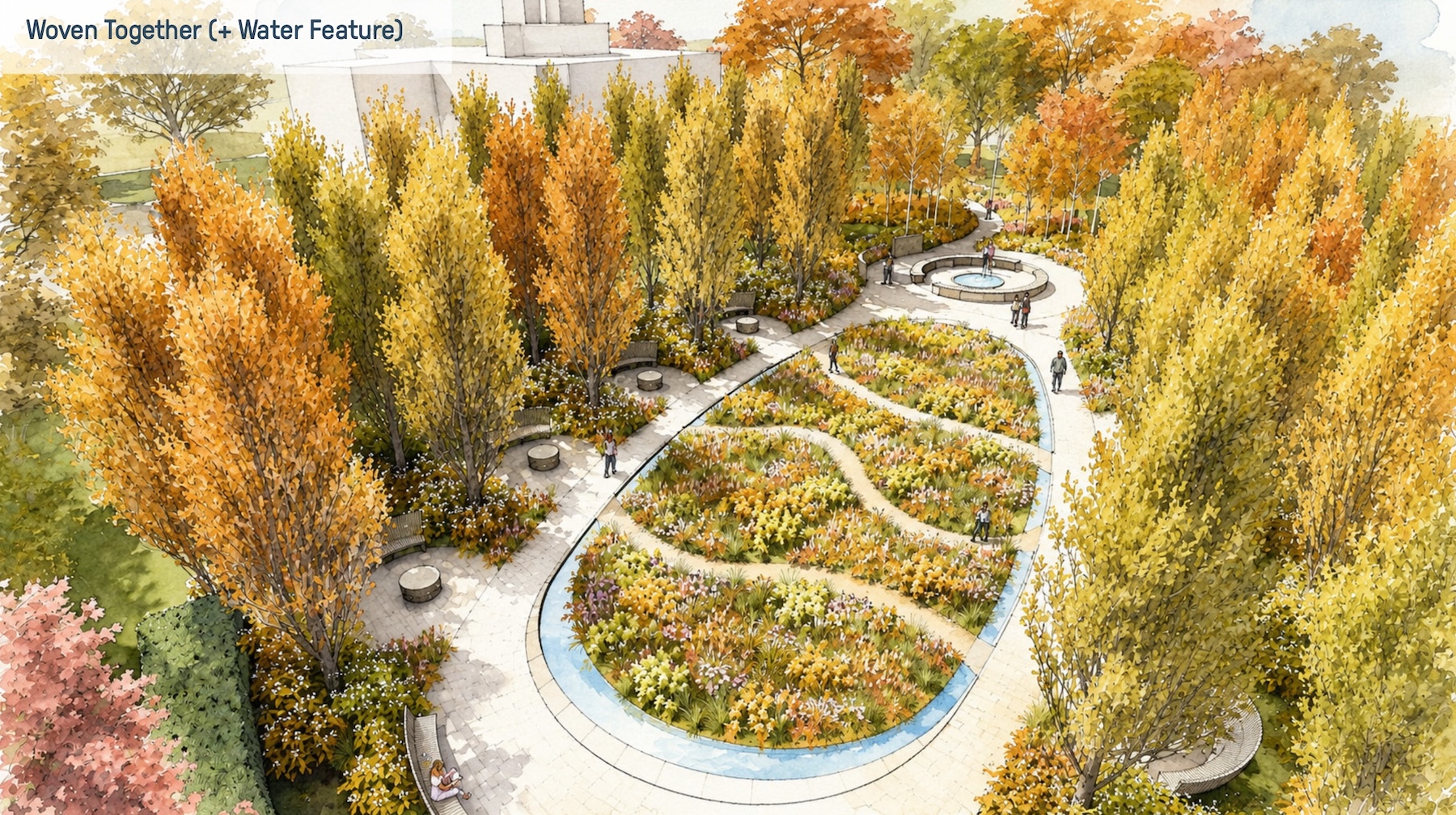
For the rose garden location, out of the three concepts (which debuted in early May), Woven Together resonated most strongly across every group, planners said on Monday.
Brand strategist with All Together Kristian Gist said that in Woven Together people appreciated the nature-based elements; the seven niches (representing the seven victims) for private reflection; the ability to choose a path through the space; and that it allows people to grieve and remember in different ways.
Still, respondents suggested improvements to the design, like “creating a solid center pathway where people can walk by without disturbing others in the niches, putting the names of the victims into the collective in addition to featuring their names in the niches, acknowledging the people who were injured in a more significant way and making sure there is accessible parking nearby for easy use,” Gist said.
With that feedback in mind, updates were made to Woven Together, according to Ben Waldo, landscape architect with SWA Group:
• Adding a walking loop around the outside to avoid awkward traffic moving through the niches,
• Increasing the amount of framing trees to 48, representing those injured in the attack,
• Adjusting the water element to a ring framing the garden rather than a line running through the center of the space,
• Including the names of the victims at the end of the water feature, engraved on stone panels, and
• Having light beam out from the tables in the seven niches.
Design concepts will be discussed further at the Historic Preservation Commission meeting at 6 p.m. on June 24 in City Hall.
More advanced designs from SWA Group should be put together by the end of summer.
All designs, meeting notes and more can be viewed at the place of remembrance’s dedicated website. With feedback, email remembrance@cityhpil.com.
The cost of water
Without the water feature, the space is expected to cost between $1.3-$1.7 million, and with the water feature, between $2.25-$2.8, which would exceed the city’s $2 million budget, Waldo said.
“We do think that there is a lot of value that comes from a water feature, but we are also pleased that the space works functionally very much the same without it,” Waldo said. “I think this design could stand with or without it.”
To Mayor Nancy Rotering however, the water feature is “absolutely critical,” she said.
Rotering said that the space will be “here for decades to come” and should be “done right.”
“I think that it’s an element that brings so much to what we are trying to achieve in this place,” Rotering said.
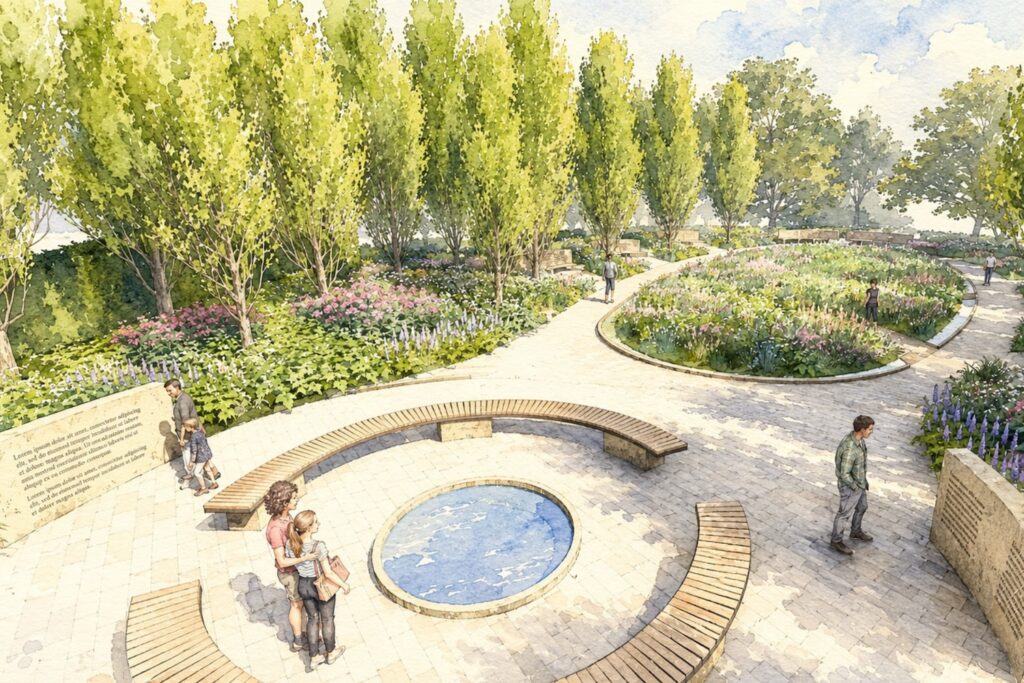
To mitigate costs, Rotering suggested including at least the reflecting pond in the design rather than the water ring, if it comes down to cost.
Though Councilmember Anthony Bloomberg would be comfortable with or without a water feature, he would prefer one.
“I like the sound and the movement of water, but there are substitutes for that like windchimes and other things that can substitute for the subtle noise,” Bloomberg said.
Councilmember Annette Lidawer thought a compromise could be small fountains, if a primary water feature is too costly.
“If you had a fountain in each niche table rather than around the perimeter, that would give whoever is visiting the niche the respect to hear the sound of the water,” Lidawer said. “The circle of water doesn’t mean that much to me, and I am just astounded and appalled at the cost. We should find other ways of including water without spending an additional $1 million on it.”
Councilmembers Yumi Ross and Andrés Tapia also suggested substitutes for the water, such as polished granite stone that “mimics the reflective nature of it,” Ross said, or an audio speaker to “mimic the sound of water,” Tapia said.
Representation
Lidawer and Councilmember Jon Center appreciated the addition of the 48 trees that represent those injured. They also liked the lighting and the crevices inside the niches, which would support the Jewish tradition of leaving stones near graves.
Councilmember Andrés Tapia, though, questioned planned representation of the Latino culture, which is based on native plantings attracting butterflies.
“Butterflies are very ethereal and may not appear. That’s putting a lot of weight on the butterfly to give the Latino experience,” Tapia said. “I think that’s very weak.”
Tapia suggested including more patterns or textiles that are baroque, like Talavera tiles, in the niche spaces.
In Port Clinton
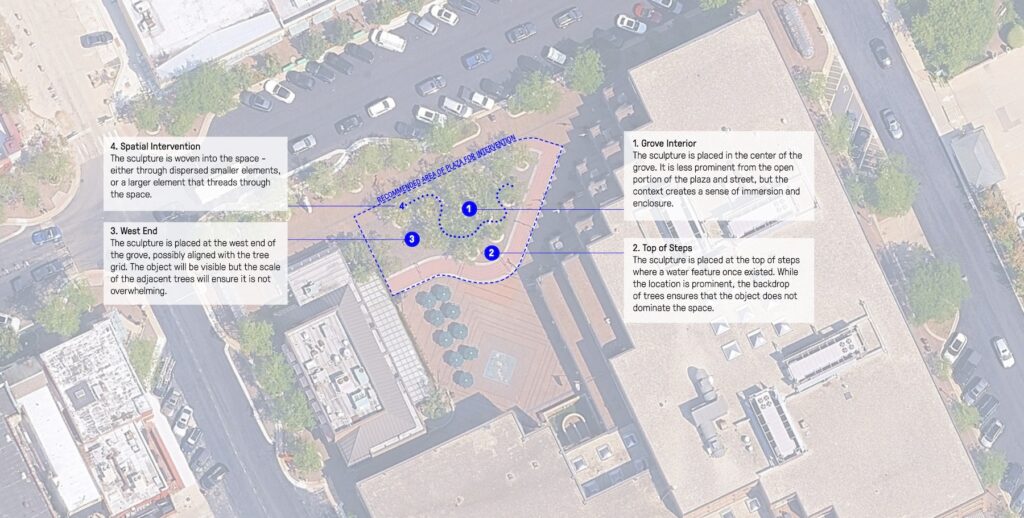
For a remembrance space in Port Clinton, near the site of the attack, no consensus emerged among the three concepts — Woven Together, Love Letters and Petals — according to the presentation.
Public feedback reportedly showed “a fear of losing Port Clinton as is,” “distrust in the process from Day 1,” “fear of the impact on downtown commerce” and “fear of retraumatization.”
Planners reported that 37% percent of those providing feedback wanted a more prominent visual, 42% wanted to keep the visual subtle and 18% wanted to exclude a visual entirely at Port Clinton.
The feedback has caused planners to consider a new idea: a sculpture, Waldo said.
Tapia supported the idea, because it would give more “flexibility,” with varying shapes and sizes.
Rotering would like to add a water feature to the sculpture, as a way to connect the space to the rose garden memorial, she said.
Lidawer liked the idea of having a tree as a sculpture, while Ross suggested using the Japanese design concept of kintsugi in the sculpture, representing that “mended pieces together are stronger than original piece,” she said.
Tapia liked the idea of having a sculpture similar to the one in Waukesha, Wisconsin, called “Holding Love,” which honors the six victims of a 2021 parade attack.
Community thoughts
Residents present at the meeting were content with the updated designs from SWA Group.
Liz Turnipseed, a resident who was injured in the shooting, felt the need to intervene at the meeting to let SWA Group and the council know to keep thinking about the sculpture at Port Clinton in a “trauma-informed” manner.
“Since I was shot at Port Clinton, with my husband and daughter at the time, we continue to struggle to go to events at Port Clinton due to concerns of PTSD,” Turnipseed said. “So ensuring that as we move forward the city takes an approach of making sure to include individuals who have sensory troubles being there like my family, and offering alternative options for people to still be able to engage in the community.”
Michael Cohn, a relative of Jacki Sundheim, who was killed in the attack, feels the opposite way and is glad the city is considering a sculpture in Port Clinton.
“For my healing, Port Clinton is where I go, so it’s important to mark it with some form of art,” Cohn said. “I am very much happy that they thought of a sculpture in Port Clinton.”
As for sculpture ideas, Cohn supported councilmember suggestions, such as something similar to what was done in Waukesha, Wisconsin, and something utilizing kintsugi, as Ross mentioned.
Cohn also believes the sculpture in Port Clinton to be related to what is done in the rose garden and thinks memorializing the seven victims is important for Port Clinton’s sculpture.
The Record is a nonprofit, nonpartisan community newsroom that relies on reader support to fuel its independent local journalism.
Become a member of The Record to fund responsible news coverage for your community.
Already a member? You can make a tax-deductible donation at any time.

Alessia Girardin
Alessia Girardin is a community reporter focused on stories out of Highland Park and Highwood. A Chicago native and Regina Dominican alumna, she has published work for local and New York City publications and earned a master's degree from New York University.
The Record is a nonprofit, community news site from former editors of 22nd Century Media
Our daily coverage of your government, schools, businesses and neighbors is not possible without your support.
Latest

The Record: Shortcut
Related Stories