
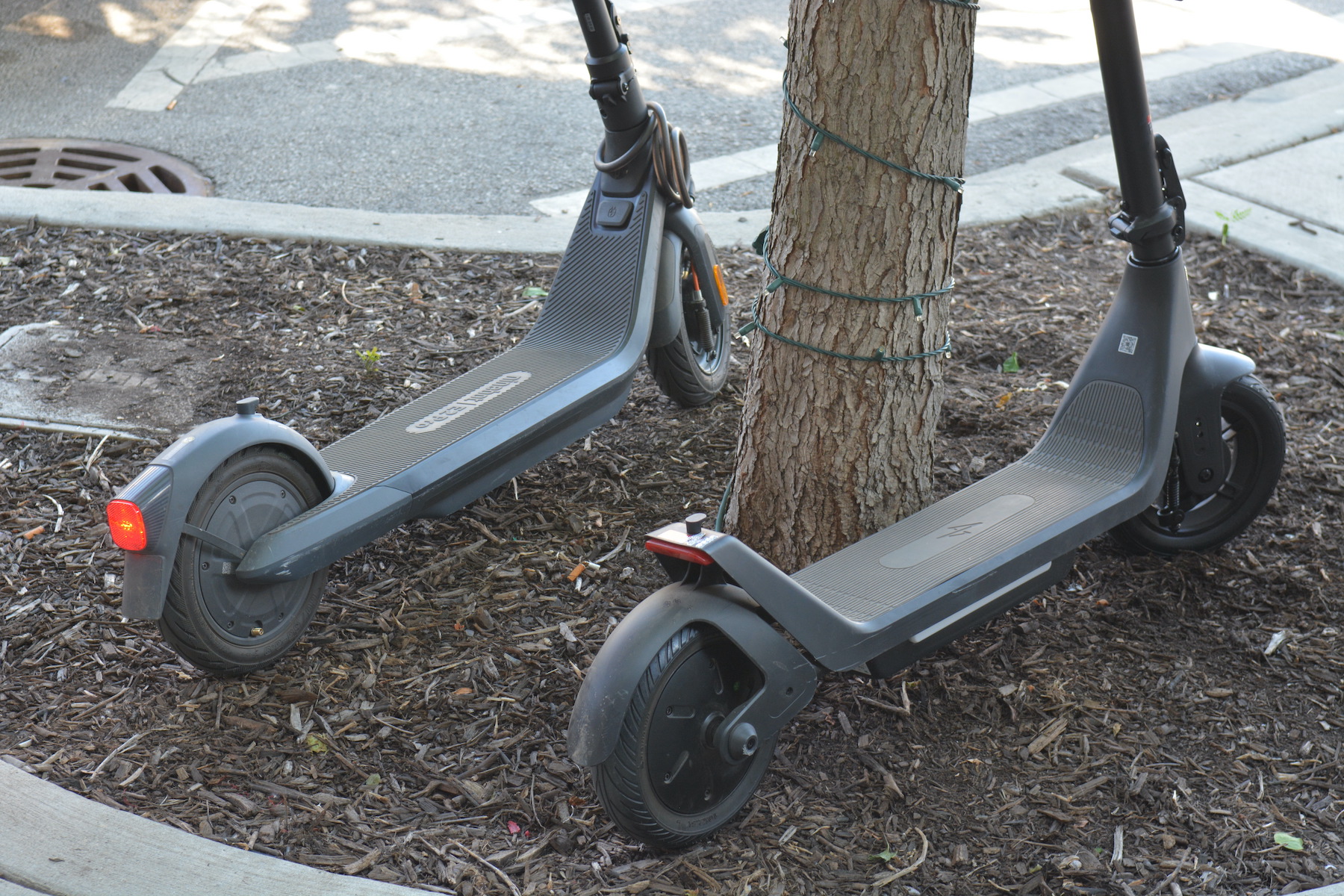
Wilmette not yet ready to regulate e-bikes, scooters
Wilmette officials are hoping a new ordinance under consideration will bring the town up to speed with its neighbors regarding electric-bike and -scooter safety.
Although a draft ordinance made its way to the Village Board during its Tuesday, Jan. 27 meeting, trustees are first hoping to round up additional community feedback before putting the wheels in motion on any new laws.
Sara Phyfer, assistant to Wilmette’s village manager, told the board that potential regulations “are partially in response to the growing popularity of these devices.”
Additionally, in a village memo to the board, Phyfer said the village “has experienced an uptick in concern from residents regarding the use of such devices in the community.”
Per Phyfer, Wilmette’s Public Safety Committee, a subcommittee of the Village Board, met twice (November 2025, January) to discuss regulating e-scooters and e-bikes prior to the board’s discussion on Jan. 27.
Wilmette’s approach to regulation differs from several of its neighbors as the village is exploring what officials described as a “speed enforcement model.” Phyfer detailed this as a “simple and practical approach” where the framework “uses familiar concepts like speed limits, rather than regulating based on the type of device being used.”
“Our primary goal here is the safety of community members and people traveling through Wilmette, so once regulations are adopted, enforcement will be focused on addressing reckless and dangerous behavior,” Phyfer said.
Wilmette officials have also repeatedly said they currently view any local regulations as “stop-gap measures,” as state policy is developed.
The ordinance trustees reviewed Tuesday night uses what officials described as a broad, “catchall term” of “motorized mobility vehicle or device.” Then, the potential ruling would utilize subterms based on the device speed or designation.
According to village documents, vehicles included in that are “an electric or gas driven wheeled scooter, cycle, cart or other vehicle utilized for personal transportation, operated by a rider in either a sitting or standing position and can be propelled without physical pedaling for which the state does not issue a title document, license plates or registration documents.”
The ordinance places the tightest restrictions on the standard mobility vehicles, which are apparatuses that can reach speeds of up to 28 mph.
The potential regulations would state that operators of such vehicles need to be 16 years or older, can only ride them up to 10 mph on sidewalks and can’t use them in Village Center sidewalks, the Village Green and village-owned parks, and where signage otherwise prohibits. This includes, per officials, all three classes of e-bikes and faster e-scooters.
Under the current iteration, the ordinance would allow use on bike paths, bike lanes, streets and alleys up to the posted speed limit.
Out-of-class electric vehicles, which are defined in proposed legislation as vehicles that can reach speeds of greater than 28 mph, would also only be permitted on sidewalks up to 10 mph or bike paths, streets and lanes up to the posted limit.
Wilmette’s Public Safety Committee during its deliberations recommended via a 2-1 vote approval of the ordinance. Trustee Michael Lieber was the dissenter, arguing that the committee should not recommend allowing standard mobility devices on sidewalks or bike paths in town.
Lieber expanded on this during the Jan. 27 session, saying he would like Wilmette to be “trendsetters” when it comes to this aspect of regulations, noting that many of the town’s neighbors have also allowed the use on sidewalks and bike paths.
“I’d like to keep our families safe, I’d like to keep our kids and our elderly people safe and essentially separate these because I think if we have clear rules it actually leads to less enforcement and more safety,” he said.
Much of the board’s conversations focused on whether it should allow the use on sidewalks and bike paths or move toward prohibiting there as well. Citing the need for more community feedback, no final decision was made at the meeting.
Although the ordinance was originally scheduled for the board to vote on during its Feb. 10 meeting, officials noted it likely won’t come back to trustees until late February or early March.
“We’ve heard a lot of input from the community and I know it’s important to the community,” Village President Senta Plunkett said. “Nobody is thinking about it right now because it’s 5 degrees and full of snow outside, so I think a little bit of extra time to remind the community that we’re discussing this right now is a good thing.”
The Record is a nonprofit, nonpartisan community newsroom that relies on reader support to fuel its independent local journalism.
Become a member of The Record to fund responsible news coverage for your community.
Already a member? You can make a tax-deductible donation at any time.

Martin Carlino
Martin Carlino is a co-founder and the senior editor who assigns and edits The Record stories, while also bylining articles every week. Martin is an experienced and award-winning education reporter who was the editor of The Northbrook Tower.
The Record is a nonprofit, community news site from former editors of 22nd Century Media
Our daily coverage of your government, schools, businesses and neighbors is not possible without your support.
Latest

The Record: Shortcut
Related Stories