
With new recruits, Skokie Police Department approaches full staffing for first time in years
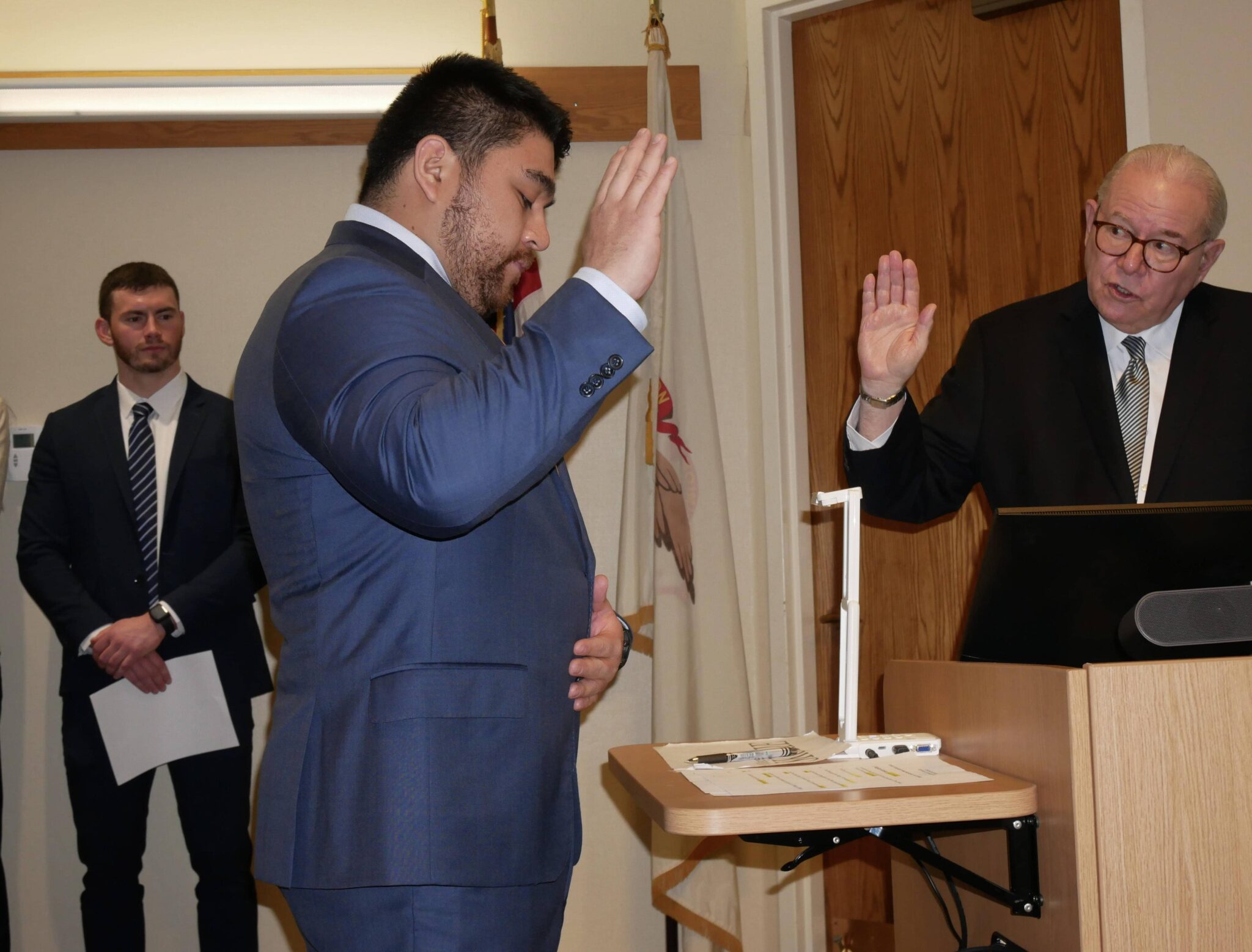
Earlier this month, four individuals entered Skokie’s council chambers in Village Hall wearing ceremonial uniforms and each raised their right hands and pledged to uphold the laws of the constitution in the name of the Skokie Police Department.
Three additional recruits are expected to join the force later this year when they complete police academy training, giving the department a total of seven new officers — a major step toward filling the Skokie police ranks for the first time in at least five years.
Skokie Police Chief Jesse Barnes said getting the force to full capacity with 113 sworn personnel on staff is one of his goals this year after the department, like others across the country, contended with an “unprecedented” number of early retirements starting in 2020.
The Skokie Police Department’s six vacancies are spread across its investigations, special operations, crime prevention and patrol divisions in order to avoid a disproportionate impact on services in any one specific unit, Barnes said.
The police chief attributed Skokie’s relative success in recruiting and retaining officers to the local community’s support of the department and measures like the $15,000 hiring bonus the Village implemented in 2025.
But given the lengthy (11-month) process it takes for new hires to complete training, Barnes said he obtained approval from the Village to do something new this year: hire more than 113 sworn employees to insulate the department from future retirements or injuries.
‘Nationwide perception’
The Skokie Police Department was nearly fully staffed with 112 sworn personnel in January 2020, but its ranks dipped in the following years, to 106 in January 2021, 104 in January 2022, 108 in January 2023, 105 in January 2024 and 107 in January 2025.
The village saw 17 of its police officers retire between 2022 and 2025. While not all were early retirements, seven left the force in 2025 alone.
“The early retirements were a direct result of some of the nationwide perception of law enforcement,” Barnes said, citing public backlash to a Minnesota police officer’s murder of George Floyd in 2020 and the inability to engage with the community during the pandemic.
Barnes noted the job of being a police officer has become more complex in recent years with the rise of body cameras and emphasis on de-escalation training.

There is also a strong job market for retired officers to take private security jobs at places like houses of worship, Barnes said. Additionally, some recruits retire after realizing they’re not suited for the intensive nature of the job — of the 14 officers Skokie hired in 2025, five have already left the force.
All of those conditions contribute to a recent decline in individuals seeking to become a police officer.
Approximately 60 people applied to become a Skokie police officer in 2025 and just 42 passed the department’s physical and written exam. That stands in stark contrast to the 500-1,000 applicants the Skokie Police Department received annually in the late 1990s and early 2000s, Barnes said.
‘A higher level of service’
Once the Skokie PD reaches 113 sworn-in employees, Barnes said it will become a standard “best practice” moving forward to hire and begin training officers in anticipation of staff departures, whether from retirement, sickness and injury, or transfers.
The police chief said he is not aware of any officers who plan to retire in the next six to eight months. Skokie reportedly has 39 officers who are still within their first decade with the department, and officers seeking maximum benefits from their pension must stay on for more than 30 years.
Hiring past full capacity will be important, Barnes said, because of the length of time it takes for new hires to take the physical, written, polygraph and psychological tests; interview with the department; and complete a background check.
Undergoing training at a state police academy subsequently takes four and a half months, and field training in Skokie takes another three to fourth months, making it approximately 11 total months before an individual who accepted a job offer can be deployed on solo patrol.
The Village of Skokie allocated $21.7 million for its police department in fiscal year 2026 (a 5.1% bump from 2025), with $18.4 million of that going to department salaries — $11 million for uniform patrol salries, according to the village budget.
Starting pay for a new hire police officer is $89,713, Barnes said, though certified candidates can start between $97,035 and $113,516 depending on their level of experience.
Barnes said the $15,000 hiring bonus Skokie offers, the collective bargaining agreement the village approved with the police union in 2024, and the general support the local police force receives from the community have helped fortify the department.
“I think Skokie is incredibly supportive of us, so that’s helpful. That has an impact on our people’s morale and mindset,” Barnes said. “There are some communities that are not nearly as supportive as ours has been and I think some of those communities have really struggled in their staffing.”
While Barnes said the police department has provided Skokie “an incredibly high level of service even at our toughest days,” becoming fully staffed will help the agency further retain its officers as there’ll be more flexibility in schedules for those seeking time with family and special training.
Barnes said there’s been instances in which the FBI has offered to take on Skokie police officers for task forces, but he’s had to decline in order to prioritize patrols in the village.
By becoming fully staffed, the department can offer Skokie police officers more opportunities to advance their careers and spend more time on investigations.
“Being fully staffed allows us to be more flexible with our resources and it will allow us to certainly provide a higher level of service to the community,” Barnes said.
“What I mean by that is I have vacancies in some of my specialty positions and adding staff to some of those specialty positions would certainly allow us to increase the level of service that we give those types of investigations and things of that nature,” Barnes said.
The Record is a nonprofit, nonpartisan community newsroom that relies on reader support to fuel its independent local journalism.
Become a member of The Record to fund responsible news coverage for your community.
Already a member? You can make a tax-deductible donation at any time.

Samuel Lisec
Samuel Lisec is a Chicago native and Knox College alumnus with years of experience reporting on community and criminal justice issues in Illinois. Passionate about in-depth local journalism that serves its readers, he has been recognized for his investigative work by the state press association.
The Record is a nonprofit, community news site from former editors of 22nd Century Media
Our daily coverage of your government, schools, businesses and neighbors is not possible without your support.
Latest

The Record: Shortcut
Related Stories