
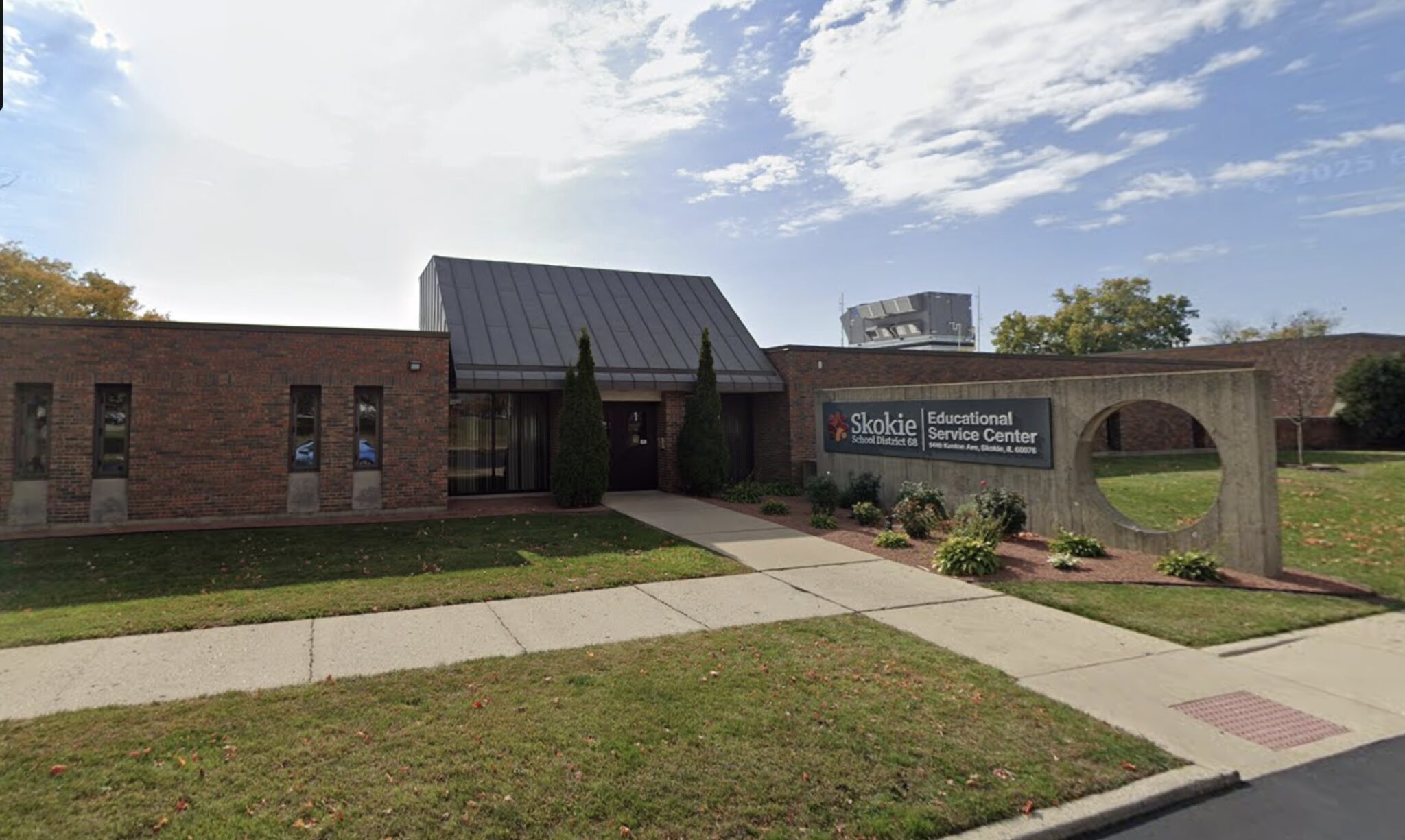
New development could plump Skokie District 68’s shrinking reserves
The outcomes from a pair of large-scale local developments will play a “critical” role in the financial future of Skokie School District 68, which operates five schools in northeast Skokie.
District officials during a late November board of education meeting heard a presentation detailing a financial projection for the district’s next six fiscal years.
That forecast, presented by Dr. Robert Grossi of Illuminate Consulting, depicted a coming era for the district that will be defined by its two “biggest uncertainties” right now: the Westfield Old Orchard redevelopment and The Henry at Harms Woods project.
These are two developments that the district, per the advice of Grossi, must “follow closely” given that combined the projects — both within the district’s boundaries — will bring close to 1,000 new residential units into the village.
Precise projections related to the number of students these two projects will add to District 68 schools are ambiguous at this time, officials noted, but the district must prepare for two vastly different outcomes: either an influx of new students or a minimal enrollment uptick that would only slightly shift operations.
The former, if played out in the most bullish scenario, could result in the district needing to add more staff and potentially even alter its buildings to accommodate more students. The latter would bring in millions of revenue to the district without a significant increase in expenses.
Yet, regardless, the district should expect significant new funds thanks to new properties adding to its taxing base.
“On the positive side, if you end up getting $2 million-plus in revenues and there’s very few students coming out of this project, that’s great,” Grossi said. “But there’s about 1,000 new units coming in and I know the village has been told and I believe schools have been told that a lot of students aren’t coming out of there, but 1,000 units is a lot of units.
He continued, “But if a lot of students are to come out of those units that could have significant impact on your district both in terms boundaries, figuring out the additional students and how to get them into your buildings, and worst-case scenario is that if you may have to do major construction again if there’s enough students coming out of those facilities. (The district should) really closely keep an eye on these projects.”
Financial concerns
The potential surplus from new funds but not a significant enrollment increase could help patch some of the troubling trends that may be on the district’s horizon.
Although District 68 has traditionally maintained balanced budgets, spending, according to officials, has “in recent years begun to exceed incoming revenue.”
Per a district memo from Kenya Austin, assistant superintendent of business, over the last eight fiscal years, the district’s “spending growth rate has significantly outpaced our income growth rate.” The spending rate, 4.4%, is one percentage point higher than the 3.4% income growth rate, per the district’s data.
That spending gap, per Austin, has led to what she described as “growing annual deficits” where spending exceeded earnings in 2024 and 2025.
The district still has “substantial cash reserves” but needs to consider measures to address the deficit or else savings will continue to decrease and it could risk a downgrade in its state financial profile rating.
Fund balances, Grossi said, have dropped from a high level of 641 days of reserves (in 2019) to 372 as of this fiscal year. The key number the district needs to maintain is 180 days, which is the minimum level that the state prefers for a school district to maintain the highest financial standing.
Austin, in the memo, said the “most critical issue is the speed at which our total cash reserves are expected to decline.” Illuminate’s forecast shows that if the district makes no changes, its reserves would fall below the 180-day level within the projection window and could reach as low as 110 days by 2031.
An added concern that Grossi highlighted is under-funding from the state that could occur in the coming years. Grossi coined the last seven years as “probably been the greatest financial time for school districts in Illinois.”
“Things lined up good” for districts in large part because of stimulus money distributed during the COVID-19 pandemic, Gross said, but noted that the next several years could be “extremely challenging … for all districts in the state.”
“Everything that was positive over the last seven years I believe is going to start dwindling,” he said.
How new construction can help
Along with the increased probability that state funding growth will slow, a downward trending Consumer Price Index is also concerning. Growth in revenues is predominantly related to real estate taxes, which make up nearly 75% of the district’s revenues. Real estate tax growth is tied to CPI growth.
This is where the district can find new revenue though thanks to the two big development projects on the radar. Grossi estimated that The Henry project will hit tax rolls in 2028 while Old Orchard could hit in 2030.
These two developments and additional lower-scale projects, once finished, he said, are expected to bring more than $2 million in new annual tax revenues for the district.
Regarding the potential changes in enrollment, Superintendent Dr. Scott Grens noted there may only be a minimal increase.
Grens said he collected data from districts in Fox Valley and Vernon Hills, where similar large developments have also recently taken place. In Fox Valley, 300 units fully leased for 18 months resulted in the district taking on 20 new students. Two developments in Vernon Hills, one that featured 260 units and another that featured more than 300, resulted in four students and no more than nine, respectively, Grens said.
“So if you’re feeling angst around this topic, that was where I was at last year — but I’ve come a long way and I feel much more confident right now,” he said.
Grossi’s forecast concluded with several recommendations for the district, including prioritizing balanced budgets, identifying operational efficiencies within the budget as the first major step to slowing expenditure growth, and considering a board policy to maintain fund balance above the 180-day reserve level.
Additionally, he also recommended considering issuing bonds to address “both current and future major capital investment, with the objective of preserving fund balances for operating expenses.”
The district plans to hold annual reviews to compare its performance against the projects as well as also exploring revenue-enhancing opportunities and policy adjustments.
Those avenues may include seeking grants and partnerships to supplement revenue, Austin says in her memo.
The Record is a nonprofit, nonpartisan community newsroom that relies on reader support to fuel its independent local journalism.
Become a member of The Record to fund responsible news coverage for your community.
Already a member? You can make a tax-deductible donation at any time.

Martin Carlino
Martin Carlino is a co-founder and the senior editor who assigns and edits The Record stories, while also bylining articles every week. Martin is an experienced and award-winning education reporter who was the editor of The Northbrook Tower.
The Record is a nonprofit, community news site from former editors of 22nd Century Media
Our daily coverage of your government, schools, businesses and neighbors is not possible without your support.
Latest

The Record: Shortcut
Related Stories