

Wilmette’s approved anti-ICE policies aim to restrict access, document conduct, protect laborers
In front of a standing-room-only crowd of more than 150 locals, Wilmette trustees delivered their rebuke to what they described as the “arbitrary, lawless actions” of federal immigration-enforcement agents in the village.
The Village Board on Wednesday, Nov. 12, unanimously approved an ordinance outlining several actions in response to the federal government’s Operation Midway Blitz, an ongoing immigration crackdown that has brought federal agents into Chicago and its surrounding suburbs, including Wilmette.
The now-approved ordinance, detailed in length by Wilmette Village Manager Michael Braiman during the three-hour-long Wednesday meeting, includes a series of provisions and policies that will immediately go into effect.
Trustees’ vote on the ordinance also formally ratifies a series of directives that Braiman, under his authority as village manager, issued to all village employees prior to the board’s meeting.
Those directives include restricting Village employees from inquiring about anyone’s immigration status, prohibiting the denial of Village services or benefits to anyone based on immigration status, barring the use of Village property and parking lots for civil immigration enforcement, and extending restrictions stated in the Illinois Trust Act to all village employees.
The ordinance prohibits the use of Village open space from being used for civil immigration enforcement, Braiman said, noting that those properties include Veterans Park, Village Green and Howard Park.
It also directs village staff, including the Wilmette Police Department, to gather information regarding the conduct of federal agents during civil immigration enforcement for submission to the Illinois Accountability Commission.
As part of the ordinance, trustees also called on federal and state officials to pass laws or regulations that would require federal agents to be clearly identified, require the use of body-worn cameras, restrict the use of masks for federal agents while conducting enforcement, and bar enforcement near schools and places of worship when in session.
Additionally, the ordinance also places a moratorium on village requirements for landscaping companies obtaining village business licenses and the display of construction permits.
Village President Senta Plunkett, during remarks that preceded Braiman’s presentation, described the ordinance as a collaborative effort between trustees, village staff, neighboring communities and residents.
Plunkett noted the limitations local municipalities face when dealing with the actions of federal agencies but expressed her belief that the ordinance is Wilmette’s first step.
“Our local authority to regulate much of what we are seeing in our community and elsewhere across the country is limited, and our ordinance tonight, while providing as many protections as we can, reflects those limits,” Plunkett said. “But our power, effectiveness and values as a community, working together to support our immigrant neighbors, friends and workers far exceeds the reaches of our local government.
“Tonight’s board approval of this ordinance is not the end of our work, but the beginning.”
As previously reported by The Record, ICE agents’ activity in Wilmette was first confirmed on Oct. 29, only one day after more than a dozen residents urged the board to take preemptive action to protect the safety of Wilmette residents, workers and visitors.
Village officials said that federal immigration enforcement also took place on Oct. 31 and Nov. 7 in Wilmette.
‘This is the Wilmette that I love’
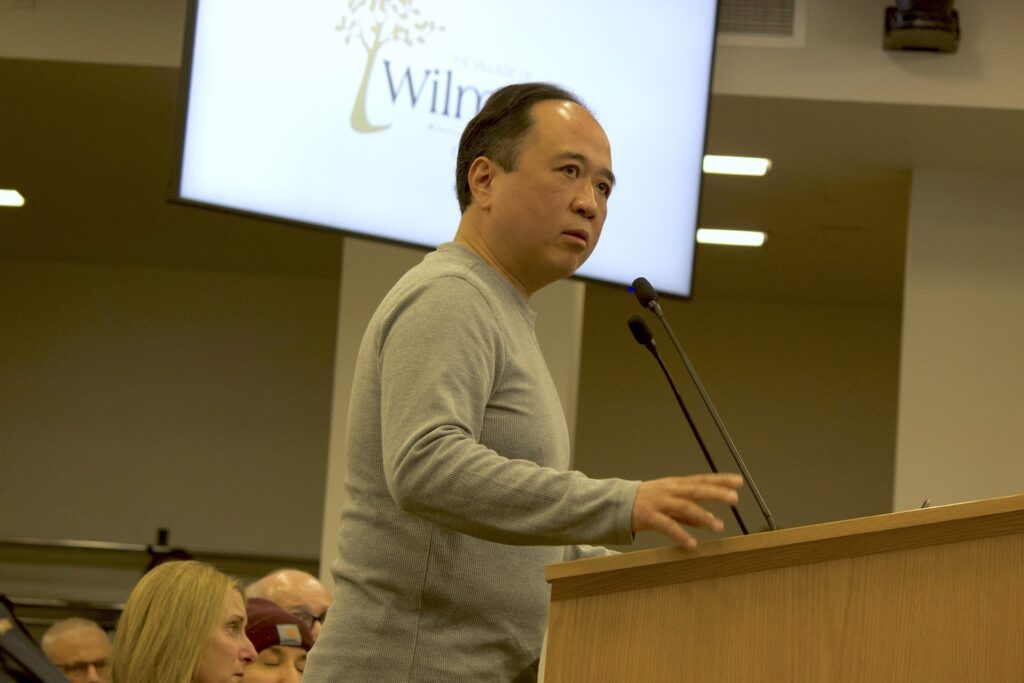
Twenty-nine residents addressed the board during the public-comment portion of the meeting, all but one of whom expressed outright support for the ordinance.
Wilmette resident Bonnie Kim lauded the board for developing the “comprehensive, welcoming ordinance.” She also said she believes “that the ordinance will make Wilmette safer for all residents and visitors.”
“I am hopeful that the board will pass this important ordinance,” she said, “which clarifies that we are a welcoming community to all residents and visitors, regardless of immigration status or color of skin and explains how the village will interact with federal civil immigration agents so that we all know what to expect in this unprecedented crisis.”
Cindy Fey urged the board to “act to protect every resident’s right to live free from fear and discrimination” and stated her belief that “every person in Wilmette deserves to feel safe and valued no matter the color of their skin or where they were born.”
“Our community must show that racism and intimidation have no place here,” she said. “We love this village and the values that it stands for.”
Lora Amigo, an eight-year resident of Wilmette, expressed her gratitude and offered her “enormous thanks” to “the countless people who have shown up every day” in Wilmette. She also said she’s “happy that (officials) are catching up and … are putting new policies in place.”
“I hope that you don’t stop at this,” she said. “I hope that you keep going.”
“As an immigrant, as someone who could be picked on, thank you to every single person who has put themselves on the line in the last couple of weeks,” she later added. “I will forever be grateful. This is Wilmette. This is the Wilmette that I love and everybody can support.”
Former Wilmette Village President John Jacoby told the board that striving to be a welcoming community has been part of the village’s DNA for decades.
“I commend our residents who called upon the board to do what it can to mitigate this injustice and I compliment you all and your staff for coming up with an ordinance that pushes but hopefully doesn’t exceed the limits of your authority,” he said.
‘We are confident that we are doing as much as we legally can’
After public comment, trustees took a short recess to prepare answers to some resident questions that came up during the meeting.
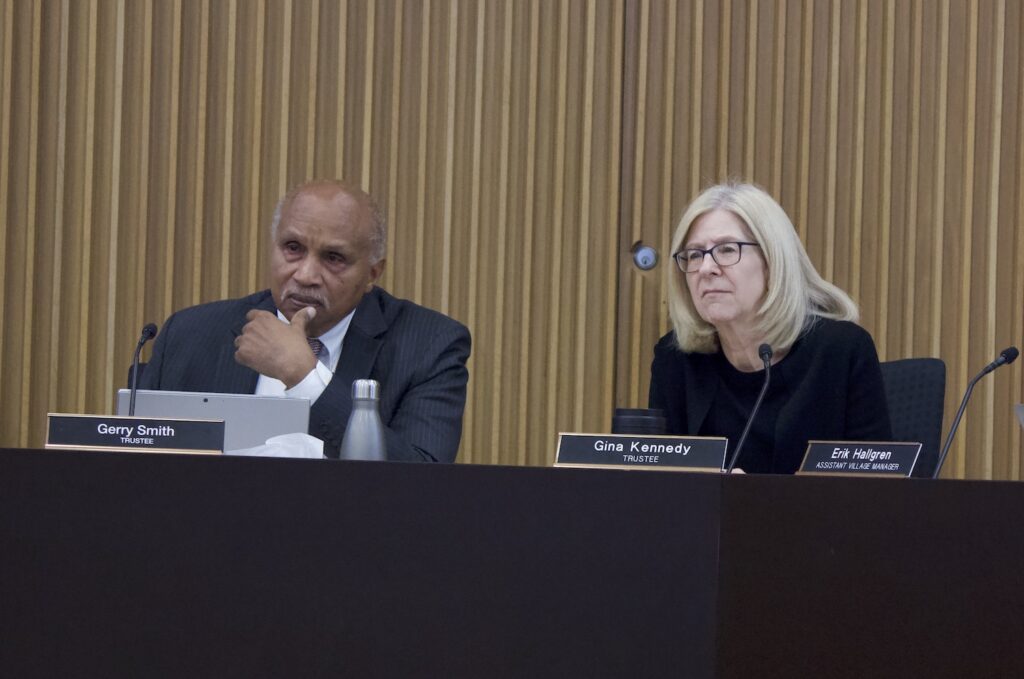
As part of that, officials responded to a few calls from residents who argued that the ordinance did not go far enough and who asked the village if there was more that could be done.
“We are confident that we are doing as much as we legally can right now,” Braiman said. “We think it’s a model for other communities in our area and we have and we will share this draft ordinance with our counterparts throughout the region.”
Braiman also said officials are committed to learning of other ideas if they come forward regarding options for additional action.
Similarly, during their pre-vote comments, several trustees also pledged to do the same.
“Hearing your stories, hearing the intelligence out here, if there are other things like that that you can think of, that you can brainstorm, come to us, email us, email the village manager and we can absolutely put those things in,” Trustee Michael Lieber said.
“It is frustrating that there are certain things that we can’t do, but I think we have done a tremendous amount in a short period of time … and I’m fully in support of it.”
Trustee Gerry Smith called the ordinance a “living document,” rather than a static one.
Board member Justin Sheperd concluded his remarks by detailing his pride in voting for the historic ordinance but like his peers acknowledged the limitations the village faces in legislating federal actions.
“I’m very proud to vote for this ordinance but … I am painfully aware of the limitations of the board’s power in this matter and it will take grassroots efforts, legal challenges, supporting like-minded candidates at the ballot box to continue making a substantial difference,” he said. “And I hope that positive energy and the talents that have been brought here tonight can be carried forward to further effect change.”
The Record is a nonprofit, nonpartisan community newsroom that relies on reader support to fuel its independent local journalism.
Become a member of The Record to fund responsible news coverage for your community.
Already a member? You can make a tax-deductible donation at any time.

Martin Carlino
Martin Carlino is a co-founder and the senior editor who assigns and edits The Record stories, while also bylining articles every week. Martin is an experienced and award-winning education reporter who was the editor of The Northbrook Tower.
The Record is a nonprofit, community news site from former editors of 22nd Century Media
Our daily coverage of your government, schools, businesses and neighbors is not possible without your support.
Latest

The Record: Shortcut
Related Stories