Jorian Micor spent much of the past five years as a territory salesman, pitching various vape products to smoke shops and corner stores scattered all across the northern Illinois and southern Wisconsin region.
It was during those winding, lonely drives that the 34-year-old from Morton Grove began to outline a dream he had long considered pursuing: opening his own boba tea shop.
“There would be long drives to nowhere, Wisconsin, and you’re forced into your thoughts that way,” Micor recalled of that time. “So I’m driving, thinking about it and just constantly always thinking about it until I was just like, ‘You know what, let’s try and make this happen.”
That dream has become a reality with the opening of Funky Boba Lounge last month. Located at 338 Green Bay Road in Highwood, the shop is open from 1-9 p.m. every day except Wednesdays.
The city’s first boba spot, Funky Boba Lounge offers both a menu of flavored drinks with specialty tapioca pearls and a backroom arcade filled with claw machines, karaoke booths, a pool table and more. The cafe also features alcoholic boba cocktails and hot ramen makers.
With previous experience managing a boba shop in college and noticing more restaurants in Highwood offering different cultures of cuisine, Micor pitched the idea of opening Funky Boba Lounge last year to his father, Christian Micor, and godfather, Tang Wong.
The two are owners and operators of the long-running Vape312 shop and, interested in joining the business venture, signed a lease on the storefront property by Everts Park last July.
While the co-partners’ original vision called for only a boba cafe in the approximately 1,300-square-foot space, the property’s landlord wanted to keep an adjoining, additional 1,300-square-foot space from being walled off from the cafe area, Micor said.
That left the group scrambling for ideas of how to profit from the one side of their cafe while busy making drinks on the other side. Wong, inspired from his travels in Asia, then suggested filling the space with the kinds of arcade machines he had seen in Korea, Micor said.
This means Funky Boba Lounge is one half drink shop and one half game room with a row of 17 neon-lit claw machines, two karaoke booths, and several other test-your-skills prize machines. As a temporary opening promotion, those who buy a drink will receive a few tokens to play.
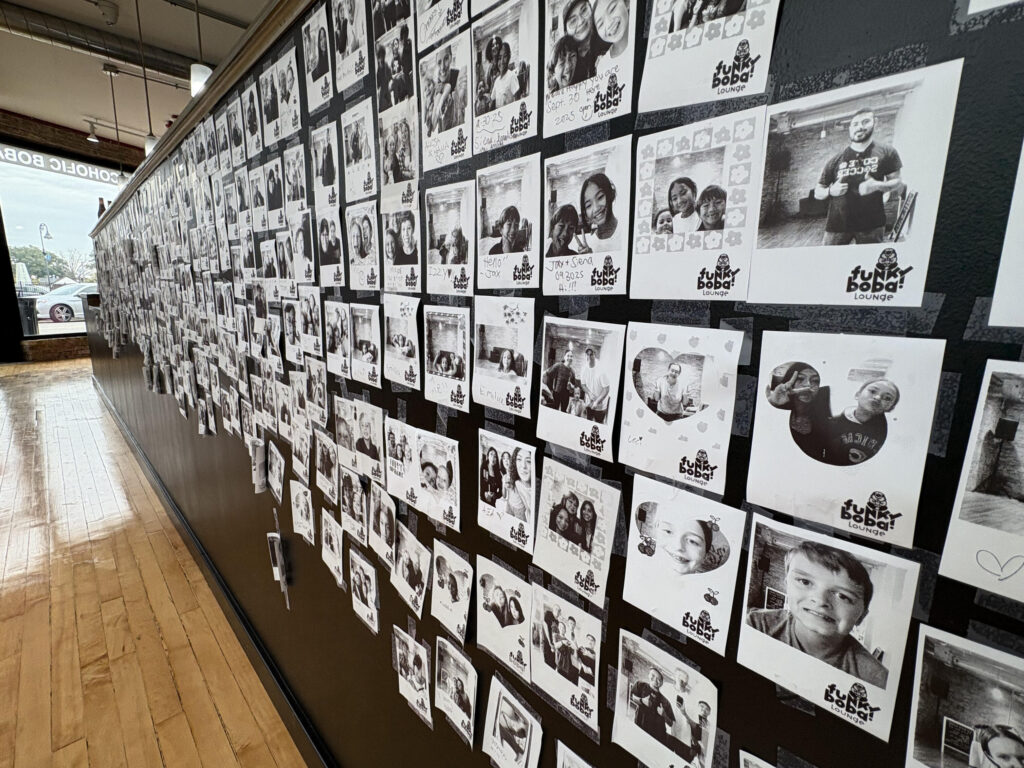
Photos from a free photo machine in Funky Boba Lounge. The cafe’s front wall was plastered with customer photos within three weeks of opening.
The games help draw and entertain two different kinds of crowds to the boba shop: kids who stop by the cafe after school for a sweet drink, and adults who swing by in the evening for a novelty cocktail. Micor said he’s unaware of any other boba tea shops who carry a liquor license.
So far, Micor and his family have run the shop, with his brothers sometimes even picking up shifts for free. While the cafe is open for business, Micor said they still have work to do, like setting up more decorations, before a grand opening can be set in approximately a month.
But even after launching with little marketing for a Sept. 29 soft opening — in part to participate in the city’s popular Pumpkin Fest — Micor said Funky Boba Lounge has already seen a good amount of customers.
Near the rear of the cafe, a free photo-booth machine spits out pictures on receipt paper. Over the course of that festival weekend, Micor said the entire length of the bar became full of photos from those who stuck their selfies to the cafe’s counter wall.
“It kind of gave a personal touch in terms of the shop,” Micor said of the photos. “I’ve already seen kids walk in and they’re like, ‘Oh my god look who it is.’ Or they come in and, ‘Oh, so and so was here.’”
“I don’t know, it makes the community feel like they built this place up with us,” Micor added. “They’ve been in here from the start.”
The Record is a nonprofit, nonpartisan community newsroom that relies on reader support to fuel its independent local journalism.
Become a member of The Record to fund responsible news coverage for your community.
Already a member? You can make a tax-deductible donation at any time.
A 13-year-old Wilmette boy who went missing Tuesday afternoon was found “in good condition” around 11 p.m. Tuesday, according to the Village of Wilmette.
The boy reportedly was found in Chicago approximately seven hours after he left his home in the 300 block of 14th Street in Wilmette.
According to a Village press release, the boy, Jacob, is 13 and nonverbal with autism and was last seen leaving his home. In the release, the village reported that Jacob “has sometimes wandered into unlocked homes.”
The Record is a nonprofit, nonpartisan community newsroom that relies on reader support to fuel its independent local journalism.
Become a member of The Record to fund responsible news coverage for your community.
Already a member? You can make a tax-deductible donation at any time.
Ban toy guns from public parks. Make data on hate crimes more accessible. Partner with religious groups to improve education. Use direct language in public statements. Enforce recourses if offenders don’t comply with Village recommendations.
Those measures stuck out during a Skokie Human Relations Commission discussion on Monday evening at the Skokie Police Department as efforts to fight antisemitism in light of a recent hate crime that involved minors on Oct. 7 at Shawnee Park.
The meeting drew more than 100 people — including State Sen. Laura Fine, Mayor Ann Tennes, Skokie Park District staff, and current and former Village trustees — to the police department’s headquarters at 7300 Niles Center Road.
Village Trustee Alison Pure Slovin addressed frustrations that have circulated over the limited information the village provided so far about the hate crime and cautioned the public to be “very careful about conjecture, rumor and accusations.”
“There was nothing nefarious about the lack of communication from the village,” Slovin said. “It is not the responsibility of the village to notify residents unless there is an actual threat to the community. It is our responsibility to protect those involved, especially when we are talking about minors.”
Police Chief Jesse Barnes outlined what courses of action the juvenile court system may choose for the parties involved, though noted that disposition won’t be shared with the general public.
The Community Engagement Subcommittee of the Human Relations Commission plans to meet on a yet undetermined date to continue the discussion over what measures the Skokie community should take to prevent antisemitic hate crimes.
The subcommittee will likely meet several times before sending their recommendation to the commission for a vote.
‘Accounts conflict’
According to village officials, officers responded to Shawnee Park around 6 p.m. on Oct. 7 after one group of minors “used” antisemitic language at another group of minors. The offending group then chased the other and struck one minor in the leg with a “gel pellet” fired from a toy gun.
The minors were primarily between 13 and 15 years old, officials said.
The exact sequence of events remains “somewhat unclear for certain parts of this investigation” as investigators have received conflicting statements from the more than a dozen youths who were involved, Barnes said.
“Someone at the park said antisemitic and hateful things,” Barnes said. “Accounts conflict as to who said this. Evidence did not establish that the child with the gel blaster made those remarks.”
“Accounts provided within friend groups differ in parts as well, which is not uncommon when dealing with juveniles at this age,” Barnes continued.
In juvenile cases like this, a police department’s investigation into a crime will be forwarded to a juvenile state’s attorney for additional review and offenders may go before a judge or through a “diversionary process” in the court system, Barnes said.
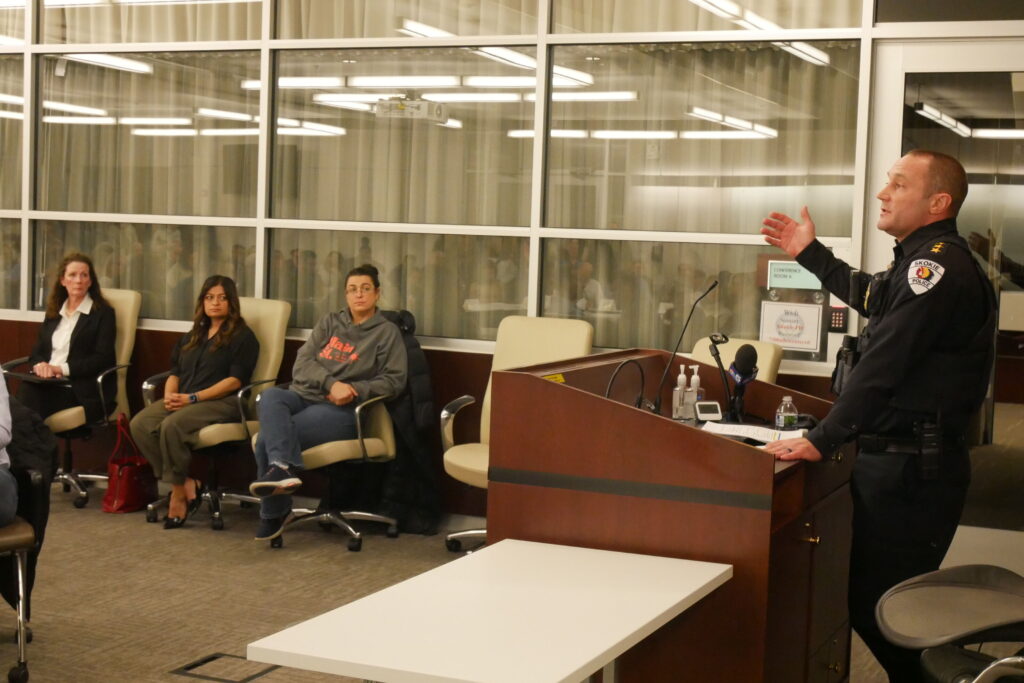
Skokie Police Chief Jesse Barnes addresses the Human Relations Commission on Oct. 27.
Juveniles involved in a case like this, he said, may also be connected with a youth outreach coordinator within a police department, linked with social services from third-party providers, and asked to complete an act of accountability, like an apology letter.
There are a variety of ways a juvenile case can reach a legal resolution, though that disposition will only be shared with the stakeholders directly involved in the investigation, Barnes said, adding that a number of the kids at Shawnee Park will go to school together for the next several years.
‘How did this happen?’
Fourteen different people addressed the commission during Monday’s session, asking questions, offering suggestions about how the village could better respond and voicing concerns about what they saw as a resurgence of antisemitism in Skokie.
Danny Cohn, a Skokie resident, said he was frustrated with the Village’s Oct. 22 news release, which he said did not make clear which group of minors was the instigator or immediately disclose that Skokie police determined the incident a hate crime.
“As a Jew I long understood that there will always be those who hate us. But when our own local government minimizes or sanitizes an antisemitic attack, that is something that we can and must change,” Cohn said.
Adrienne Naumann said she’s lived in Skokie for 50 years but has found the years since Oct. 7, 2023 — the date Hamas violently attacked Israel — “unbearable.” She added she’s not sure people understand how frightened members of the Jewish community are, commenting that many people she knows have signed up for gun lessons.
Several members of the Skokie Human Relations commission listen to members of the public on Oct. 27.
“I never thought for a million years that in my old age that we would be required to carry guns, that there would be bomb sniffing dogs at synagogue, in addition to hired thugs who are carrying military grade weapons to protect us while we pray,” Naumann said. “How did this happen?”
Mickie Weiss emphasized she’s heard about the hate crime at Shawnee Park from people all over the country, and while she understands the restrictions governed by the Illinois Juvenile Court Act, she wants to know the truth of what happened.
“I get confidentiality, but somehow — how do you stop misinformation if you can’t give correct information?” Weiss asked. “It’s tricky, I understand, but is there any way to do that? And know that this is not just a Skokie issue anymore.”
‘The common theme’
During their discussion, commission members considered various possible measures offered by the public, including creating a third space for teens and publicizing the “Hate Crimes & Bias Motivated Incidents” annual summary report that was presented to the commission in June.
The report noted the Skokie Police Department recorded 28 bias-motivated incidents and one hate crime in 2024. The majority of these incidents, or 66%, were motivated by religious bias. A quarter of these incidents were motivated by race or ethnicity, and 11% by sexual orientation.
The Skokie Police Department classified 12 of the 18 religiously motivated bias incidents as anti-Jewish and six were classified as anti-Muslim.
Skokie Human Relations Commission member and Rev. Carl Johnson speaks during the meeting, which focused on how to move forward from a recent antisemitic hate crime that occurred at Shawnee Park.
Brad Sugar, a member of the Human Relations Commission, said he is friends with two of the families whose children were attacked in Shawnee Park. In the conversations he’s had with the families, Sugar said they have emphasized a desire for education.
“The common theme was that they were very interested in the opportunity to educate these children and that they weren’t looking for opportunities to permanently harm them in their lives and their careers or seek particular damage,” Sugar said.
“What was important to them was the children, and they are children, involved in this understand the repercussions of their actions and the fact that words have consequences, especially hateful words and hateful acts in a crime like this.”
Yosef Meyers, a commission member, said authorities need to pay attention less to what offensive things children are saying than why they’re saying it, and Gurjot Bilkhu, another commission member, asked the community to care for the victims, as well.
Commissioner Sidney Freitag-Fey said any measure the commission takes needs to be done clearly.
“I also just want to call witness that the sense of safety has been shattered for many community members and families,” Freitag-Fey said. “So when we think about communications strategies, having that visibility behind what is done is crucial in my opinion.”
Ari Hart, a rabbi at Skokie Valley Agudath Jacob synagogue, told The Record that he has communicated with the families harmed in the hate crime as they are all affiliated with the synagogue.
“They want people to know that this happened,” Hart said. “They want people to know that this is not the Skokie that they hoped for.”
“We want Skokie to be a place that welcomes everyone and this was the opposite of that,” Hart said. “So they’re encouraging us as a community to make sure things like this don’t happen again in Skokie.”
The Record is a nonprofit, nonpartisan community newsroom that relies on reader support to fuel its independent local journalism.
Become a member of The Record to fund responsible news coverage for your community.
Already a member? You can make a tax-deductible donation at any time.
The following reports were pulled from the latest incident summaries provided by law enforcement departments in our coverage area (Wilmette, Winnetka, Highland Park, Northfield, Kenilworth and Glencoe).
WILMETTE
Oct. 24
• Jewelry reportedly went missing from a home in the 2800 block of Old Glenview Road.
Oct. 23
• Several items reportedly were taken overnight from an unlocked car in the 900 block of 12th Street.
• At least three unlocked cars reportedly were illegally entered overnight in the 1500 block of Elmwood Avenue.
• An unlocked car reportedly was stolen overnight from the 400 block of Washington Avenue. The car was later recovered in Chicago, police say.
• An unlocked car reportedly was stolen overnight from the 2500 block of Iroquois Road. The car was later recovered in Chicago, police say.
• An individual reportedly battered another motorist after following the motorist in an apparent road-rage incident.
Oct. 21
• Two individuals were arrested for allegedly pulling a motorist from a car and beating them in an apparent road-rage incident.
• Newly purchased items reportedly were stolen from a car in the 400 block of Green Bay Road as the car owner reportedly was returning a shopping cart.
Oct. 20
• An individual was arrested in the 3200 block of Lake Avenue for alleged financial crimes as part of an Iowa arrest warrant after the car they were driving was spotted in Wilmette.
• Jewelry reportedly went missing from a home in the 200 block of Valley View Drive.
WINNETKA
Oct. 20
• More than $2,000 in damage reportedly was done overnight to a putting green at the Winnetka Golf Club, 1300 Oak St.
GLENCOE
No reported incidents between Oct. 15-22 that meet The Record’s standards for publication.
HIGHLAND PARK
Oct. 24
• A locked bicycle reportedly was stolen from the Highland Park Metra station at 1700 St. Johns Ave.
• Clothing and other items reportedly were stolen from an unlocked locker at LA Fitness, 115 Skokie Valley Road.
NORTHFIELD
No reported incidents between Oct. 20-26 that meet The Record’s standards for publication.
KENILWORTH
No incidents reported between Oct. 17-24.
The Record’s police reports are taken from police-activity summaries prepared by local police departments. Police Reports contain public information from preliminary reports and are not a complete listing of all police activity. The Record does not publish the names of individuals arrested and named in preliminary reports unless the incident is a matter of public safety or has significant community implications. All arrestees are innocent until proven guilty.
An attempt by Winnetka officials to clarify its new lakefront regulations is heading backward after both trustees and the public shared several concerns about the document’s wording and intent.
Drafted to provide guidance on what work can and can’t be done near the shore of Lake Michigan, the policies need more clarity, according to the Winnetka Village Council on Oct. 21.
Given how much concern the community has had about the lakefront, Village President Bob Dearborn said trustees wanted to address it with a set of guidelines.
“We felt it was important to develop some guidelines … largely important for the public to understand, but also for our public safety personnel, our police department,” he said. “It’s an issue for our police department, so we felt that there should be some guidelines.”
In summarizing the guidelines, Village Attorney Peter Friedman said they include a definition of the “normal water line,” or the line where the water usually sits, which divides the public and private sections of the beachfront.
He also said that if a private landowner builds their own structure, such as a steel or stone groin, into the lake, that structure is private property. Friedman said, however, that the bed of the lake is public.
“The (Illinois Department of Natural Resources) and state have stated their belief, and we concur, that the structure is privately owned,” Friedman said. “The bed remains public, but the state … has the ability to issue permits for private property owners to build on state land, but that structure itself remains private.”
Regarding public access to those private structures, Friedman said a resident may face a trespassing charge if they use it.
“That being said, there’s obviously the circumstance of it, if it’s going into the lake and in order to continue to use the public trust land that it’s dissecting, then there may be a need, in order to continue along the lakefront, to traverse that structure,” he said, adding that the IDNR often requires a private structure to have a way for the public to continue along public land.
But seven members of the public spoke in opposition of the guidelines, with many disagreeing with Friedman that privately made structures are private property. Most of those speaking have frequently raised concerns about Winnetka’s lakefront.
Ted Wynnychenko, who was cited for allegedly trespassing on the Ishbia property in 2024, said he agrees that a privately built structure’s maintenance should be that of the person who built it.
“But that doesn’t mean that the structures are theirs and that people can’t do what they want,” he said, adding, “The idea that I can’t climb a structure that’s public — and it is public; it’s on public land — is crazy.”
The Village’s proposed guidelines mention the Ishbia’s property by address, 205 Sheridan Road, multiple times. Some residents expressed concern over including a private address in a village document.
“I believe this policy was written for one property owner only: Mr. Ishbia,” longtime resident Irene Smith said. “Why would policy guidelines be written for only one property? You are a deliberative body, and I think you need to deliberate this awkward set of guidelines.”
Another resident, Chuck Dowding, criticized the process the Village Council took in drafting the guidelines.
“In other difficult matters like this, we have a study session, we have two meetings,” he said. “That doesn’t seem to be followed here. I think, given some of the concerns that have been raised here this evening, it’s not a very clear cut and straightforward definition of what is public and what is private.”
Dowding also said there are legal arguments that contradict Friedman’s statement that privately built structures are not public, and asked that the Village claims include supporting documentation.
Trustees acknowledge ‘murky’ situation
Trustee Bridget Orsic was the first to state that the Village should not be mentioning specific addresses, an issue raised even before public comment.
“It should be for all of the property owners,” she said, with other trustees agreeing that a specific private address should not be listed.
Trustee Kim Handler said she’d like some changes to be made as well.
“I would like to see a change such that we are making sure we’re very factual in what we’re saying people can and can’t do, and eliminate some anecdotal information about things that we understand residents have asked or there might be concerns,” she said.
Handler later added, “I would like to see this clarified for the community and for the lakefront owners so we’re all on the same page. But I do believe this document needs a lot of tightening up and clarity for everyone.”
Trustee Rob Apatoff acknowledged that the Village may have rushed the initial proposed document but said that can be rectified.
“There’s nothing murkier,” he said. “I think in an effort to try to give guidance to our public safety officials, we may have rushed something. We shouldn’t have rushed it. The one thing that’s great about this council is that we own up and we figure it out. We’ll get it done right.”
Dearborn agreed with Apatoff’s comment about the topic being “murky.” He said that Friedman will draft a new set of guidelines and bring it back to the board. The goal is to vote on it at the Nov. 4 regular meeting, but Dearborn said that is subject to change.
The Record is a nonprofit, nonpartisan community newsroom that relies on reader support to fuel its independent local journalism.
Become a member of The Record to fund responsible news coverage for your community.
Already a member? You can make a tax-deductible donation at any time.
Jessie Kafka never envisioned playing girls flag football for Loyola Academy.
Yet, the sophomore became an integral part of the team’s success in Year 2 of the program. The Ramblers saw their program double in size and advanced further than it did in Year 1, finishing with a 19-5 record with a perfect 10-0 record in the inaugural season of the Girls Catholic Athletic Conference.
“One of my friends who did basketball told me to come out for (tryouts),” Kafka said. “It was the last week of camp and I really enjoyed it. … It kept getting fun with more time.”
Kafka, who played linebacker, led the team with five interceptions and also added four pass breakups in conference play, while Ali Banaszek recorded three interceptions and Michaela Burm had two, including a pick-six.
For Kafka, playing defense in flag football came almost naturally, as she also plays basketball for the Ramblers.
Jessie Kafka on the run for Loyola Academy flag football.
“Playing defense in flag football is definitely using your athleticism,” Kafka said. “It was just fun to be out there and using that.”
Kafka led a Loyola Academy defense that allowed just 7.04 points per game.
“I am going to nominate her for All-State because I truly think she’s one of the best defensive players in the state,” Ramblers coach Connor Buckridge said. “Just really natural instincts for the game.”
Buckridge had some doubts about what the team could achieve entering the season following news that last year’s starting quarterback, Riley Williams, sustained an offseason injury and would miss the season.
But freshman Sophia Calhoun switched to the signal-caller role, and after an audition, she grew into the new role and ran with it.
“She had grown up playing flag football as a receiver and linebacker, and we convinced her to give quarterback a shot,” Buckridge said. “She had a phenomenal year.”
Buckridge said coaches envied that he could have three more years of Calhoun piloting the Ramblers.
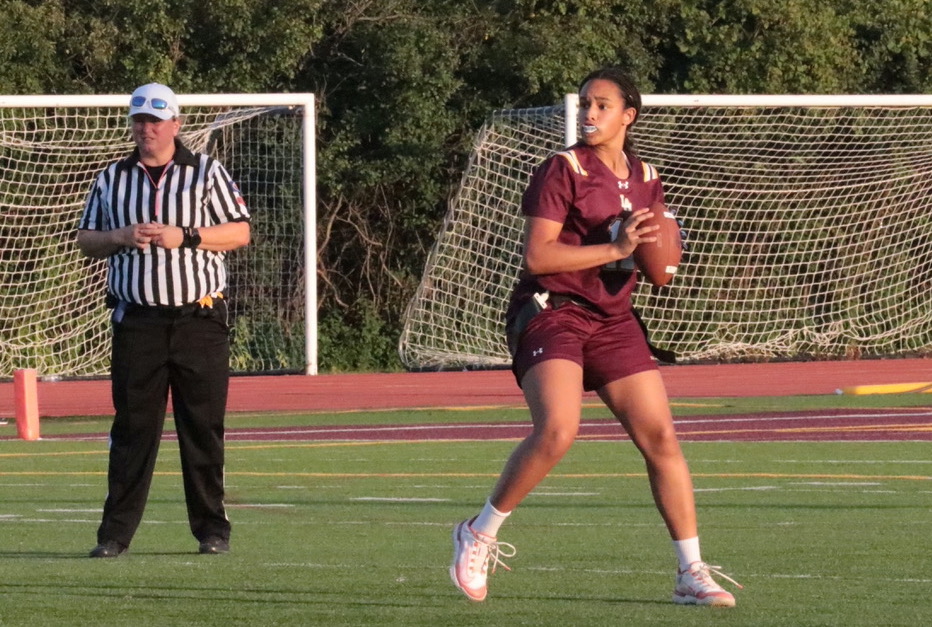
Ramblers freshman quarterback Sophie Calhoun looking at her options.
In 10 conference games, Calhoun threw 22 touchdown passes and added another six scores on the ground. Mary Grace Connolly was her favorite target with six TD receptions, while Burm added three.
While Kafka said some of her teammates were worried about the loss of Williams, she said had confidence in Calhoun based on what she saw on the hardwood.
“I did know Sophia because she plays basketball with me,” Kafka said. “And she was amazing. I just told her to play with her heart and I knew that she was going to be great at it.”
Early in the season, on Sept. 8, Loyola Academy lost 25-7 to one of the state’s best, Glenbrook South, dropping the team’s record to 3-3 at the time; however, that game was when Kafka felt the team connected. And it took off from there.
The Ramblers lost just once more in the regular season, won seven straight games and then proceeded on a 10-game winning streak before losing to Evanston in the IHSA postseason round of 32.
“I just thought it was so competitive and so fun,” Kafka said. “It’s when the team truly discovered ‘We want to win now.’”
In the first year of the program in 2024, Buckridge said he had 50 players come for tryouts. Twenty-eight players were kept on the varsity team, with no JV team. This season, the Ramblers fielded a varsity and junior varsity team, with nearly 60 players in the program.
“Unfortunately, the budgets were already in,” Buckridge said. “So, we could only keep the one team, which was a little difficult because we were in the balance of wanting to win now but also making sure we kept freshman and sophomore players on the team so we wouldn’t be starting over in Year 2.”
Following the success of Year 2, Kafka said she has begun the process of ensuring next year’s team grows in numbers and achieves on-field results.
“I am recruiting my friends right now, ‘You have to come out and play,’” Kafka said.
The Record is a nonprofit, nonpartisan community newsroom that relies on reader support to fuel its independent local journalism.
Become a member of The Record to fund responsible news coverage for your community.
Already a member? You can make a tax-deductible donation at any time.
Highland Park’s second Día de los Muertos, or Day of the Dead, weeklong community celebration has begun and continues through Sunday, Nov. 2.
The event marks the Mexican holiday on Nov. 1–2 that celebrates the lives of departed loved ones, rather than mourning their deaths, and downtown Highland Park’s DDM week has transformed the district into “a vibrant corridor of themed experiences,” says a release from the City.
The week began on Saturday, Oct. 25, with a celebration at the Memorial Park Gazebo, 405 Prospect Ave., where a large ofrenda (altar) designed by local resident and designer Jessica Rivero serves as the anchor of the festivities.
The altar is complemented by decorative planters throughout the downtown adorned with cultural symbols, such as marigolds, skulls and corn elements.
More information on the events, including ticket purchase, is available online.
“I’m thrilled to bring Hispanic culture, tradition, and community spirit to life in Downtown Highland Park once again this year,” said Diana Gran, owner of Diana Gran Portraits, in the release. “Día de los Muertos is a celebration for all to experience, and it’s wonderful for our businesses and community members to come together to honor this tradition and pay tribute to those who have passed before us.”
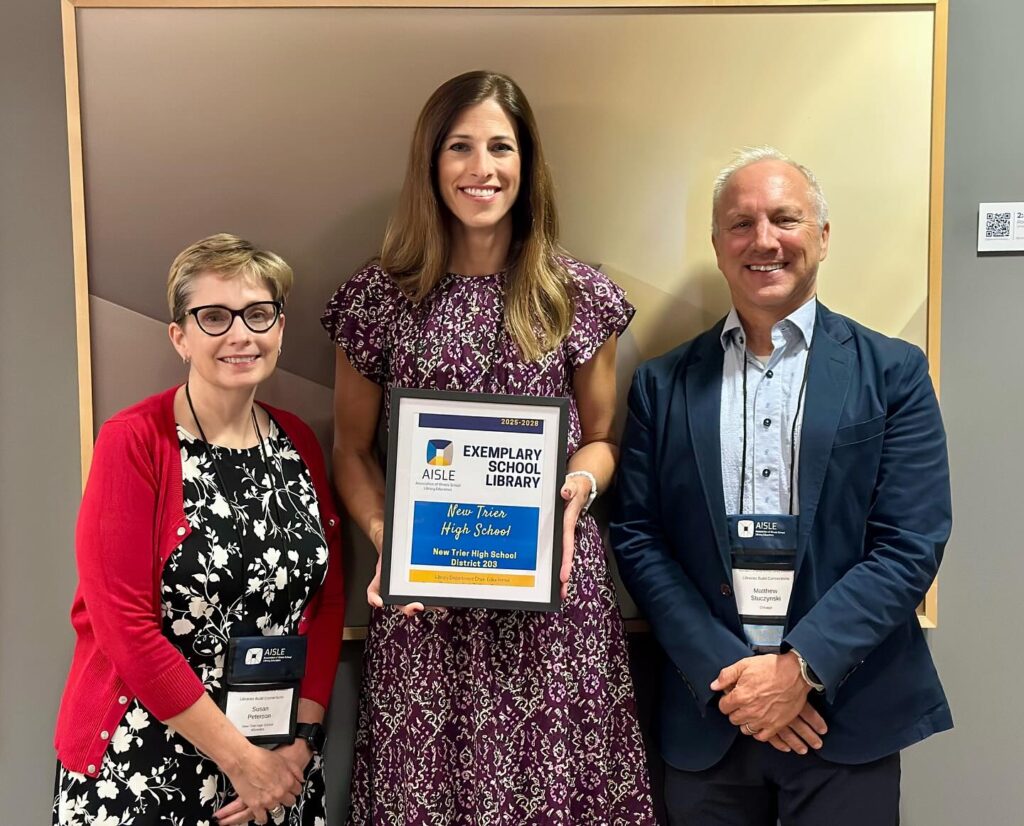
New Trier library staff with their recently earned recognition.
New Trier library lauded
New Trier High School’s library department was honored with an Exemplary School Library Award from the Association of Illinois School Library Educators.
According to the school, “Library faculty and staff on both campuses help students develop information literacy and research skills that will serve them well in a rapidly changing, information-rich environment.”
Dudley Onderdonk, of the Village of Glencoe.
Glencoe trustee earns professional lifetime achievement award
Glencoe resident and Trustee Dudley Onderdonk was awarded the Lifetime Achievement Award from the American Planning Association, Illinois Chapter, as announced by the Village of Glencoe.
According to the Village, Onderdonk’s five-decade career in planning spans leadership roles across the country, from directing planning departments in the Midwest and West Coast to serving as a senior advisor, educator, author and community advocate in Glencoe.
“His lasting impact on preservation, sustainability, housing, and design—combined with his mentorship, public service, and induction into the AICP College of Fellows—embodies the spirit of the APA-IL Lifetime Achievement Award,” a village newsletter says.
The Record is a nonprofit, nonpartisan community newsroom that relies on reader support to fuel its independent local journalism.
Become a member of The Record to fund responsible news coverage for your community.
Already a member? You can make a tax-deductible donation at any time.
Only three days prior to their regional final match, New Trier boys soccer got a firsthand feel of the challenges that come with conceding an early goal in postseason play.
Yet, behind a spirited effort, the Trevians on Wednesday, Oct. 22, found the resolve to pull off a thrilling, come-from-behind victory over Notre Dame Prep. But on Saturday, Oct. 25, one stage later in their playoff journey, New Trier experienced the harsh aftermath of falling behind.
The Oak Park-River Forest Huskies jumped out to an early advantage over the Trevians after a perfectly executed set piece in the 14th minute. New Trier could not pull the match level from there, as the Huskies found the back of the net three more times in the second half to claim the regional title over the Trevians 4-1 on Oct. 25 at DePaul College Prep.
“In playoff games, the first goal changes a lot,” New Trier head coach Matt Ravenscraft said. “On Wednesday against Notre Dame, they got the first and it made it really difficult for us. We were able to get back in the game, equalize and get the late winner in double overtime.
“But in high school boys soccer, particularly in the state tournament, that first goal is so critical, so to concede the first goal again tonight, it was going to be an uphill battle after that.”
OPRF heavily controlled possession in the opening minutes, but neither side put forth a true threat on goal until Huskies’ senior Evan Max delivered a 30-plus-yard pass to Liam Moder, who struck the ball midair and into the top corner of the net.
New Trier responded with a flurry of offensive chances after allowing the goal. Junior Aman Alakhramsing worked his way past the Huskies’ midfield to put a dangerous ball in the box that just missed the finishing touch.
Minutes later, junior Tristan McGrath put a strong header on the net that was saved by OPRF’s keeper. Captain Calyx Hoover, the Trevs senior attacker, found a small opening with 10 minutes to play in the half but his shot slid just wide of the net.
New Trier continued its pressure right out of the gate in the second half, putting forward a couple more strong scoring chances. But the Huskies quickly transitioned into their counterattack after the Trevs put the ball on the net.
The result of OPRF’s rush ended with a penalty kick awarded to the Huskies in the 47th minute. Adrian Bondartsov took advantage of the opportunity, moving OPRF’s lead to two goals.
The Huskies’ unrelenting attack then struck again only moments later. Cole Grining finished off a ball played into the box in the 48th minute to give OPRF a commanding 3-0 margin over the Trevs.
New Trier refused to give in, though. Jakob Richter fired a strong shot on net that was saved by the Huskies’ keeper in the 52nd minute. Richter then nearly snuck a header into the bottom corner two minutes later, but the shot hit the goal post.
“We generated chances in both halves,” Ravenscraft said. “We were able to put some shots on frame, we were able to get some crosses off and across the face of the goal … but it’s a real challenge against a team of that quality.
“We knew that there were a variety of ways that they could beat us and we were going to have to be excellent in defending free kicks and excellent in our transition and excellent in our defensive shape, which we did so well, and I’m so proud of how we started that game.”
OPRF found its fourth goal with just under 19 minutes to play when an unmarked runner, Peter Bondartsov, finished off a pass from Kingston Petersen.
New Trier’s Aidan McConnell drew a penalty shot in the 73rd minute, and Richter took the freebie and drilled home the Trevs’ lone goal.
While three goals separated the two sides, New Trier had just one fewer shot on goal than the Huskies. But OPRF’s efficiency in finishing its chances and its play inside the box proved to be two key differentiators.
“We needed to be excellent in all phases of the game over 80 minutes and we were nearly there,” Ravenscraft said. “I don’t think that the scoreline necessarily reflects what truly separated the teams in terms of quality, but they definitely won the box over the 80 minutes and you have to give them credit.”
The Trevians finished the year with an 11-6-2 overall mark but New Trier found its top form late in the season, winning five consecutive games prior to the regional-final loss.
New Trier will say goodbye to 13 seniors, six of whom started Saturday’s game. Ravenscraft described the team’s seniors as a group that “truly supported one another.”
“There was a clear friendship among that group of seniors and that just percolated through the team,” he said, later adding, “They were just a great group to coach.”
All of the Trevians’ departing seniors were a part of New Trier soccer for all four of their high school years, Ravenscraft said.
“They had different pathways to the varsity team, but they have represented this program incredibly well and with class and with quality and I’m just extremely proud of them,” he said.
The Record is a nonprofit, nonpartisan community newsroom that relies on reader support to fuel its independent local journalism.
Become a member of The Record to fund responsible news coverage for your community.
Already a member? You can make a tax-deductible donation at any time.
Glencoe officials will soon formally hit the books on a multi-million-dollar project that would start a new chapter for a beloved institution.
Village trustees during their Thursday, Oct. 16 Committee of the Whole meeting heard a thorough presentation from Glencoe Public Library officials that detailed the library’s plans for a massive renovation and expansion project.
The library’s large-scale vision for reimagining its building on Park Avenue aims to create more versatile spaces, improve accessibility and add smart, sustainable and safe systems to the facility, officials said.
Plans call for multiple additions to the existing structure and design proposals, according to library documents, will bring “intuitive, community-focused spaces where people can gather for innovative programming; collaborate or work independently; learn, reflect, dream and play.”
Officials say the library, which was built in 1941, has “not kept pace with how people live, learn and connect today.” The current building, officials add, faces challenges related to inaccessible and cramped spaces, uneven building temperature, nonintuitive spatial flow and limited storage areas for staff.
Additionally, the building had a shortage of meeting and program space, which has in turn led to the library turning away potential programming opportunities.
Andy Kim, executive director of the Glencoe Library, told trustees that the library’s board of trustees conducted a capital needs assessment in 2021 that identified more than 300 issues requiring repair or remediation within the next 20 years.
The Library Board then in 2023 approved its current strategic plan with the goal of completing a renovation of the building by the end of 2028 to create a facility that “better serves the community today and tomorrow,” according to a library memo submitted to the village.
A concept for a new children’s space in the Glencoe library.
Project architect and Glencoe resident Adam Semel, from the firm Skidmore, Owings & Merrill, presented some of the specifics of the library’s vision to trustees during the Oct. 16 session.
Semel said project planners to this point have done a “huge amount of community engagement” and extensive “learning, listening and engaging.” The firm first spent time understanding the best parts of the existing library and the areas where residents want to see less change before diving into improvements.
A key goal for planned revisions to the interior is improving wayfinding throughout the library and enhancing the flow of the space through vertical connections. Semel noted that library patrons who aren’t overly familiar with the building can have difficulties navigating the space when entering.
The library’s current elevator is difficult to find and doesn’t touch every half floor, Semel said, noting that parts of the library are not fully accessible to all now.
Renovation plans also call for the creation of new spaces to better accommodate the needs of both the library and its patrons. Library officials are proposing a 1,840-square-foot addition to the southwest side of the building that will serve as a “state-of-the-art Glencoe program and community room.”
Per Semel, the new space would accommodate up to 150 guests and through a deployable wall feature will offer flexibility to partition into smaller spaces. Semel said the addition will be a “great space for event and community gathering” and will be a room that’s “super multi-functional.”
A 1,000-square-foot addition is also proposed for the top floor of the library. That space will be mainly geared toward enhancing the library’s children’s services but could also be used as a “flex space.” The addition will expand the children’s space by nearly 40%, according to the library’s website.
A large portion of the library’s existing collections are crowded into stacks on the west side of the building that are not ADA-accessible, Semel noted. Renovation work will address this with a 1,000-square-foot addition that will reconfigure the area through increased accessibility and better browsing for patrons.
The plan also features a new public entrance at the south side of the library next to the proposed community-room addition, a new central elevator, new spaces for staff, small group meeting rooms on the lower level and more.
Semel said that the building also needs an overhaul of HVAC and mechanical systems as well as repairs to the foundation.
Funding plan
The project’s current price tag is steep.
Kim told trustees that the library is estimating the total cost as of October will be $17.3 million. Kim outlined the several ways in which the library is hoping to fund the effort.
The Library Board earlier this spring launched a capital fundraising campaign, and thus far, Kim said the campaign has raised nearly $800,000. Officials have set a goal for the campaign of $2.5 million, Kim said, adding that “we feel strongly we can reach it by the end of the year.”
Those campaign funds along with money saved in the library’s special reserve will reduce the amount of a bond issuance that will be needed to finance the rest of the project.
Right now, the estimated bond amount is $14.3 million but Kim said that library officials are working to re-estimate the overall cost given the rapid increase of capital projects in the current market.
Due to the way the Glencoe Public Library is classified under state legislation, the library cannot levy its own property taxes. The Village of Glencoe levies on behalf of the library at the request of the Library Board, Village Manager Phil Kiraly explained.
Because of this, for library projects that require a bond issue, the village ultimately has the responsibility to levy on behalf of the board.
As a newly minted home-rule municipality, Glencoe no longer is required to have a binding referendum to issue bonds. But “given the scale and magnitude of a project like this, it would be in all of our best interests that a referendum question still be posed to the community,” Kiraly said.
Given the timeline of their project, library officials hope to place the advisory referendum question on the March 2026 primary ballot, which is the next election that would be held in the area. To do that, trustees would need to approve placing the question on the ballot either during their November or December meeting.
Although the referendum will technically be considered non-binding, Village President Howard Roin said the village will only move forward with issuing the bonds if voters give the green light.
“If the referendum passes, I think we all understand that we’re going to proceed to issue the bonds … and if the referendum doesn’t pass, no matter how excellent we think the project is, we’re not,” Roin said. “I think everyone on the Village Board is with that program.”
“For worthwhile projects, generally Glencoe residents say yes, and I hope that they will say yes now,” Roin later added.
The library’s plans will next appear in front of Glencoe’s Zoning Commission during its Nov. 3 meeting where the board will consider special-use permits required for the project. The village board then could author a final decision on the permits at its December meeting. Plans will also need exterior appearance review by Glencoe’s Plan Commission.
The Record is a nonprofit, nonpartisan community newsroom that relies on reader support to fuel its independent local journalism.
Become a member of The Record to fund responsible news coverage for your community.
Already a member? You can make a tax-deductible donation at any time.
On the final day of the state championships, New Trier tennis was well represented at the event’s host site, Hersey High School, on Saturday, Oct. 25.
But as singles player Julia Ludwig and doubles team Ava Katz and Lily Hermann fought in their respective third-place matches, the most consequential action was happening about four miles up the road.
There, at Buffalo Grove High School, Trevians sophomore Ingrid Fiedler was fighting off Waubonsie Valley’s Lydia Parranto — 6-2, 1-6, (10-8) — in a backdraw bout to deliver the one point her team needed to guarantee an IHSA Class 2A state championship.
The Trevians following their state championship win on Saturday, Oct. 25, at Hersey High School.
New Trier (33 points) outlasted runnersup Hinsdale Central and Stevenson (both 28 points) to claim the program’s third consecutive state title, a feat the Trevians last accomplished 36 years ago (1986-’88).
“The three-peat,” New Trier coach Jerry Morse-Karzen said with a smile. “The first two we actually clinched on Friday. This one, every point really mattered. … Sometimes the harder they are, they feel more worth it.”
The result gave New Trier its 12th state championship, including one as New Trier West, and 11th state trophy in the past 15 seasons.
Singles players Julia Ludwig (left) and Ingrid Fiedler following Ludwig’s third-place win at state.
Ludwig, a junior, led the way for the Trevians with her third-place finish. The junior came back to win her final match 2-6, 6-2, 6-1 to finish with a lineup-best 11 team points.
Katz, a senior, and Hermann, a junior, placed fourth, winning their first four matches to gain 10 team points. The pair fell in the third-place match 7-5, 6-3 to Stevenson’s Emma Blass and Ava Sukovic.
One of this year’s team captains, Katz gave credit to New Trier’s coaching staff — which includes Donna Chudacoff, Brett Morse-Karzen, Lisa Finke and Kerry Hall — for preparing the Trevians throughout the season.
“That’s a big part of it,” Katz said. “And our team community is also a huge part. We all are supportive of each other and want the best for each other.”
Of another state title, she said: “It feels amazing. We worked really hard the whole season. We were going for it and wanted the three-peat so I’m really glad.”
Katz gets there in time for a return shot in the third-place match with her partner Lily Hermann.
Katz was a singles state qualifier a year ago, and Ludwig paired with Coco Zabel for a nice run at state last season.
This year, Morse-Karzen said it was best for the team if they switched. Ludwig and Fiedler provided a powerful 1-2 singles punch much of the Trevians’ season, and Katz’s move to doubles paid big dividends.
“She made this lineup stronger playing doubles,” Morse-Karzen said of Katz. “For a team to be successful, they all have to do what the team needs, and she did. She’s done that all year.”
Fiedler won her first three matches before falling to fourth-place finisher Lucy Stein, of Oak Park-River Forest, in the quarterfinals. She then earned two backdraw victories and finished sixth for the second straight season.
Morse-Karzen said Fiedler has succeeded ever since becoming a Trevian.
“She has been so solid,” he said. “Competing wise, she has a real good game. She doesn’t miss many balls. It doesn’t matter what level of player she’s playing, she seems to handle it. She’s a tough out.”
Julia Ludwig hits a forehand return in the third-place bout.
Trevians freshman Olivia Orlando and junior Annabel Kim won their first two matches to gain four team points before losing two long matches to end their weekend.
Jerry Morse-Karzen said Orlando and Kim’s big important run began in the sectional, where they finished second to earn a seed at state and a better draw.
Going into state, he said five elite teams — all of which advanced a full lineup — had a shot at the team title. New Trier needed contributions from everyone.
“I knew we were capable of winning state team title, but there were four other teams that were also capable, I felt,” Morse-Karzen said. “… I thought, ‘This is wide open.’ Who’s going to play well at state? That’s what it boils down to. You play well, get some points here and there, and someone makes a run.”
The Record is a nonprofit, nonpartisan community newsroom that relies on reader support to fuel its independent local journalism.
Become a member of The Record to fund responsible news coverage for your community.
Already a member? You can make a tax-deductible donation at any time.