
Winnetka’s initial attempt at cheat sheet for ‘murky’ lakefront policies comes up short
An attempt by Winnetka officials to clarify its new lakefront regulations is heading backward after both trustees and the public shared several concerns about the document’s wording and intent.
Drafted to provide guidance on what work can and can’t be done near the shore of Lake Michigan, the policies need more clarity, according to the Winnetka Village Council on Oct. 21.
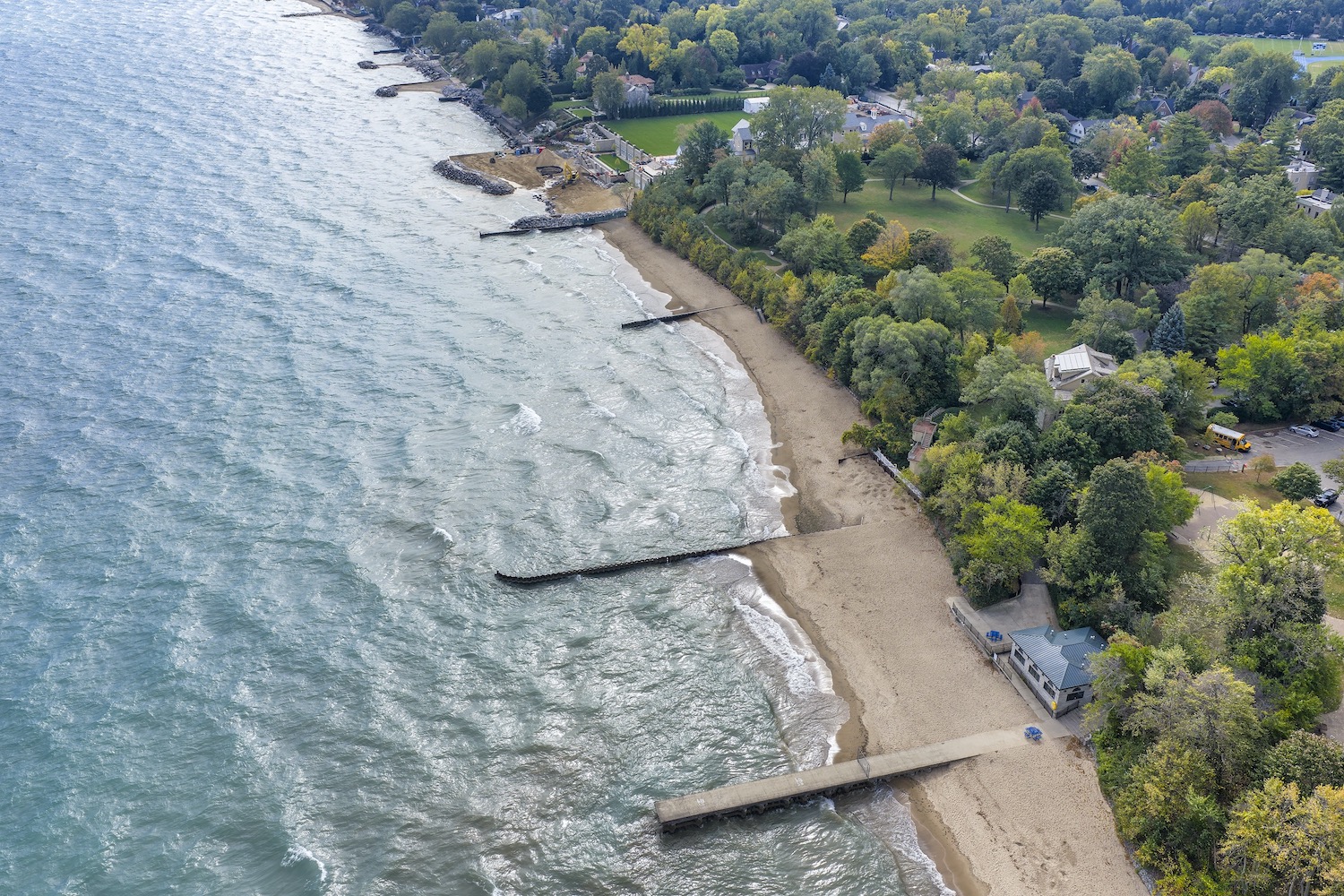
Lakefront development has been a hot-button issue in Winnetka over the past several years. The discourse led in 2024 to the adoption of new lakefront construction and steep slope ordinances, regulations sparked by the Ishbia family’s massive residential project at 205 Sheridan Road.
Given how much concern the community has had about the lakefront, Village President Bob Dearborn said trustees wanted to address it with a set of guidelines.
“We felt it was important to develop some guidelines … largely important for the public to understand, but also for our public safety personnel, our police department,” he said. “It’s an issue for our police department, so we felt that there should be some guidelines.”
In summarizing the guidelines, Village Attorney Peter Friedman said they include a definition of the “normal water line,” or the line where the water usually sits, which divides the public and private sections of the beachfront.
He also said that if a private landowner builds their own structure, such as a steel or stone groin, into the lake, that structure is private property. Friedman said, however, that the bed of the lake is public.
“The (Illinois Department of Natural Resources) and state have stated their belief, and we concur, that the structure is privately owned,” Friedman said. “The bed remains public, but the state … has the ability to issue permits for private property owners to build on state land, but that structure itself remains private.”
Regarding public access to those private structures, Friedman said a resident may face a trespassing charge if they use it.
“That being said, there’s obviously the circumstance of it, if it’s going into the lake and in order to continue to use the public trust land that it’s dissecting, then there may be a need, in order to continue along the lakefront, to traverse that structure,” he said, adding that the IDNR often requires a private structure to have a way for the public to continue along public land.
But seven members of the public spoke in opposition of the guidelines, with many disagreeing with Friedman that privately made structures are private property. Most of those speaking have frequently raised concerns about Winnetka’s lakefront.
Ted Wynnychenko, who was cited for allegedly trespassing on the Ishbia property in 2024, said he agrees that a privately built structure’s maintenance should be that of the person who built it.
“But that doesn’t mean that the structures are theirs and that people can’t do what they want,” he said, adding, “The idea that I can’t climb a structure that’s public — and it is public; it’s on public land — is crazy.”
The Village’s proposed guidelines mention the Ishbia’s property by address, 205 Sheridan Road, multiple times. Some residents expressed concern over including a private address in a village document.
“I believe this policy was written for one property owner only: Mr. Ishbia,” longtime resident Irene Smith said. “Why would policy guidelines be written for only one property? You are a deliberative body, and I think you need to deliberate this awkward set of guidelines.”
Another resident, Chuck Dowding, criticized the process the Village Council took in drafting the guidelines.
“In other difficult matters like this, we have a study session, we have two meetings,” he said. “That doesn’t seem to be followed here. I think, given some of the concerns that have been raised here this evening, it’s not a very clear cut and straightforward definition of what is public and what is private.”
Dowding also said there are legal arguments that contradict Friedman’s statement that privately built structures are not public, and asked that the Village claims include supporting documentation.
Trustees acknowledge ‘murky’ situation
Trustee Bridget Orsic was the first to state that the Village should not be mentioning specific addresses, an issue raised even before public comment.
“It should be for all of the property owners,” she said, with other trustees agreeing that a specific private address should not be listed.
Trustee Kim Handler said she’d like some changes to be made as well.
“I would like to see a change such that we are making sure we’re very factual in what we’re saying people can and can’t do, and eliminate some anecdotal information about things that we understand residents have asked or there might be concerns,” she said.
Handler later added, “I would like to see this clarified for the community and for the lakefront owners so we’re all on the same page. But I do believe this document needs a lot of tightening up and clarity for everyone.”
Trustee Rob Apatoff acknowledged that the Village may have rushed the initial proposed document but said that can be rectified.
“There’s nothing murkier,” he said. “I think in an effort to try to give guidance to our public safety officials, we may have rushed something. We shouldn’t have rushed it. The one thing that’s great about this council is that we own up and we figure it out. We’ll get it done right.”
Dearborn agreed with Apatoff’s comment about the topic being “murky.” He said that Friedman will draft a new set of guidelines and bring it back to the board. The goal is to vote on it at the Nov. 4 regular meeting, but Dearborn said that is subject to change.
The Record is a nonprofit, nonpartisan community newsroom that relies on reader support to fuel its independent local journalism.
Become a member of The Record to fund responsible news coverage for your community.
Already a member? You can make a tax-deductible donation at any time.

Peter Kaspari
Peter Kaspari is a blogger and a freelance reporter. A 10-year veteran of journalism, he has written for newspapers in both Iowa and Illinois, including spending multiple years covering crime and courts. Most recently, he served as the editor for The Lake Forest Leader. Peter is also a longtime resident of Wilmette and New Trier High School alumnus.
The Record is a nonprofit, community news site from former editors of 22nd Century Media
Our daily coverage of your government, schools, businesses and neighbors is not possible without your support.
Latest

The Record: Shortcut
Related Stories

