History By Design: All Aboard! the story behind Glencoe’s historic depot
Commuters take their ride on Metra for granted as their means of getting into the city, but the stations along the North Line have special appeal.
In 1855, the Chicago & Milwaukee Railroad (later the Chicago & North Western Railway) provided the only reliable means of transportation north from Chicago. There was the Green Bay Trail, an old Native American travel route, but that was about it.
One of the earliest stations along the line was in Glencoe. But the first settlement of the area was not where the station is currently located. It was Taylorsport, an early logging and shipping community settled by fur trader Anson Taylor in 1835 centered on Harbor Street.
In 1854, Walter Gurnee, president of the railroad, built a large house with elaborate landscaping on several hundred acres that belonged to his father-in-law, Matthew Coe. It was called Glencoe Farms. For years it has been known as The Castle and today the house has been lovingly restored.
In 1855, when the railroad came through, the area’s depot was built across from Gurnee’s house not at Taylorsport, which didn’t survive without rail access.
The first train station was a modest frame building that by the 1880s was dilapidated. At that time the Village of Glencoe, which had been incorporated in 1869, had a population of approximately 600 residents and was beginning to develop as a residential suburb. A new depot may have been part of the development.
Charles Sumner Frost, a graduate of the Massachusetts Institute of Technology (America’s first architecture school) was the station architect. Undoubtedly, he was familiar with the Romanesque Revival train stations designed by famed architect H.H. Richardson that dotted the commuter lines in Boston.
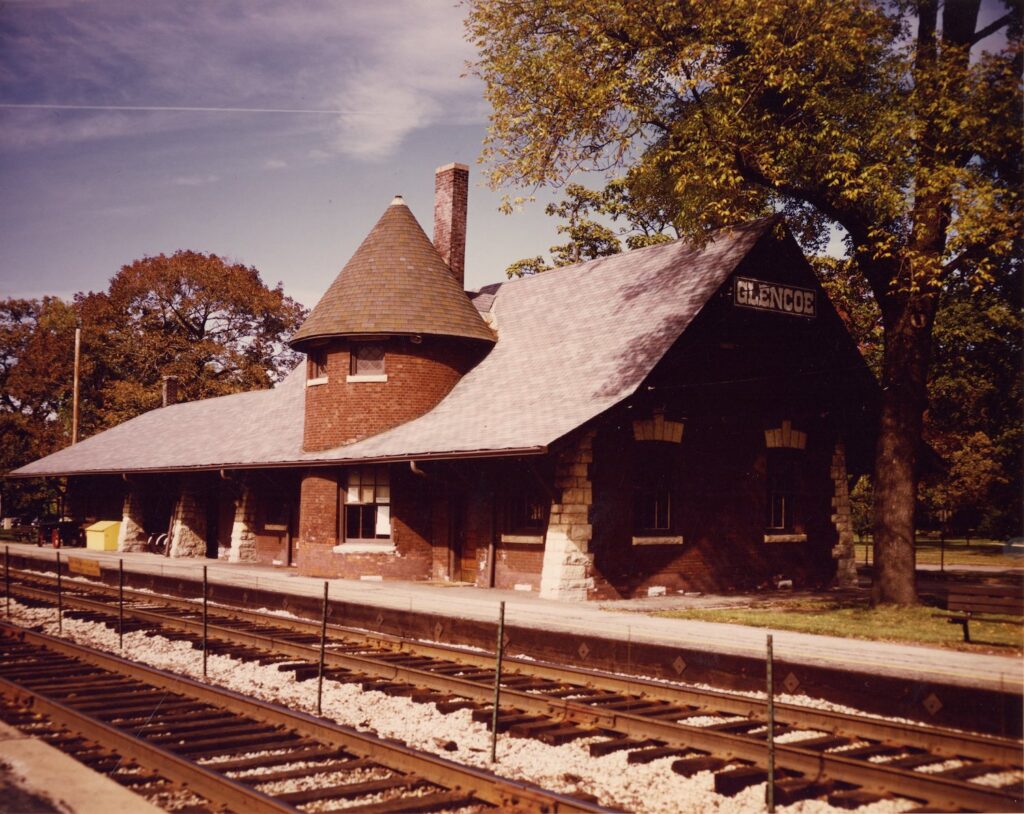
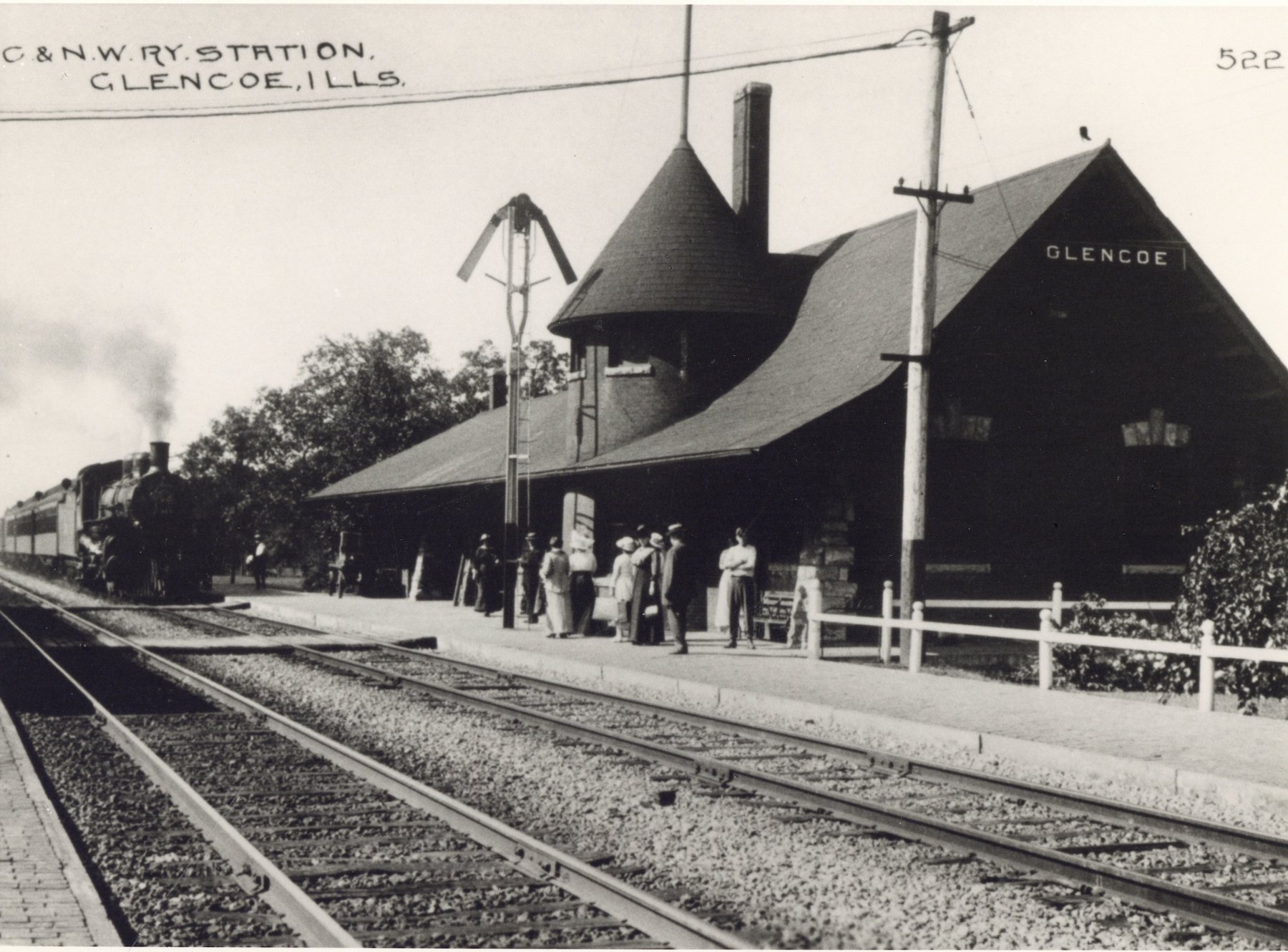
The 1891 Glencoe depot, 724 Old Green Bay Road, is an imposing brick masonry building, substantial to withstand the vibrations of multiple trains passing through. Its sheltering roof — designed to shield passengers from rain and snow — extends over the platform.
Rusticated limestone piers buttress the roof and limestone quoins define the corners of the building. A cylindrical tower with a conical roof projects through the sloping gable roofline and beyond the overhang.
The first floor of the tower housed the ticket agent. To the north is a semi-attached baggage room.
The overall impression recalls Medieval architecture. There were originally two separate entrances: one for men and one for women. During the station’s early years, the railroad grew flowers to make their stations more inviting for riders.
In 1897, Charles Frost married Mary Hughitt, a daughter of Marvin Hughitt, then president of the Chicago & North Western Railway. The next year he partnered with Alfred Hoyt Granger, who married another daughter of Hughitt. From that time forward, Frost & Granger designed dozens of stations for the North Western, including the Chicago Terminal — now replaced by the Ogilvie Transportation Center designed by Helmut Jahn.
Hughitt didn’t need to look beyond his own family for designing rail stations throughout the Midwest.
Two years before the Glencoe train station was built, one was erected in the Ravinia business district of Highland Park at 510 Roger Williams. It is a wood structure, but like its Glencoe neighbor has a sheltering roof and a tower. The tower is polygonal with a bay for the ticket agent to watch for trains.
Originally the station contained two waiting rooms: one for men and one for women and children. To the south is a train stop at Ravinia Park. It is said that conductor Sir Thomas Beecham commented that “Ravinia Park is the only railroad stop in the world with its own symphony orchestra.”
History By Design is The Record’s monthly column focusing on the North Shore’s special and influential architectural history. Local historians and authors Susan S. Benjamin and Robert A. Sideman write and research the column, and the Glencoe Historical Society contributed photographs for this edition.
The Record is a nonprofit, community news site from former editors of 22nd Century Media
Our daily coverage of your government, schools, businesses and neighbors is not possible without your support.
Latest

The Record: Shortcut
Related Stories